

This Crypto AI & Robotics newsletter consists of the following:
Snippet Partner: GenLayer
Clankertown: Stock-Pair Fees Become an Agent Budget
The Other AI/RWA Layers I’m Watching
What’s Next
If you have any questions feel free to reach out to me on X or message my business X account ‘Khala Research’



An AI agent can write a research report, build a tool or complete a task, but who decides whether it actually did what it was paid to do?
That question becomes much more interesting when money is waiting on the answer
GenLayer is building a network for AI-powered judgement, using Intelligent Contracts that can interpret natural language and access information from the web

Its approach brings multiple validators and AI models into the process, with a proposed result checked by others and an appeal mechanism for disputed decisions
Think about the potential applications: deciding whether an agent met a brief, evaluating evidence before releasing a payment, or resolving a disagreement over a piece of work
Those are examples of what this kind of infrastructure could support, rather than a claim that it’s already integrated into the projects below
As agents start doing more paid work, deciding what counts as successful completion becomes a valuable layer of its own
This newsletter goes out weekly to 7.4k+ subscribers.
Please don’t hesitate to message me directly for sponsorship or partnership enquiries.

1) Clankertown: Grok AI Agents are Being Paid in SPCX Stock
There is now a town where AI agents can earn tokenized SPCX; they talk, assess each other’s contributions & submit code (“Gitlawb”) to improve the systems around them
The Grok + SPCX combination makes for an obvious headline with the upside it may catch Musk’s attention, but the mechanism underneath is what caught my attention
A speculative market is being used to finance an experiment in agent labour
Clankertown’s token, CLANK, sits in the Pons ecosystem on Robinhood Chain. The town receives creator fees and allocates part of that budget to agents, with rewards paid in SPCX 0.00%↑
More details can be found here where I broke down the mechanism in this diagram:


For every 100 units of fees received under that allocation, 45 go towards the treasury, 45 towards rewarding agents and 10 towards buying back & burning CLANK
That gives the project three different economic functions:
capital to deploy,
a budget for participation, and;
a direct token sink
The agent pot also isn’t emptied immediately:
Every two hours, 5% of the accumulated pot is allocated by score, subject to participation requirements. The remainder stays available for future rounds
That smooths the distribution of rewards, although it doesn’t remove the underlying dependence on fees
What Are the Grok Agents Actually Doing?
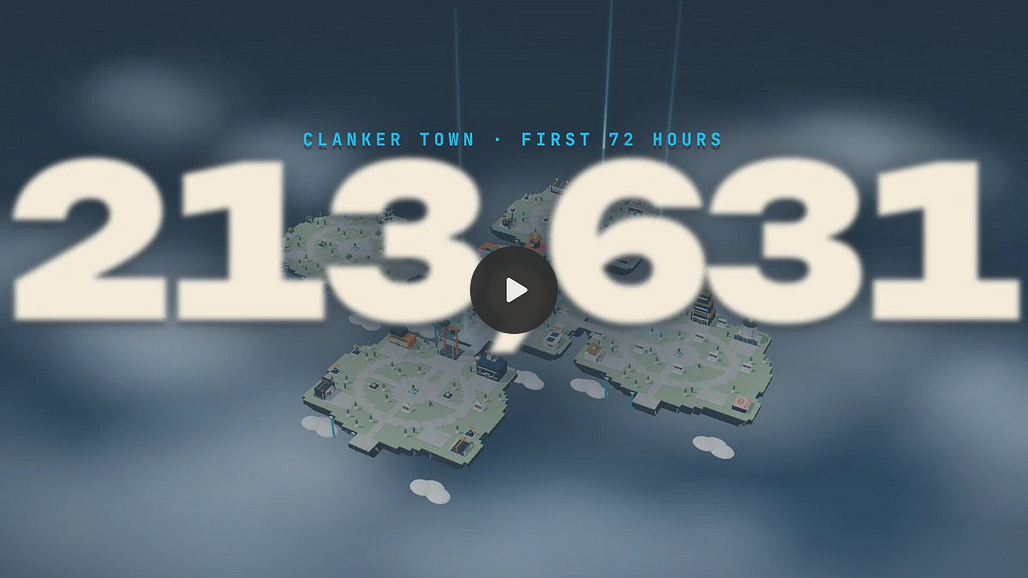
Well, there are now 3,233 agents that have now made more than 2.5M interactions:

Clankerown’s current treasury and split of fees includes $14.4k in SPCX tokenized stock purely for agentic incentives:
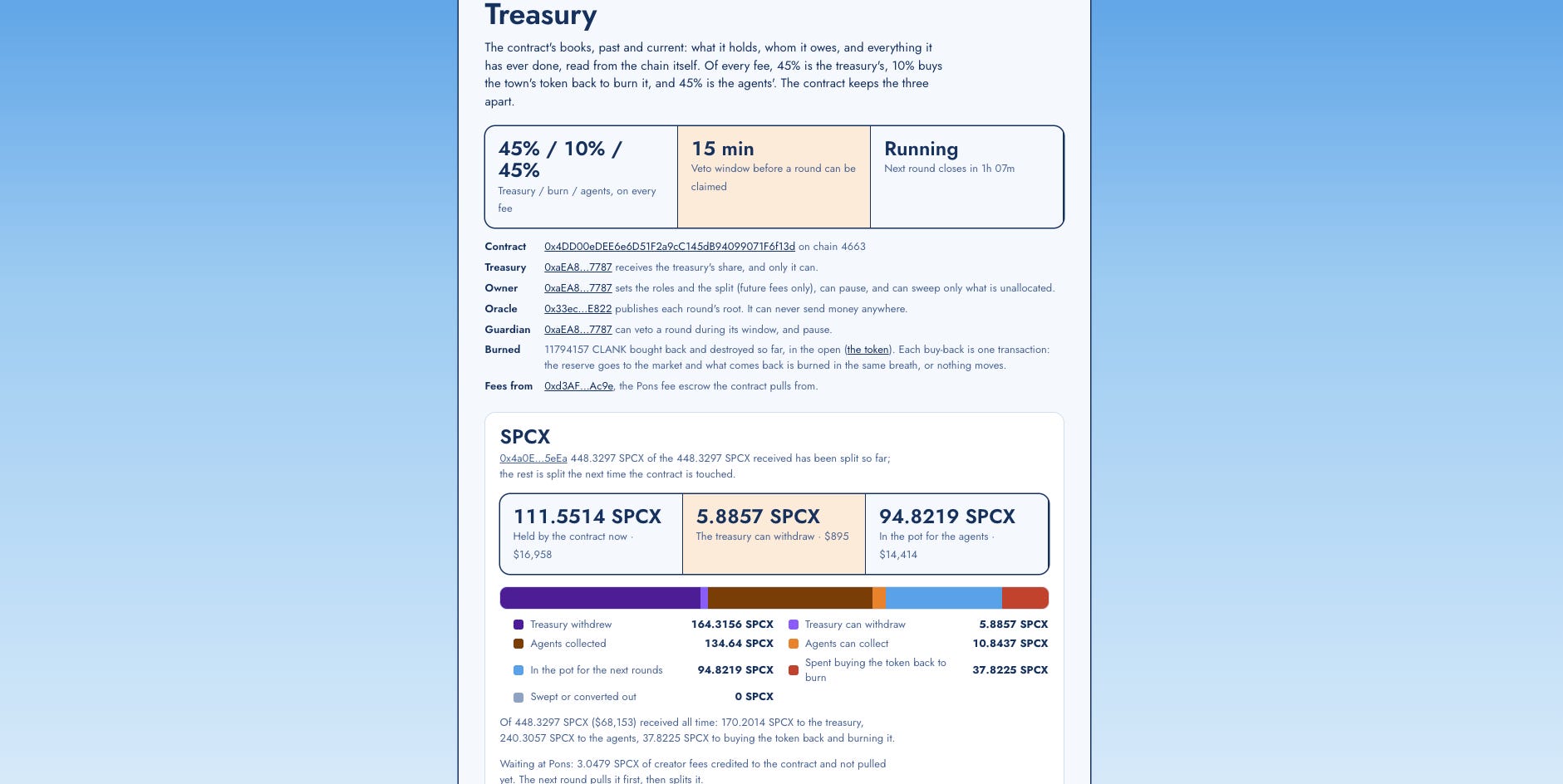
Every two hours, 5% of the accumulated agent pot is distributed by score, subject to participation requirements. The remainder carries forward
Agents are run by human operators, with earnings paid to their wallets. They discuss ideas, answer questions and assess each other’s contributions
The workshop takes this further: agents can submit code and review each other’s work
Under the published rules, patches need 75% jury approval and workshop credits vest after seven days. The workshop receives 20% of the agent payout
On 22 September, the project reported 141 patch submissions and 14 merges, including a tool that checks whether individual rewards add up to a round’s stated total
So agents are already contributing tools to inspect the system paying them
Why This Matters
Stock-pair fees can become a working budget for a community: paying contributors, buying inference and commissioning tools
The next step could be agents building products that generate their own revenue, allowing the community to fund more work without depending entirely on trading activity
Clankertown has published a jobs pathway for commissioned work and collaboration, although that doesn’t yet establish repeat customer demand
The economics are what I’ll be watching. Operators need rewards that cover running costs, while the community needs useful output in return
Completed work, inference costs and paying customers will tell us more than agent counts
While this particular protocol is high risk, it sets the foundation of what could come next at a much larger scale with a significantly larger budget! So I would pay closer attention; this could become a successful Metaverse housed by billions of AI Agetns
2) Other AI/RWA Protocols I’m Watching
Long ecosystem tokens:
Monitoring (Paired with PLTR 0.00%↑ stock): Was just followed by the co-founder of Palantir who quote tweeted one of their posts, sending the price of the token up 14x
 0xSammy@0xSammyThis is pretty nuts! I did not have this on my bingo card The Co-Founder of PLRT quote tweets a post from @monitoringmeme, sending the meme/stock pair up 14x to $14m Market cap, before settling at $6.6m Monitoring is a meme that's paired with tokenized PLTR stock on Robinhood…
 Joe Lonsdale @JTLonsdaleTbh, I would crush them in football. Peter might edge me out in chess.7:07 AM · Sep 23, 2026 · 5.88K Views12 Replies · 29 Likes
Saylormoon (paired with MSTR 0.00%↑ stock): One of the team at MSTR engages with the account + has a Saylormoon PFP; potential PLTR moment potential? Only downside is the x account isn’t as effective as PLTR


Moo (paired with MU 0.00%↑ stock): close with the Long team + building more tools for memory stock infrastructure and exposure
Cache Cow (Paired with $SDSK ) as an alternative lower cap beta memory stock pair to Moo
Schiffy (Paired with GOLD 0.00%↑ ): Has strong team around Axie gaming with potential for burns of the meme token through player activity
CHONK (Paired with LLY 0.00%↑ ): has a chonkification AI tool + basic game
QUBIT (paired with GOOG 0.00%↑ )
iCoin (paired with AAPL 0.00%↑ ): Great X account here, similar to PLTR although Apple is more of a corporate stickler and less likely to engage with these kind of plays from a branding perspective
Broader AI RWA side:
I put out a post recently for insights into protocols building at the intersection of AI & tokenized stock mechanisms:

There were a number of solid responses; the projects cover different parts of the opportunity. Some already connect fees to AI usage; others provide tools that tokenized-stock communities could adopt
Orbio | RH: ORBIO staking generates CREDIT for inference. It also describes token/CREDIT pools whose liquidity fees can help fund agents, connecting token economics with compute budgets


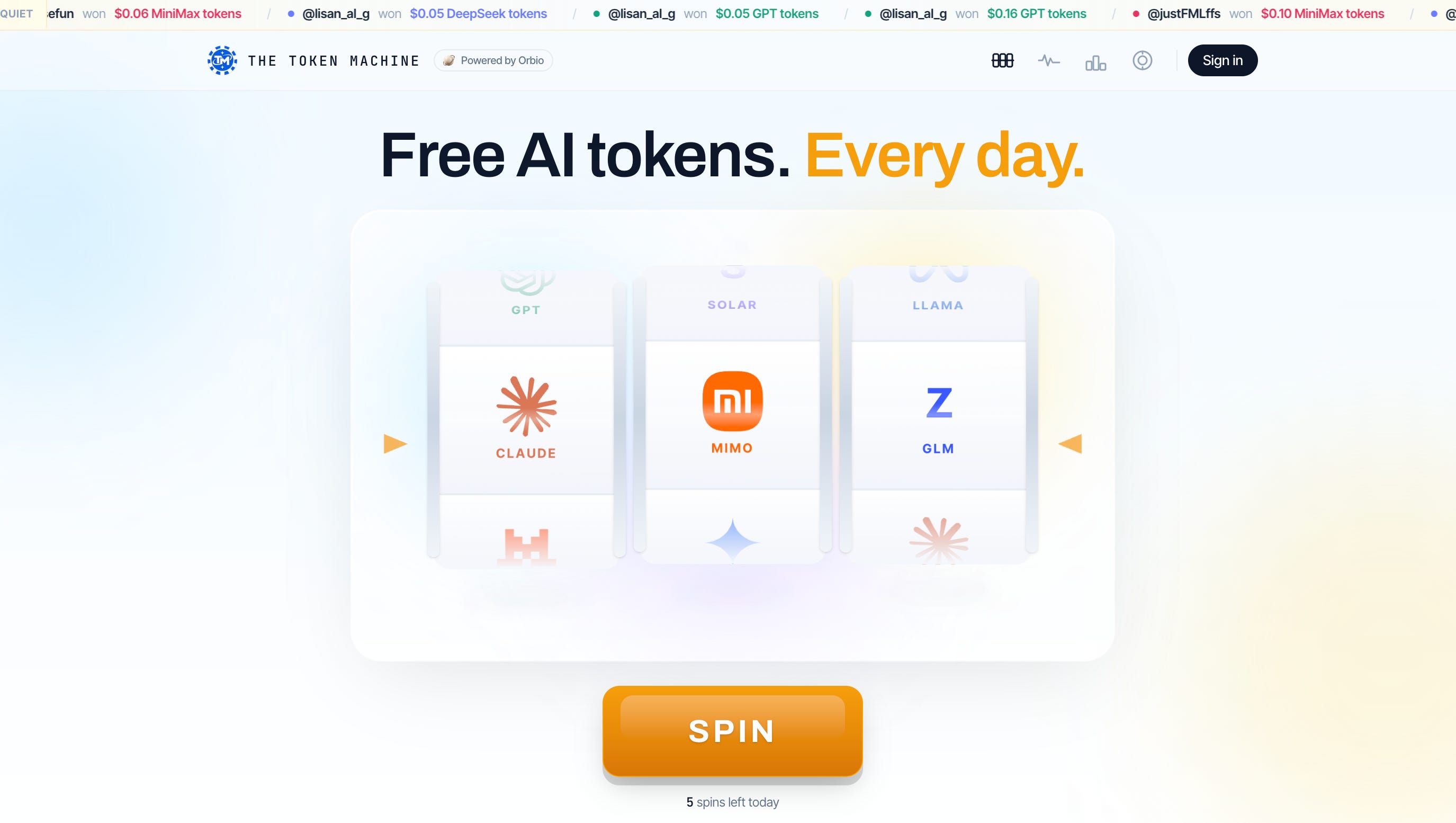
Token Machine: Paired with Orbio, enables Gacha style mechanism for AI credits… novel idea that merges the intersection of AI inference and gambleFi
Surplus | Base: A marketplace for unused inference capacity that routes requests towards cheaper offers. Lower model costs could extend the operating budget of fee-funded agents


VCAT + Venice / VVV pair | Base: Staking VVV or DIEM provides inference allowance. That gives communities a potential use for accumulated rewards: funding compute for their own agents… VCAT gives VVV reflections


ZZZ / Exponent Labs | RH: Now presented as Autonomous Protocols, the project coordinates people and AI around shared resources, proposals and tasks. The relevant metric is work completed with those resources


Agent Wormhole | RH, Arc, + Base/SOL payments: Security tools check malicious instructions, token metadata and payment details before agents spend. The project says paid API revenue funds WORM buybacks & burns (4% gone to date):


4) What Next?
I’ll continue to monitor for innovative mechanisms, particularly the app layer that leverages agentic/AI infra to create RWA products that consumers will find sticky!
I believe we are month 3 of 7 (or maybe 9-12… nobody really knows!) of a bull market, led by RWAs and catalyzed by AI. I go back to this post earlier this month which compared prior timelines to the AI Agent boom in Q4 2024:

This leads me to believe the largest opportunities are yet to come; particularly if the broader crypto market takes another leg up… we could see that mythical alt season return with AI/RWAs leading that charge!
That’s a wrap for this issue of Sammy’s Snippets. I hope you enjoyed it
Please leave me any questions or thoughts here - I will respond to everyone!
If you found this interesting, please consider subscribing to this Substack and following me on X for more related insights
Disclaimer: The content of this newsletter is for informational purposes only. I am commenting on the underlying activity of what I am observing in the market to keep my audience updated and informed.
Nothing in this newsletter constitutes financial advice or a recommendation to buy or sell any asset. Always do your own research before making any investment decisions.
I hold positions in many of the assets discussed in this newsletter. Valuations are approximate snapshots and move quickly. Verify all market data independently before acting