


This Crypto AI & Robotics newsletter consists of the following:
Snippet Partner: Walrus (AI Agent Verification)
Anthropic : IPO Benchmark Analysis
Anthropic’s $3.4bn Power Bet
What $3.4bn actually buys
Bitcoin miners become AI landlords
Texas politics + the value of existing capacity
Crypto’s opportunity + what I’m watching
If you have any questions feel free to reach out to me on X or message my business X account ‘Khala Research’



All this infrastructure is being built to let AI do more. When an agent can spend money or operate a machine, we also need a reliable record of what it did
That’s the focus of our new “WALRUS: Machine on the Record” report:


Walrus, created by Mysten Labs, provides decentralised storage with verifiable data integrity + availability. Walrus Memory extends that foundation to portable agent memory
An application can capture the instructions, approvals, tool calls + results, then preserve a record whose contents can be checked later. Sensitive data needs encryption before storage; Walrus blobs are public by default
Proving a record hasn’t changed doesn’t prove the agent was correct, or that everything was logged. Identity, complete logging + checks on execution remain part of the application
Explore our Walrus research at Khala & Explore Walrus
This newsletter goes out weekly to 7.4k+ subscribers.
Please don’t hesitate to message me directly for sponsorship or partnership enquiries.

Anthropic : IPO Benchmark Analysis
With Anthropic preparing for one of the biggest IPOs in history, I wanted to see what recent AI listings tell us about what happens next
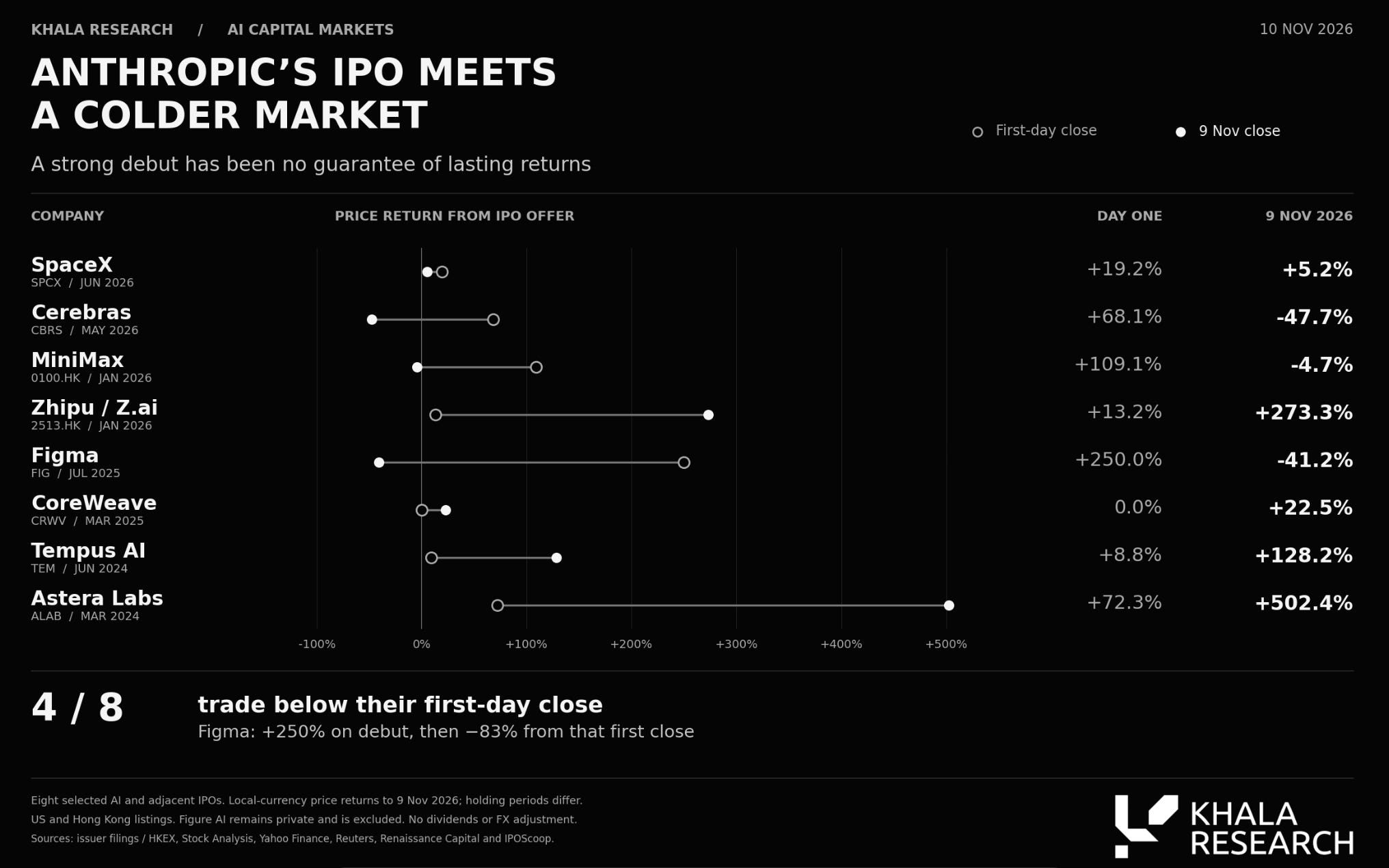
I’ve benchmarked eight AI and adjacent IPOs, from SpaceX to Cerebras and Figma, and the results are revealing…
Half now trade below their first-day closing price, despite some spectacular debuts. Figma surged 250% on day one, only to surrender most of those gains:
The takeaway?
AI hype can drive an explosive debut, but valuation and execution determine what happens afterwards. And Anthropic is entering a market far less forgiving than it was even a year ago
1. Anthropic’s $3.4bn Power Bet
An AI company spending $3.4bn on gas generators is a fairly good sign that the next phase of this cycle will look different
That’s the deal Anthropic has reportedly struck to secure 1.7 gigawatts of generation capacity; to put that in context it’s equivalent to generating enough electricity in a year to match the annual use of roughly 6 million homes… insane, I know!
Meanwhile, Riot + TeraWulf have announced roughly $47bn of Anthropic leases across two campuses, payable over many years
The interesting bit is who gets paid along the way. Bitcoin miners accumulated land, substations + power access before frontier AI labs needed them at this scale. Some are now turning that position into long-term rental income
My thesis: the AI opportunity increasingly depends on how quickly capital can become usable compute. Power access matters, but so do delivery dates, financing + the quality of the tenant
2. The IPO: growth has a physical cost
Anthropic’s proposed Nasdaq ticker is ANT, but I wouldn’t build an investment thesis around a rumoured opening price
On 10 November, Reuters reported that indicative IPO details had been circulated to banks and then withdrawn as inaccurate. That makes the final price, proceeds + timetable moving targets
The operating numbers tell us more:
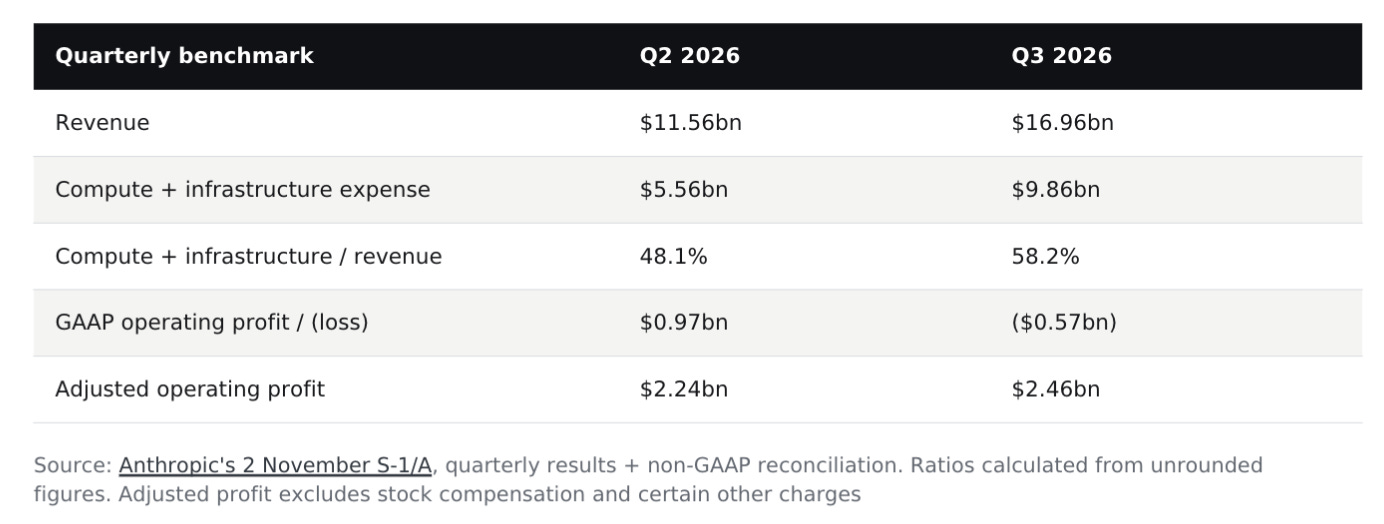
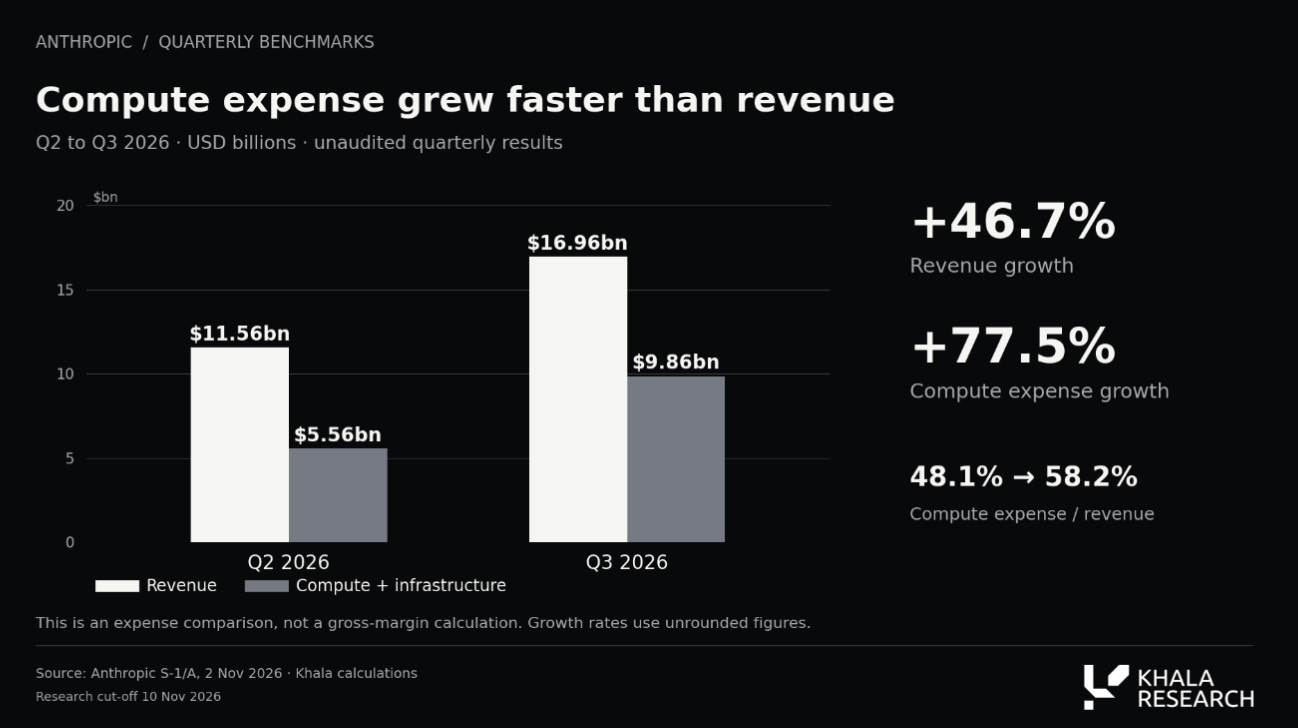
Revenue grew 47% quarter on quarter. Compute + infrastructure expense grew 78%
That doesn’t mean the economics are broken; It means demand growth and the cost of serving it need to be watched together. The GAAP loss also includes a $2bn non-cash charitable contribution charge; it would be misleading to blame the entire profit swing on compute
Here’s a useful valuation sense-check. Annualising Q3 revenue gives $68bn. Assumed equity valuations of $1.2tn, $1.5tn + $2tn would therefore represent roughly 17.7x, 22.1x + 29.5x that revenue base
Those are scenarios, not IPO targets or forward multiples. They make one point: even a lower headline valuation can still require a lot of future growth
Then there’s the commitments. Anthropic disclosed $895.4bn of purchase + lease commitments, substantially related to compute and infrastructure. Around $69.8bn falls due in the 12 months after September 2026; about half the total is expected by the end of 2030, with substantially the rest through 2045
This is a long-duration delivery + funding challenge. It isn’t a bill for $895bn arriving tomorrow
3. What $3.4bn actually buys
According to the FT, reported by Reuters, Anthropic took over commitments for 1.7GW of gas-fired generators from OnePWR Solutions. Neither company had confirmed the report to Reuters
Data Center Dynamics reports that the Caterpillar equipment was ordered two years ago and is expected to become available within the next two years
My read is that Anthropic is paying for greater control over delivery as well as the equipment itself
The headline works out at roughly $2m per MW of generation capacity, or $2,000/kW:
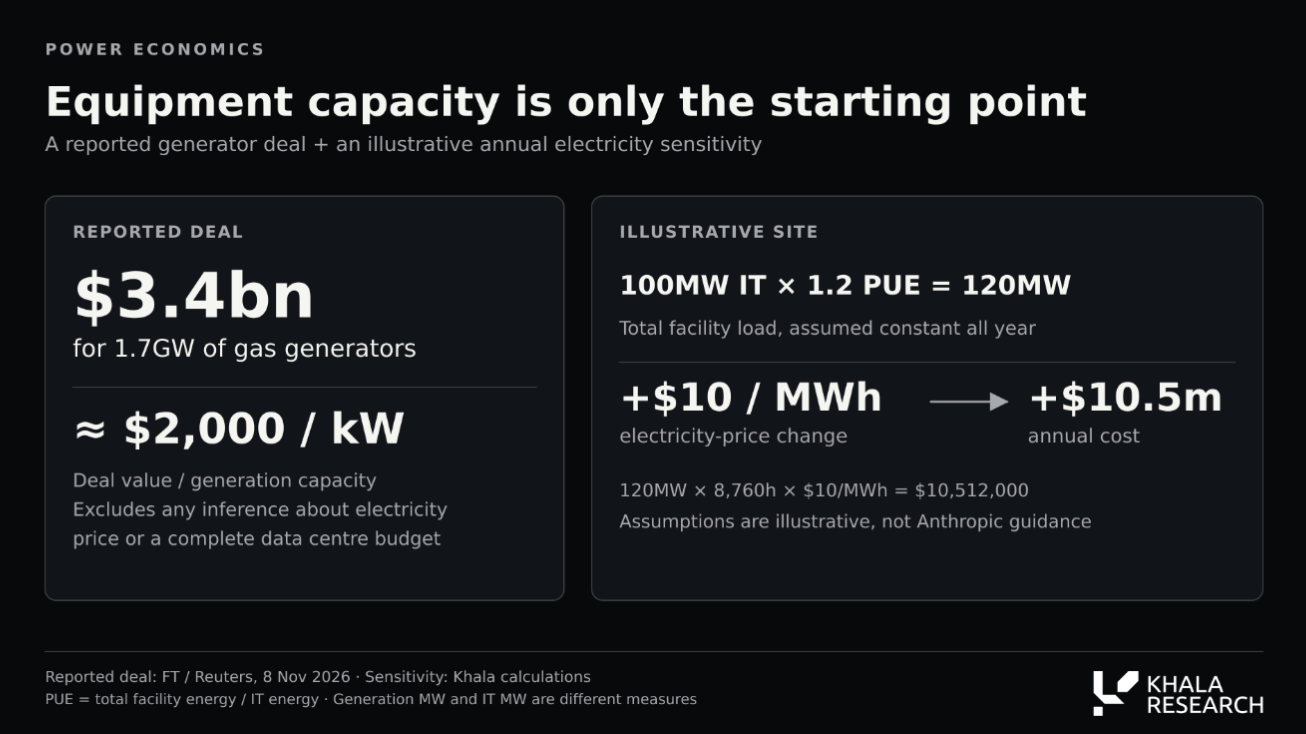
Generators help with one constraint. The site still needs fuel supply, permits, cooling, networking + the equipment to connect everything together
This is why I wouldn’t say the chip bottleneck has disappeared. The constraint varies by project. But owning GPUs is much less useful if you can’t get them installed and powered on schedule
The asset I’m interested in is usable capacity with a credible delivery date
4. Bitcoin miners become AI landlords
This is where the crypto connection gets tangible… thankfully a viable use case outside of stablecoins!
Riot’s Corsicana announcement describes a 910MW critical-IT lease, with approximately $28bn of revenue over its initial term. Its 10-Q identifies Anthropic as the tenant
TeraWulf’s Justified campus lease covers approximately 401MW of critical IT capacity and $19bn over an initial 20-year term
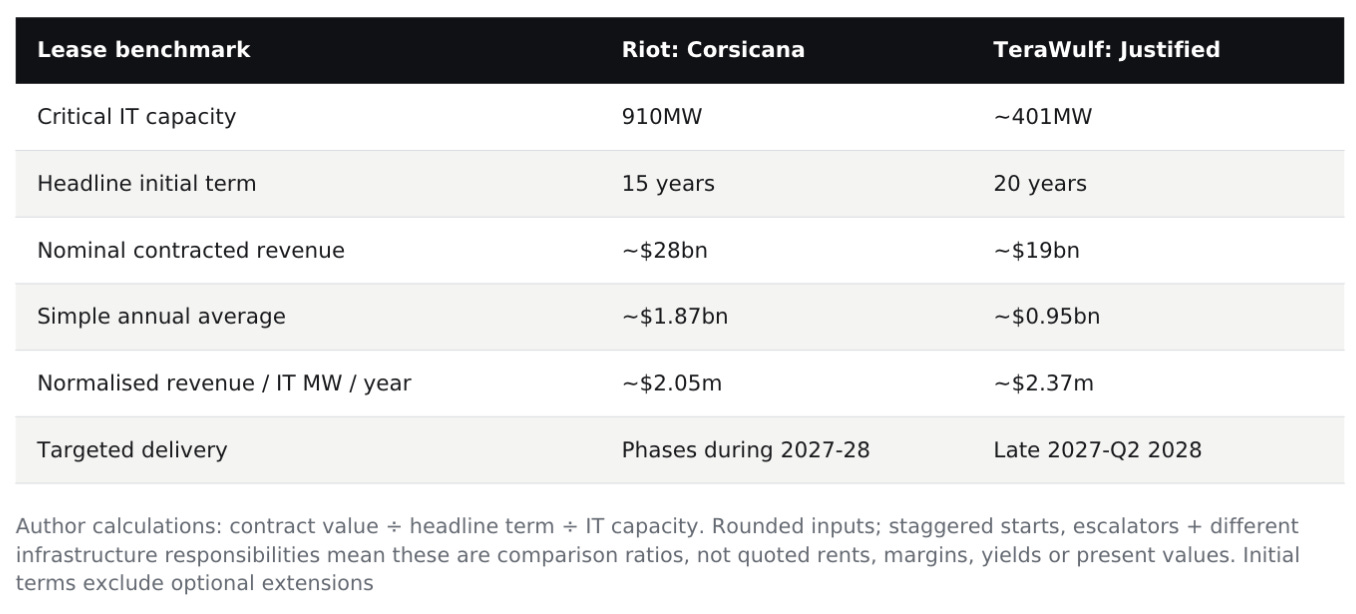
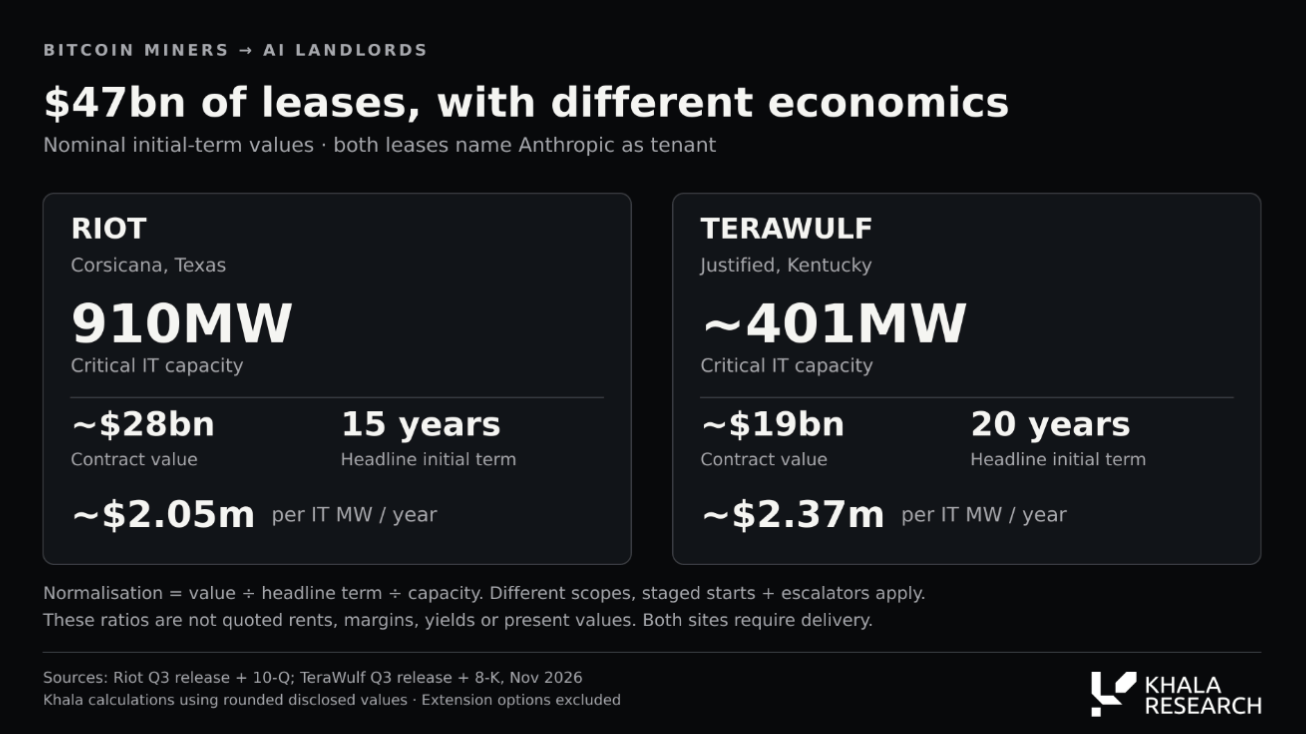
The two contracts total $47bn and 1,311MW of critical IT capacity. That capacity is a different measure from the generator deal’s 1.7GW of generation, so adding them together would be misleading
Read past the 99% margin
Riot expects a roughly 99% net operating income margin on the powered-land lease because the tenant carries most operating expenses. It also estimates around $5.5bn of development capital, including reimbursements to the tenant
Both numbers belong in the same conversation. Property-level NOI comes before financing costs + corporate overhead and doesn’t deduct the initial construction spend
Its disclosed base rent is $130/kW/month, rising 3% annually. Applied to all 910MW at the starting rate, that is approximately $1.42bn a year before escalation. It is not current rent: the campus is delivered in blocks, and the contract’s later-phase start determines the ultimate term end
The broader lesson is that a large contract value needs to be reconciled to when cash arrives, what must be spent first + how much debt sits ahead of shareholders
Google’s credit makes the structure more interesting
Google has agreed to support certain Anthropic obligations at TeraWulf’s Justified campus. The 8-K makes the limits clear: each backstop becomes effective when the final data hall under its corresponding lease commences, and there are termination conditions
If a covered default occurs, Google can assume the lease or, in specified circumstances, pay a termination fee that entitles it to an equity interest in the project company
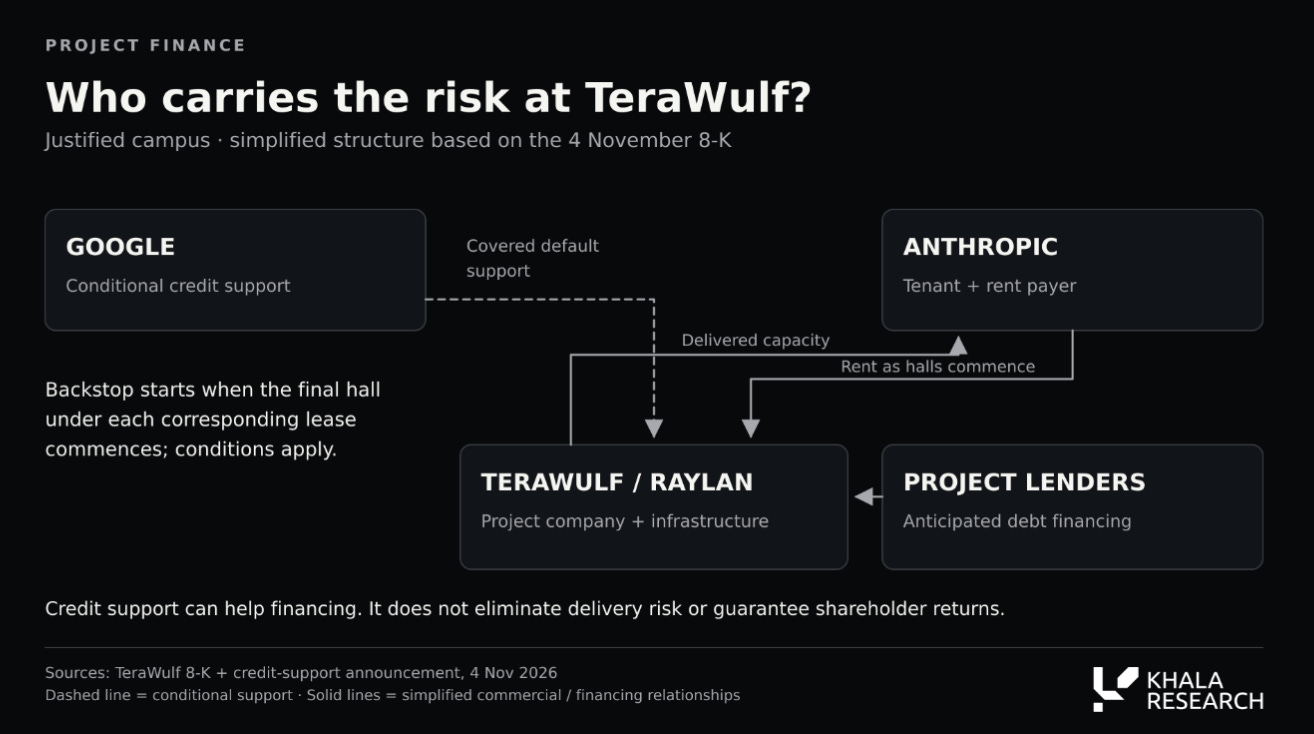
This can make the project easier to finance. It does not make construction risk, timing risk or equity losses disappear
It also connects more of the AI infrastructure chain to the same small group of counterparties. A collection of different ticker symbols can still leave you exposed to one tenant’s ability to pay
There is a separate implication for bitcoin. Riot sold 20,264 BTC in the first nine months of 2026, primarily to fund data centre development. The pivot can create value for a miner while also putting BTC into the market
5. Texas: scarcity helps only if you can deliver
Texas governor-elect Gina Hinojosa has called for a moratorium on data centres until legislators put new protections in place. The Texas Tribune reports that she takes office on 19 January 2027, following an existing Abbott-era pause affecting environmental permitting + grid connections
If new supply becomes harder to approve, an existing operational site may become more valuable. But a project that still needs permits, construction or a connection can become harder to deliver, even if the owner already has land and a customer
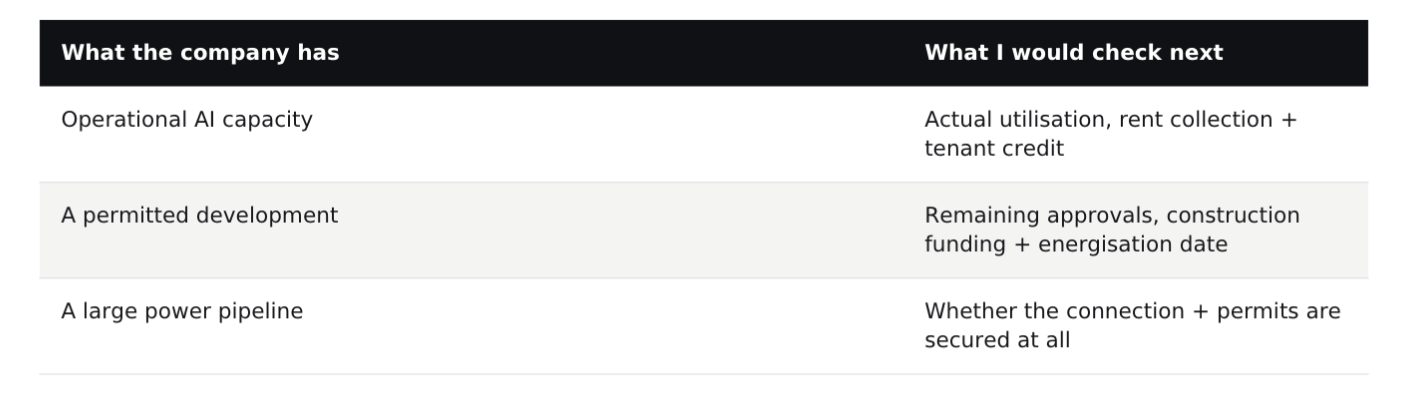
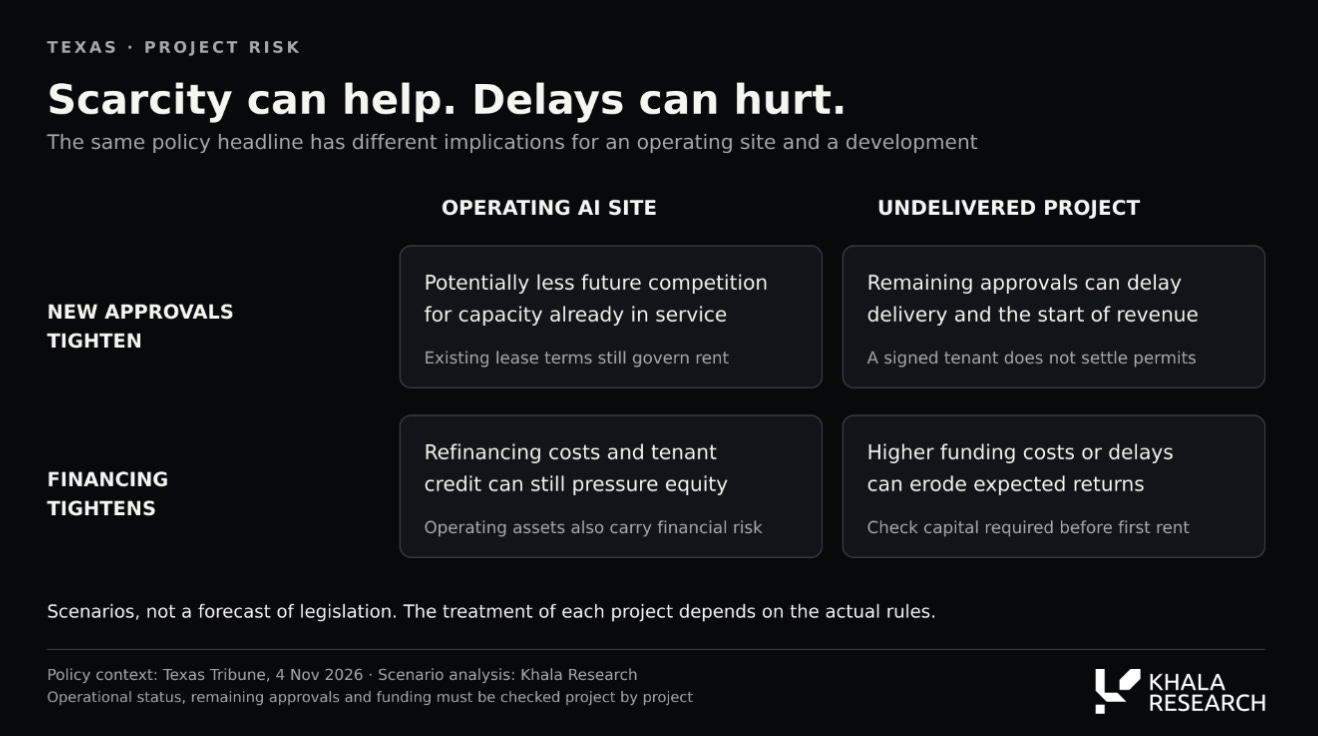
I wouldn’t assume that every signed lease is protected from future restrictions. And generating power on site still leaves environmental, fuel-supply + local approval questions
A scarcity premium only helps shareholders if the project can reach the point where it earns money
6. Crypto has three distinct opportunities
i) Price discovery before an IPO
Entropy’s Anthropic market on Hyperliquid lets traders express a view before a public listing. Its oracle provider RedStone describes a blend of order-book information + external references, weighted by available liquidity
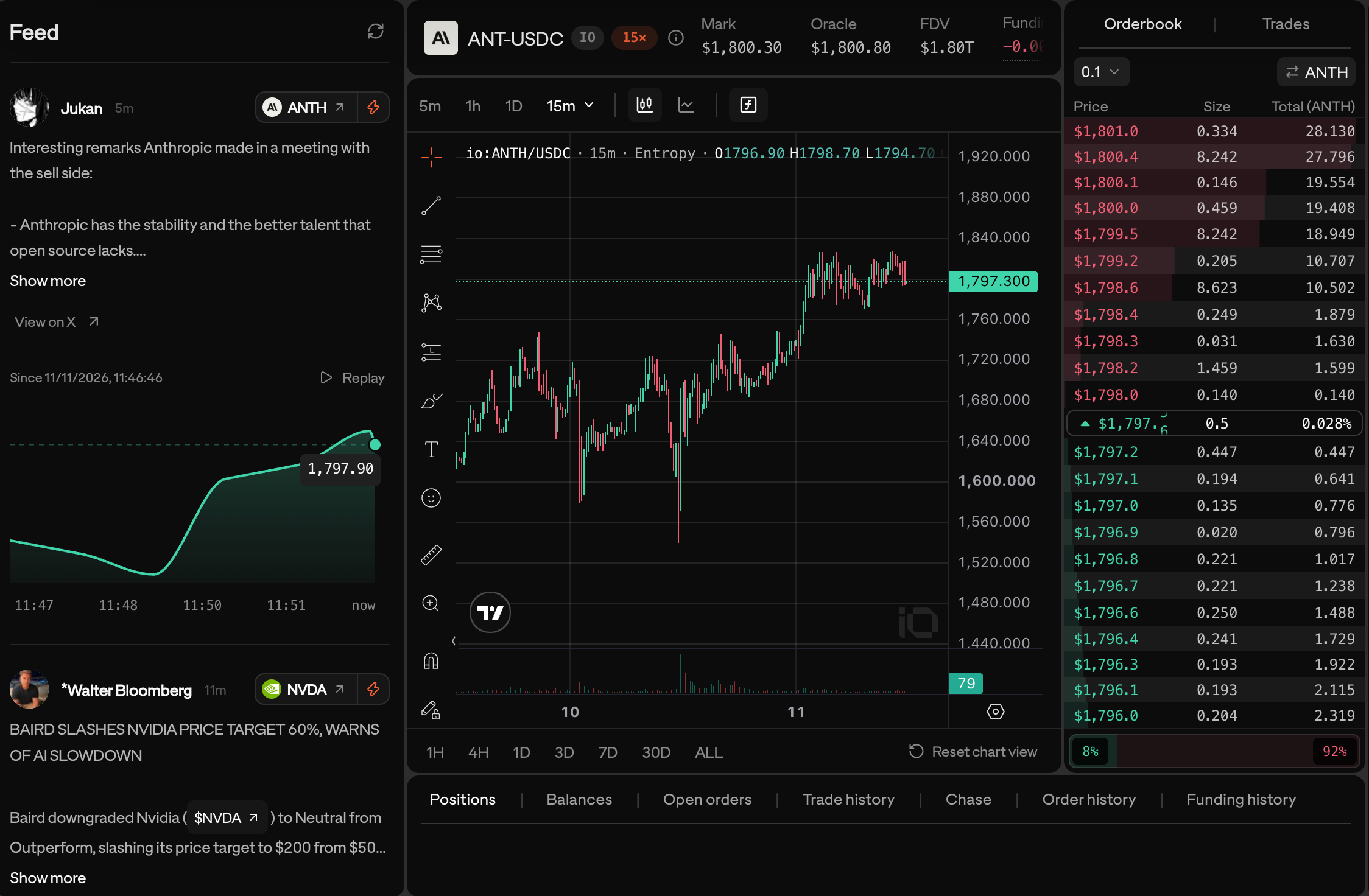
That’s useful, but a perp is a derivative exposure. It doesn’t put Anthropic shares in your wallet or give you an IPO allocation
The interesting test is whether a price recorded before the final terms predicts the eventual valuation. That requires matching timestamps, valuation definitions + share counts, then accounting for funding and trading costs. A raw chart of two differently defined prices won’t settle the question
ii)A market for the cost of compute
Injective’s Super Intelligence Compute Index, launched on 26 October, tracks a weighted basket of GPU rental prices:
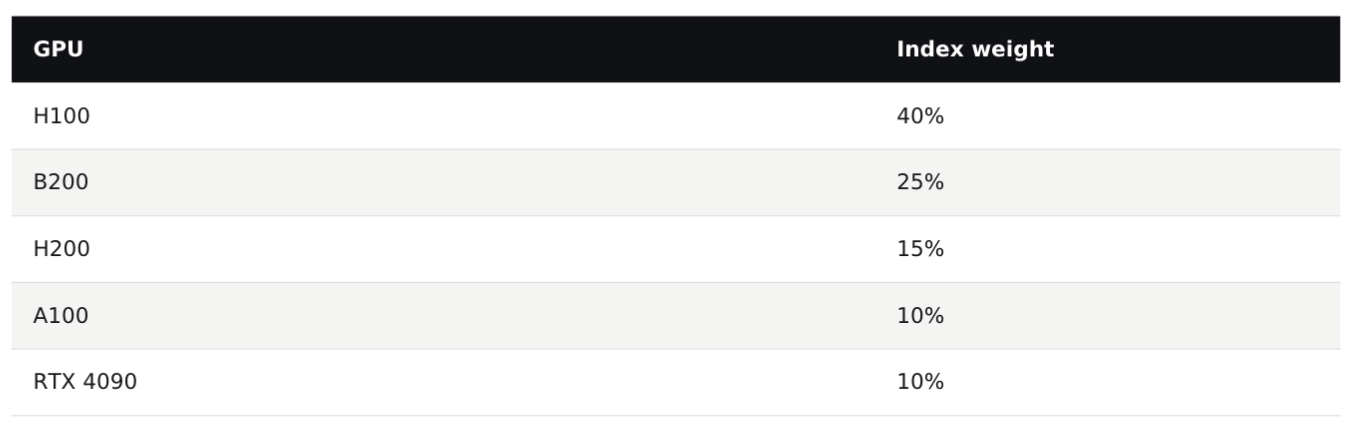
The weights are fixed and the published index uses a trailing seven-day average. This creates a way to trade compute-price exposure, but a basket of rental listings won’t track every company’s actual bill. Hardware mix, location, service terms + funding costs all matter
Owning that exposure also doesn’t reserve a GPU. The financial market and the physical capacity remain separate
iii) Selling useful compute through open networks
SubConnect estimates that revenue-generating Bittensor subnets reached roughly $70m of annualised revenue, up from about $50m a month earlier, according to its 4 November update
If you want to dig further into Bittensor’s incentive mechanisms for distributed compute, then we’ve previously produced reports on this:

What I want to see next is revenue that remains attractive after power, hardware, support + token incentives. Aggregating spare capacity may help some workloads, but a distributed marketplace doesn’t automatically reproduce the networking and reliability of a tightly integrated training cluster
For agents and robotics, the useful benchmark is cost per successfully completed task, alongside latency + reliability. Cheap GPU-hours are only an advantage if the workload finishes well
7. What I'm watching next
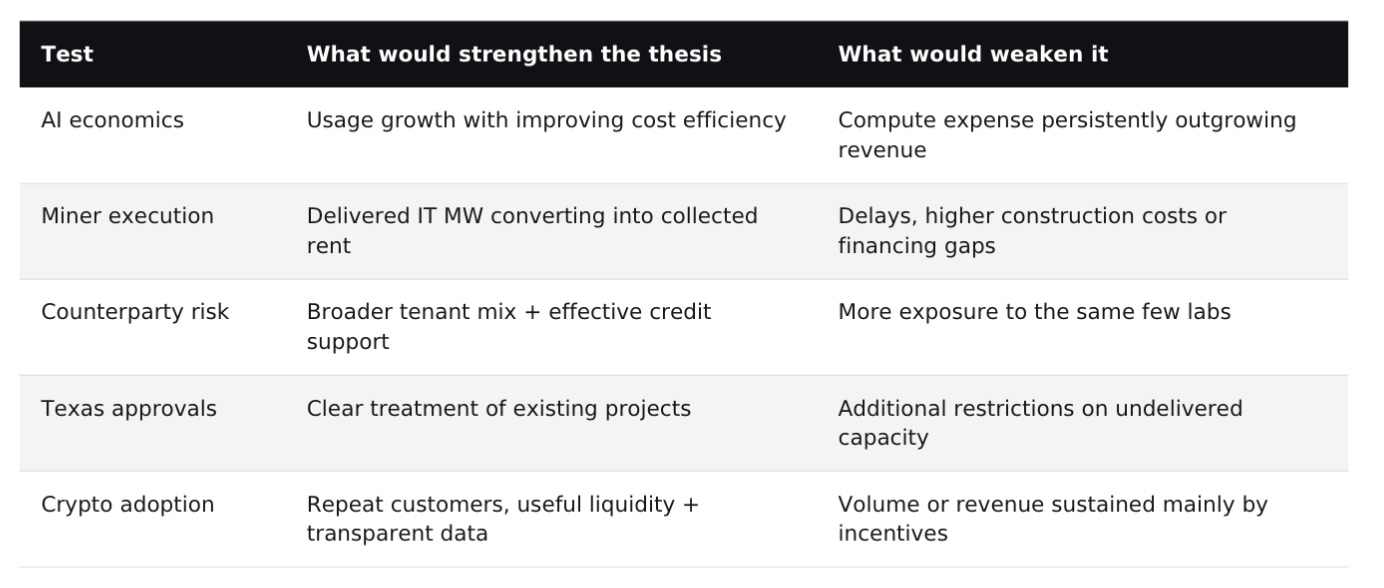
My base case is that more miners pursue AI leases and financing structures become an increasingly important differentiator. I would change my mind if the backlog keeps growing while delivery and cash collection fail to follow
I’m less interested in guessing ANT’s first-day move than in businesses that can convert scarce capacity into durable cash flow. That includes power infrastructure + equipment, selected miner developments and the emerging markets for compute
The entry price still matters. Being right about rising demand doesn’t guarantee a good return if the valuation already assumes perfect execution
The question I keep coming back to: who can turn a promised megawatt into a paying customer, and what does it cost them to get there?
That’s a wrap for this issue of Sammy’s Snippets. I hope you enjoyed it
Please leave me any questions or thoughts here - I will respond to everyone!
If you found this interesting, please consider subscribing to this Substack and following me on X for more related insights
Disclaimer: The content of this newsletter is for informational purposes only. I am commenting on the underlying activity of what I am observing in the market to keep my audience updated and informed.
Nothing in this newsletter constitutes financial advice or a recommendation to buy or sell any asset. Always do your own research before making any investment decisions.
I hold positions in many of the assets discussed in this newsletter. Valuations are approximate snapshots and move quickly. Verify all market data independently before acting