


This Crypto AI & Robotics newsletter consists of the following:
Snippet Partner: Walrus: Machines on the record)
Gamma: compute credits with a token burn
What the first onchain activity tells us
Who benefits & what I’m watching
If you have any questions feel free to reach out to me on X or message my business X account ‘Khala Research’


Giving an AI agent a budget is only part of the job. If it buys data, runs a model + acts on the result, we need to be able to establish what happened afterwards
What was it authorised to do? What did it receive? And where did things go wrong?
That’s the focus of our latest Khala report, Walrus: Machines on the Record


We explore how Walrus + Sui can preserve independently verifiable evidence of agent activity, including Mysten Labs’ work with Google Cloud on Verifiable Agent Arbiter
The proposed architecture keeps detailed records private in the customer’s Google Cloud Storage, with cryptographic proofs stored on Walrus and coordinated on Sui
That gives investigators something they can check against. The original logging still needs to capture what actually happened; preserving a record cannot fix evidence that was wrong or incomplete when it was created
Our report covers the architecture, agent payments + robotics, then examines whether this can translate into recurring storage demand
Explore our Walrus research at Khala & Explore Walrus
This newsletter goes out weekly to 7.4k+ subscribers.
Please don’t hesitate to message me directly for sponsorship or partnership enquiries.

Bittensor’s (TAO) Burn Engine
1. Gamma: compute credits with a token burn
Last week I looked at the cost of building AI infrastructure. This week I’ve been looking at how customers pay to use it, and whether that spending reaches the crypto networks supplying the service
Bittensor’s Gamma mechanism caught my attention because it creates a direct connection between purchasing service credits and burning a subnet’s token
At first glance, it’s familiar: top up a balance, use a service, watch the balance go down
The interesting bit is what happens when you top up…
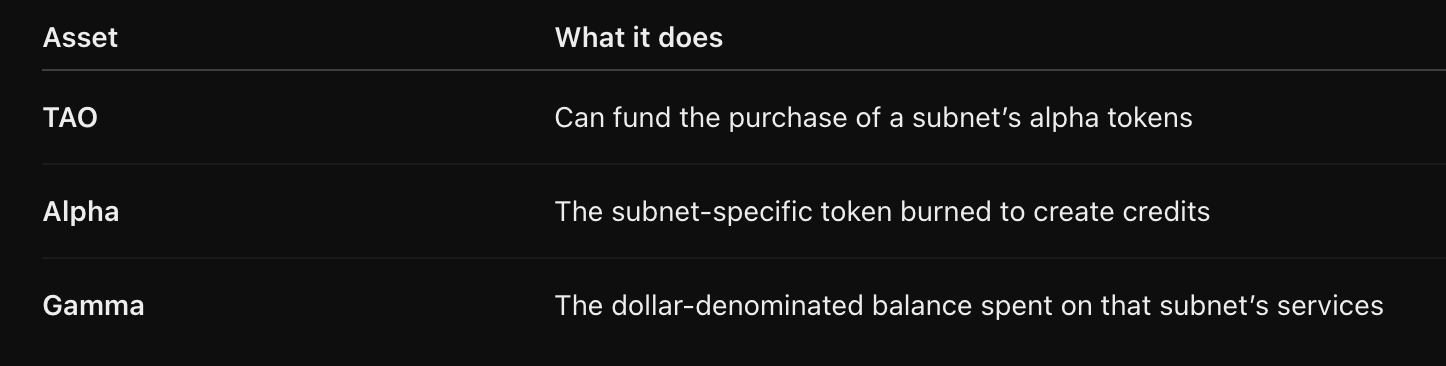
Customers can supply TAO, which buys + burns alpha, or burn alpha they already hold. Each dollar of alpha burned, valued under the protocol’s pricing rules, creates one Gamma
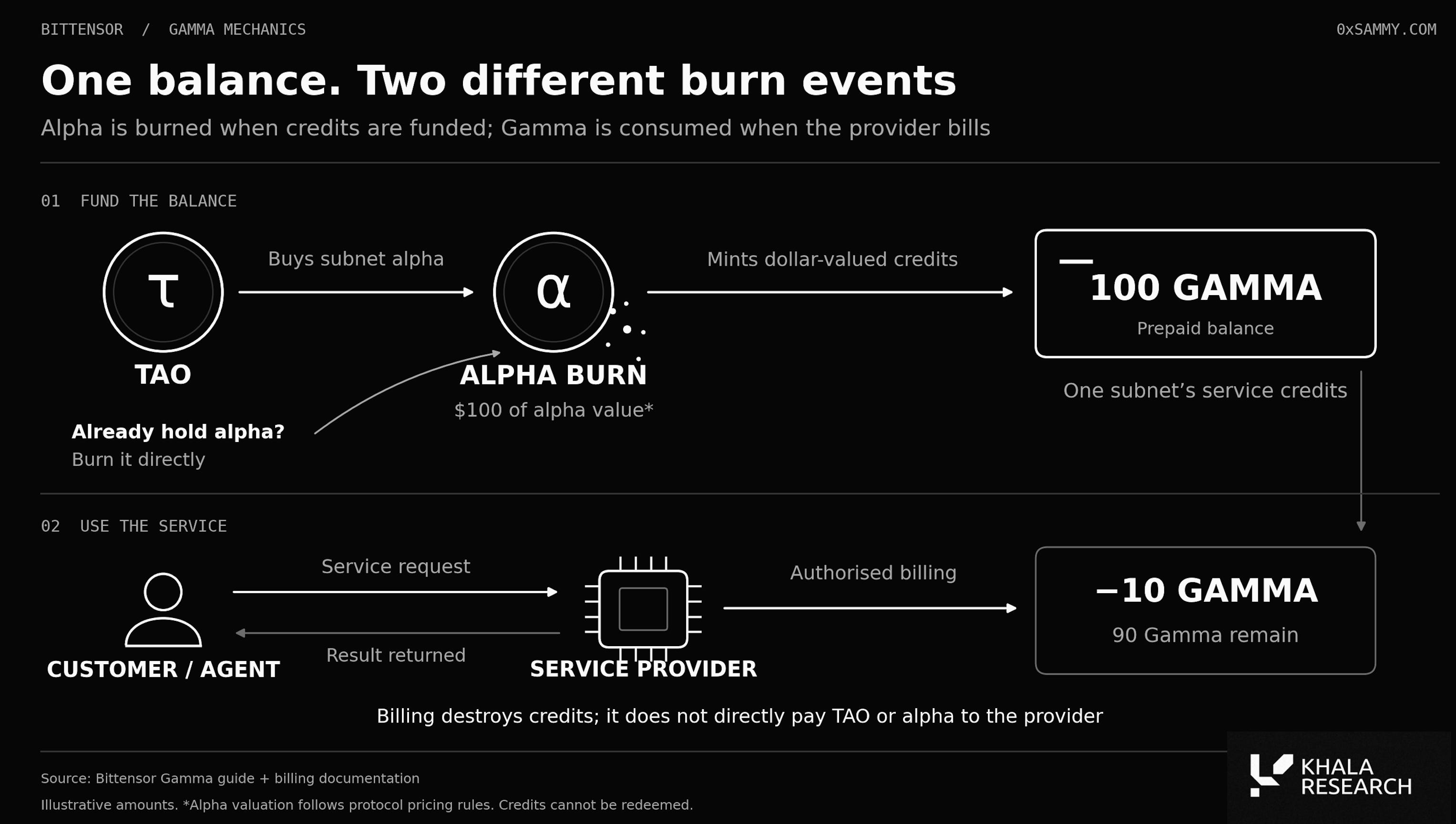
Think prepaid compute/API credits, with scope to cover other services offered by participating subnets
A simple hypothetical: burn alpha valued at $100 under those rules, receive 100 Gamma. If a service charges 0.01 Gamma per request, that buys 10,000 requests
The provider sets its rates; credits belong to that subnet and cannot be cashed back out
2. There’s already activity, but it’s concentrated
SubnetRadar’s Gamma tracker reports network activation on 9 November. Its snapshot checked (on 17 November, at block 9,525,142) showed:
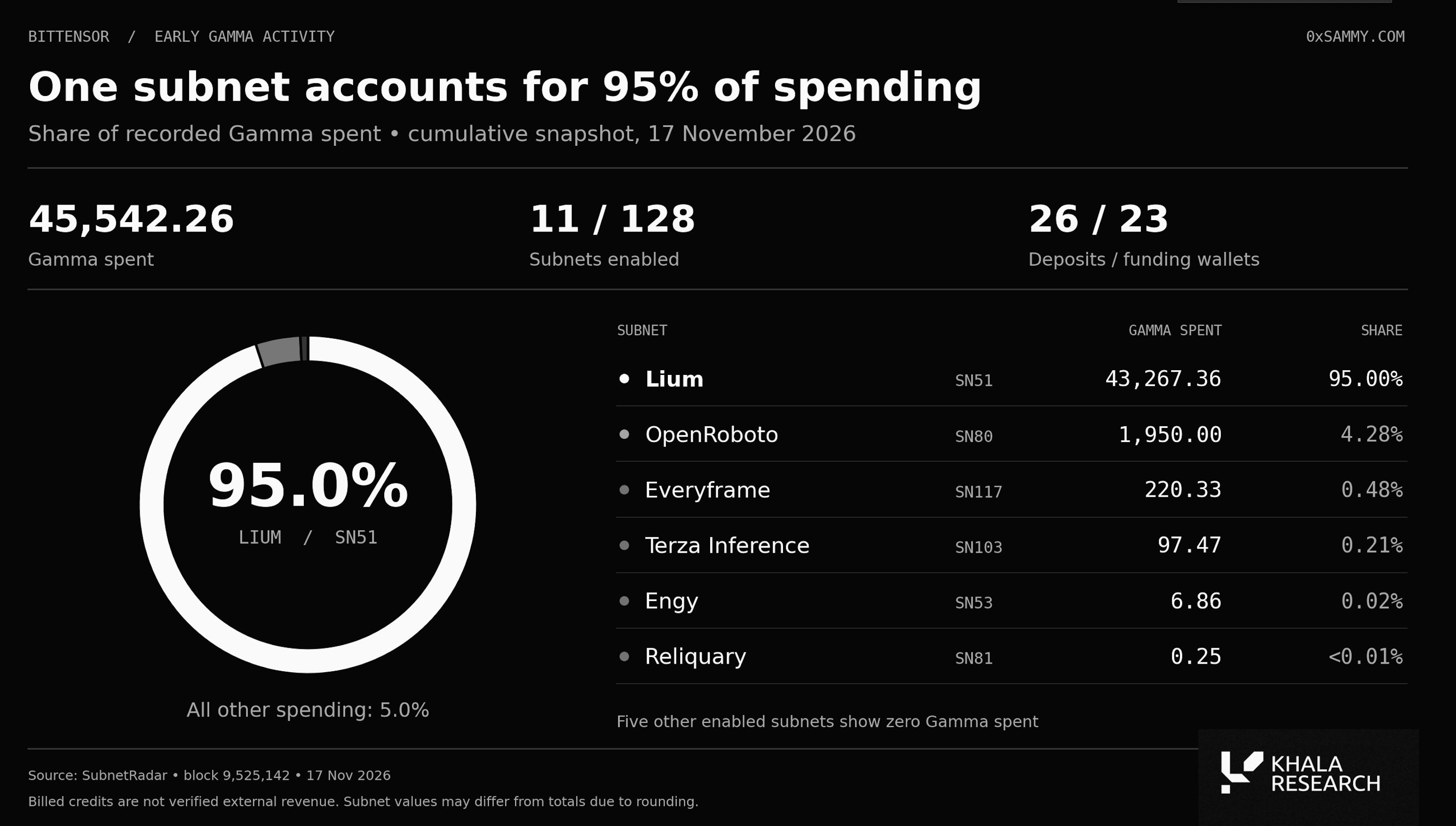
Lium (TAO Subnet 51) accounts for roughly 95% of recorded spending; customers want access to Lium’s compute and are willing to pay for its access:


That gives us something tangible to follow, but it’s a small, concentrated starting point. Those coldkeys don’t establish how many independent customers are paying, and the tracker doesn’t establish the commercial purpose of each charge
I’d be wary of annualising a few days of activity, particularly given its just ~$46k in spending so far...
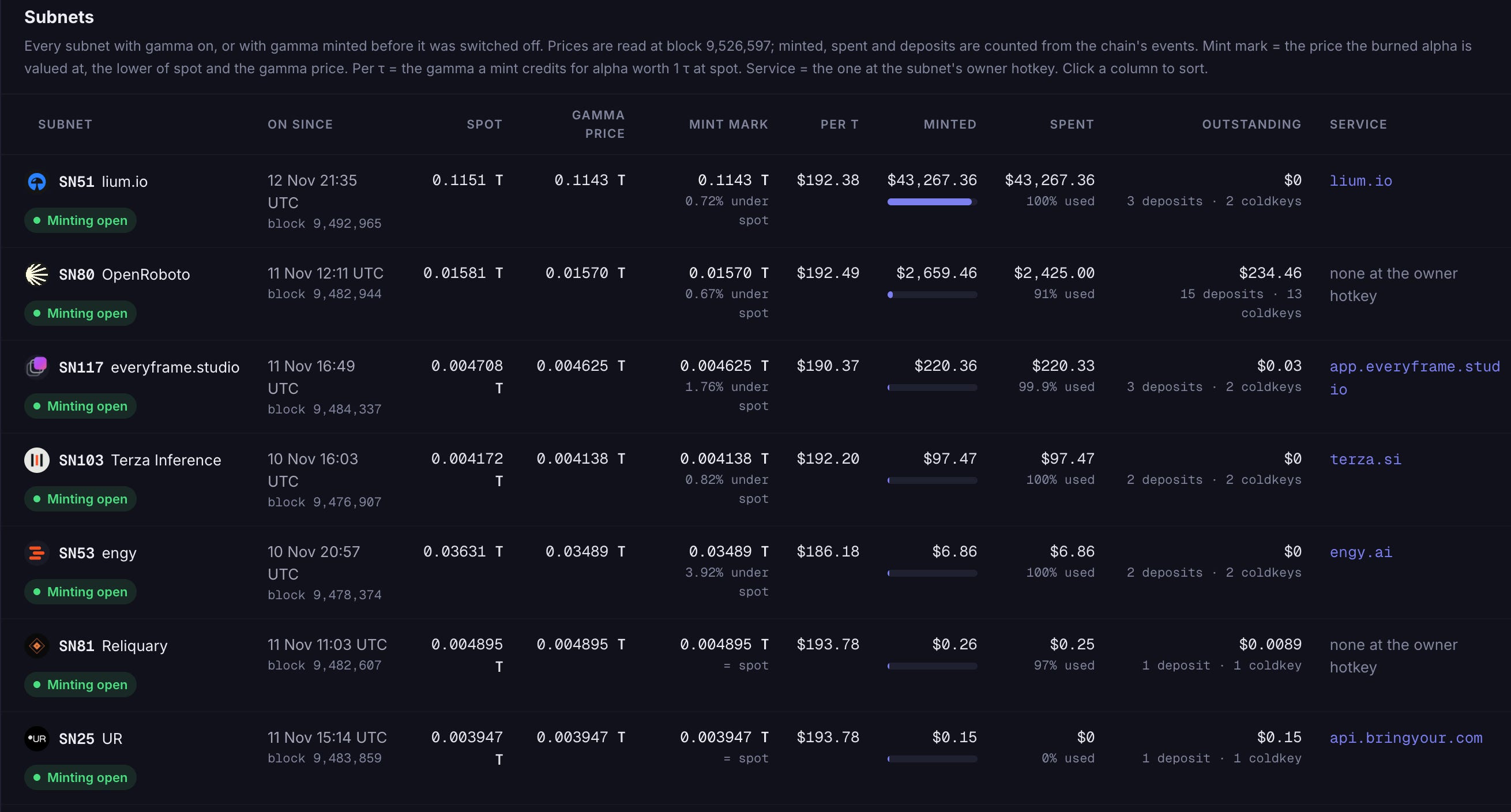
… repeat spending across a broader customer base would be much more informative. Nonetheless, it’s an interesting new mechanisms worth monitoring!
3. Follow the burn, then follow the money
Here’s the detail that makes Gamma worth looking at properly: spending the credits doesn’t directly pay TAO or alpha to the service provider
Alpha is burned when the customer funds the balance. The subsequent billing transaction destroys Gamma
The documentation also makes clear that the chain checks the authorised spender, balance + spending cap, while service delivery remains outside those checks
So the economic questions continue after the burn: how does the operator cover its hardware, power + support costs? What income or incentives does it receive, and can those sustain the service?
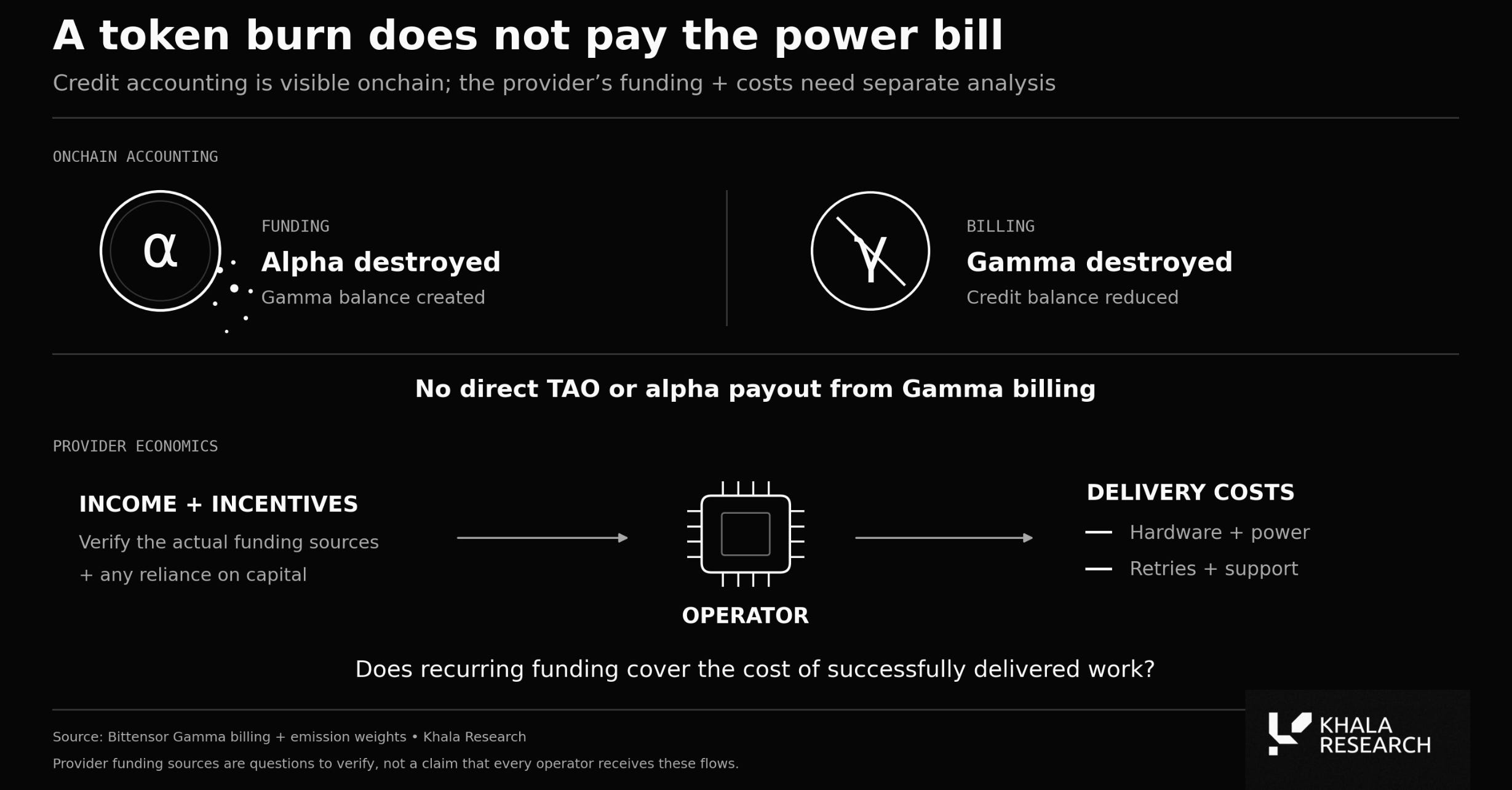
My read is that Gamma gives subnet tokens a clearer relationship with demand for their products. A customer topping up through TAO causes a purchase + burn of that subnet’s alpha
The token being burned is alpha: The existing-stake route also means credits can be created without a fresh TAO purchase
That leaves the investment case dependent on the scale of demand, ongoing issuance, selling pressure + the cost of delivering useful work. A burn mechanism alone won’t settle those questions
4. Who is actually funding the usage?
There’s another detail I’ll be watching closely
Bittensor’s documentation describes a mechanism for subnets to direct part of their emissions towards Gamma credits on other eligible subnets. That could let one service buy inputs from another through the network’s own incentive system
It also means we need to distinguish spending funded by outside customers from spending funded by token emissions:
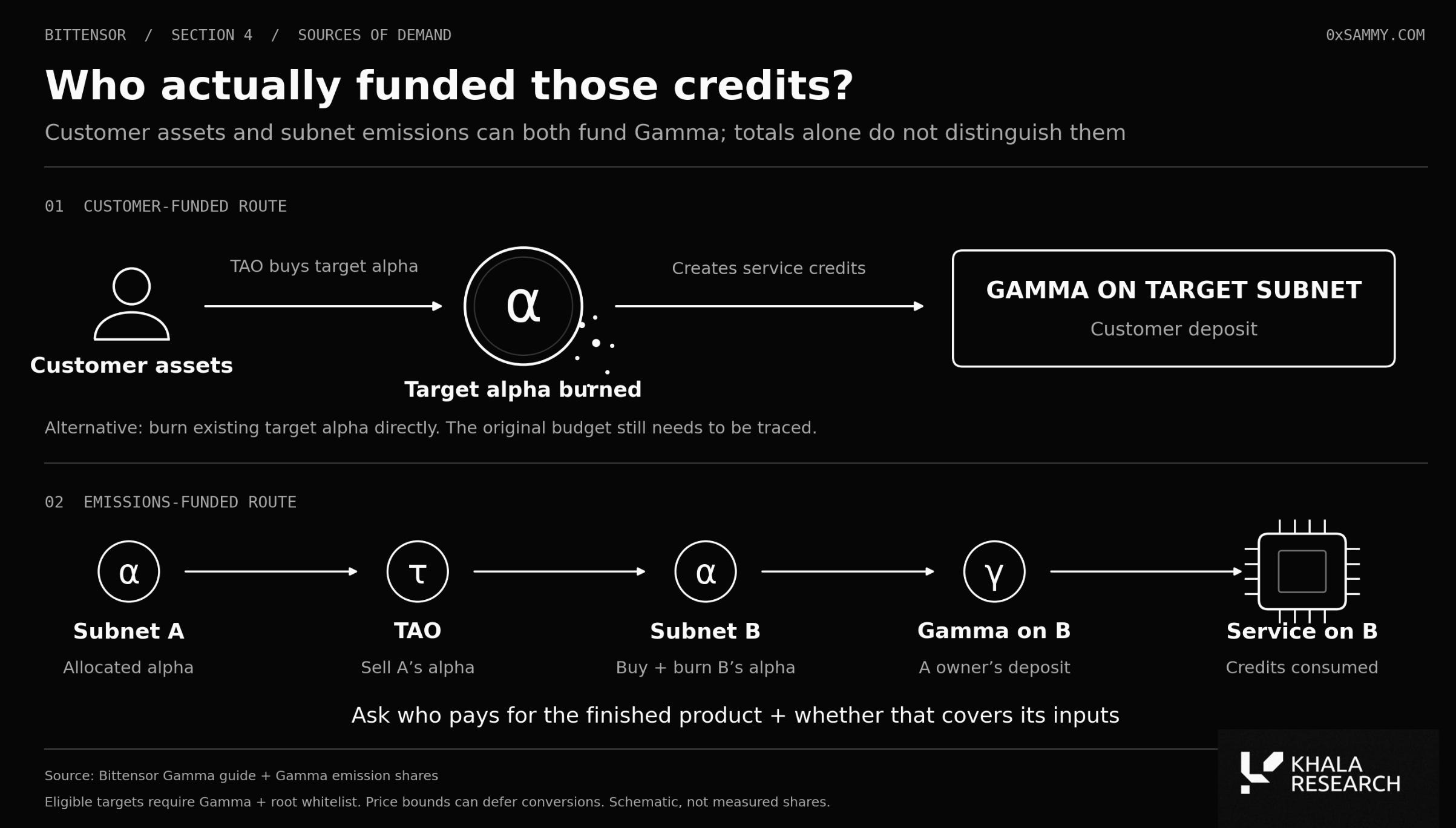
For example, a subnet buying inference to deliver a product may be useful economic activity. To judge its sustainability, I’d still want to know who pays for the finished product and whether that income covers the inputs…
… it ultimately comes down to whether the subnet has a viable product that users are ok with paying for
A larger Gamma total would tell us more credits had moved through the system. Understanding the business requires tracing where the funding came from + what was delivered
5. What I’m watching next
The numbers I’d want in a monthly subnet report are fairly straightforward:
Repeat customers: who comes back and pays from their own budget?
Funding sources: how much spending comes from outside the network versus emissions or testing?
Delivery economics: what does a successfully completed task cost, including retries + support?
Token impact: how much alpha is burned relative to new issuance?
Evidence: can a disputed charge be matched to the request, agreed terms + delivered result?
That last point brings us back to the Walrus research:
As agents buy more services on our behalf, businesses will need records that connect a budget to an instruction, a payment + an outcome
“Blockchain is undefeated in a world of abundance” — Batsoupyum


My thesis is that crypto AI becomes more compelling when we can trace those relationships all the way through. Gamma gives us another mechanism to examine, and the early activity gives us a starting point for measuring adoption
The signal I’ll be looking for is a customer returning because the service was worth paying for
That’s a wrap for this issue of Sammy’s Snippets. I hope you enjoyed it
Please leave me any questions or thoughts here - I will respond to everyone!
If you found this interesting, please consider subscribing to this Substack and following me on X for more related insights
Disclaimer: The content of this newsletter is for informational purposes only. I am commenting on the underlying activity of what I am observing in the market to keep my audience updated and informed.
Nothing in this newsletter constitutes financial advice or a recommendation to buy or sell any asset. Always do your own research before making any investment decisions.
I hold positions in many of the assets discussed in this newsletter. Valuations are approximate snapshots and move quickly. Verify all market data independently before acting