


This Crypto AI & Robotics newsletter consists of the following:
Snippet Partner: Umia Finance + Slop Cash
UK + US preparation and lessons from Texas
How AI changes the economics of cyber warfare
Banking outages, financial records + self custody
Outage timeline, household checklist + TLDR
If you have any questions feel free to reach out to me on X or message my business X account ‘Khala Research’



AI makes code cheaper to produce, increasing the importance of careful review + ongoing maintenance… so this week’s partner is very relevant!
Slop Cash (Umia’s first announced external project from elizaOS creator Shaw Walters and Drew Pierson) is building a funding system around that work
Projects fund monthly pools that reward merged code changes and accepted reviews. Results face a 14-day review period before funders authorise payments from wallets they control:


As AI expands attackers’ capabilities, funding useful software maintenance becomes increasingly relevant. Slop’s impact will depend on the quality of contributions and review.
Its treasury rules hold auction proceeds in a smart contract, give teams a defined monthly allowance and require a decision market for additional spending. Proposed Slop team allocations combine time-based vesting + price milestones, with project assets held under the governed legal entity.
$SLOP governs Slop Cash’s treasury; code acceptance and contributor payments remain separate. I like the focus on verifiable work + controlled spending, although smart-contract, governance and execution risks remain. Sustained funding and useful contributions will be the real test.
This newsletter goes out weekly to 7.4k+ subscribers.
Please don’t hesitate to message me directly for sponsorship or partnership enquiries.

Cyber Resilience in the Age of AI
I have spent part of this week looking at backup power, solar panels and a camping stove. A slightly different research rabbit hole from the usual token launches…
The UK’s emergency-preparation messaging prompted me to look properly at how our household would manage if electricity, internet access or card payments stopped working for a few days.
Some of the headlines invite accusations of scaremongering.
The actual government advice, updated on 22 October, is fairly modest: prepare for three days of disruption, build supplies gradually + leave emergency services better able to help people who need them most.
The government has published household preparedness advice since 2024. This campaign broadens its reach; it does not establish that an attack is imminent":

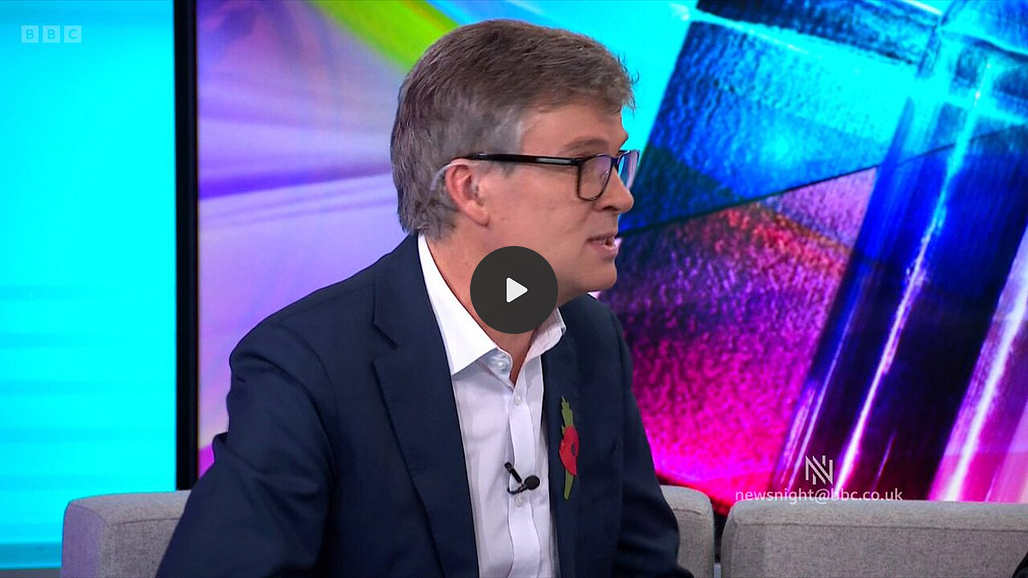
Although did lead to a surge in sales driven by panic buying:


There is a parallel development in the US.
Fox reports a 90-day independent-operation target for major US military bases. The Army’s account of Fortress America confirms the ambition for installations to generate their own power, strengthen supply chains and harden against intrusion:


These are military resilience targets that require infrastructure upgrades over time. The announcement does not mean every base is already self-sufficient for three months.
What interests me is the assumption behind both initiatives:
essential services can be interrupted, and having some capacity to operate independently makes that interruption easier to manage
AI changes the economics of cyber warfare
Most of us following AI spend our time thinking about what a small team can now build. The same improvement in capability is available to people trying to break into systems.
The NCSC’s assessment through 2027 expects AI to increase the frequency and intensity of cyber threats, leading to there being a “realistic possibility” of incidents through 2027 (essentially probable, or 50% likelihood):
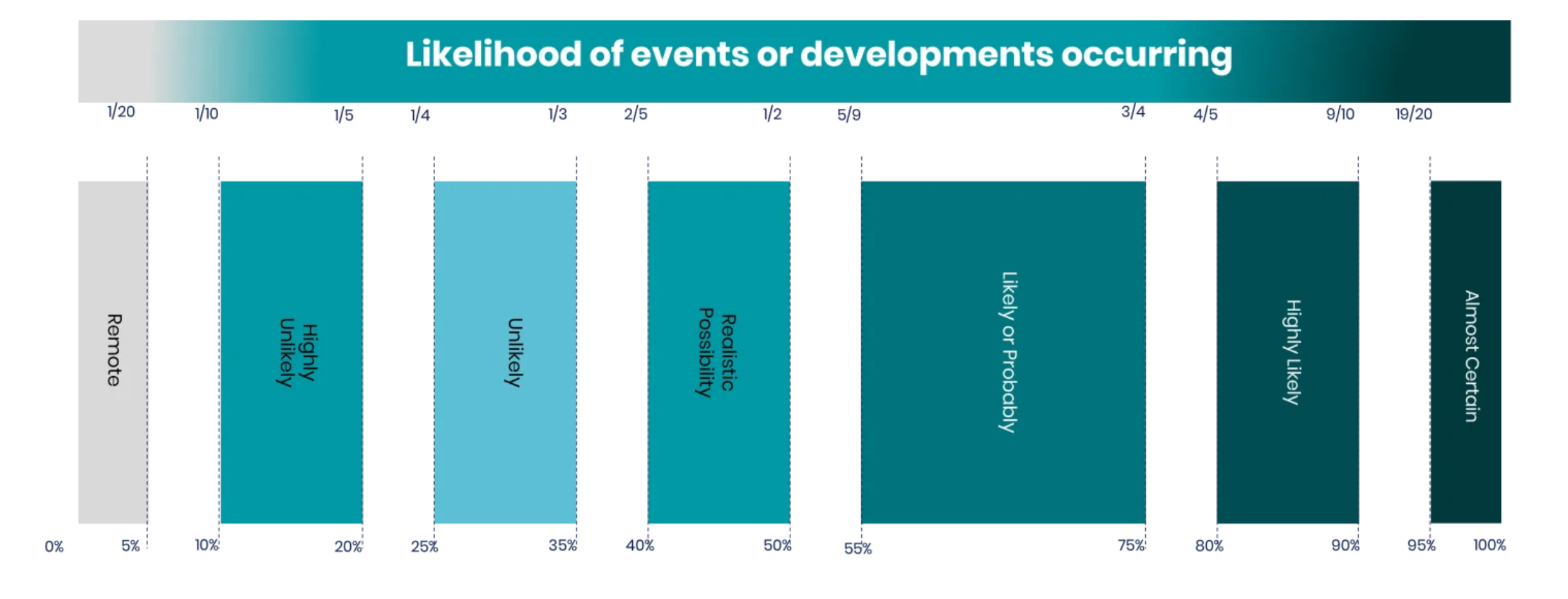
It highlights faster vulnerability research and exploitation, alongside better reconnaissance and social engineering.
In practical terms:
attackers can research more targets, produce more convincing messages and work through software weaknesses faster
Defenders have less time to install fixes before those weaknesses are exploited.
Anthropic’s September 2026 threat report gives a more recent view. Across the notable operations it investigated, it describes AI moving beyond answering questions into executing and coordinating parts of attacks, while people still chose targets and reviewed results.
One case involved a suspected Russian espionage actor using AI-assisted workflows against government, diplomatic and defence targets. Anthropic says the workflow could rebuild and redeploy tools after security software detected them. These are the company’s investigative findings, rather than a measure of all cyber activity.
For a state-backed group, that can mean more operations for the same resources.
For criminals, it can bring tasks within reach that previously required a larger specialist team.
Espionage, theft and disruption have different objectives, but they can benefit from the same tools.
A successful attack on a supplier or administrative system can also interrupt services further downstream. Disrupting payments or deliveries can affect a household even when its own devices are secure. Turning that into sustained physical disruption still depends on the target, the access obtained and the defences in place.
AI is also improving defence, so it’s certainly not all doom and gloom!
The NCSC describes Cyber Shield, a planned capability using agentic AI to help defend at machine speed. The outcome will depend partly on how quickly organisations adopt effective protection.
My expectation is that intermittent disruption becomes more likely as these capabilities spread unevenly. That is my judgement about the direction of risk, rather than a quantified forecast of UK blackouts. It is enough to make a modest household backup plan feel worthwhile.
Texas showed how power loss becomes a wider crisis
Winter Storm Uri in February 2021 is a useful case study. Extreme cold, freezing equipment and fuel problems disrupted electricity generation across Texas and neighbouring states. FERC reports that more than 4.5 million people in Texas lost power, some for as long as four days.
The disruption extended well beyond lighting. Texas’s water regulator documented failures in water treatment and pumping, frozen equipment and burst pipes. The state ultimately confirmed 246 storm-related deaths, including deaths associated with cold exposure, carbon monoxide and disrupted medical care.
This was a weather-driven disaster. It demonstrates the consequences of prolonged infrastructure failure, without telling us how likely a similar event is in the UK or establishing a link to AI. For households, keeping warm, accessing safe water and maintaining essential care can become urgent well before the power returns.
A banking outage does not mean the records disappear
There are two separate concerns here:
whether I can use my money today, and
whether the system can still establish what I own.
If a banking app or card network goes offline, the immediate problem is access. A failed balance screen does not tell us that the underlying account records have been erased.
Banks have disaster-recovery arrangements designed to restore services and records. In its review of recovery practices, the Bank of England describes firms using protected backups, rebuilding systems in clean environments and switching to separate recovery facilities.
Those backups and alternative servers are a substantial reason I regard permanent, system-wide loss of financial records as an unlikely extreme scenario. I do not see evidence that it is the likely outcome of the current threat.
The Bank also warns that attacks can affect multiple sites and backups. Recovery can take time, particularly when firms need to check that restored records are complete and accurate. Having a recovery plan does not guarantee uninterrupted access.
For me, the practical response is to keep recent statements, account details, transaction exports + insurance documents securely available offline, alongside some cash for essentials. Those records would help with reconciliation or a dispute; they are supporting evidence rather than a replacement for the bank’s ledger.
What self custody actually gives you during an outage
Crypto gives us another way to separate control of an asset from access to a particular institution. Bitcoin’s transaction history is maintained across its network, while private keys authorise spending.
A local power cut does not erase that history from the computers still operating elsewhere… hence the power of “distributed ledger technology” (DLT) which is the entire premise of blockchain
A hardware wallet holds the keys. The coins are accounted for on the blockchain. With the correct recovery material, you can regain control through a compatible wallet if the device is lost or damaged.
Actually spending still requires a route to an operating network so the transaction can be broadcast and confirmed. Local internet failure can prevent that, and a wider disruption can affect the network itself. Self custody also cannot make a shop accept crypto or protect the asset’s market price
For crypto I already hold, I want a recovery arrangement I understand and have checked, with durable offline backups protected from theft, fire and water. Recovery phrases should stay out of screenshots, email, cloud notes + AI chats. Any extra passphrase is also essential to recovery
I would keep a separate record of wallet addresses, transaction history and purchase costs. Those records help establish what happened, but an address or a screenshot of a balance cannot replace the keys. A trusted person should also know how to find the recovery instructions if I am unavailable
Stablecoins add another dependency. Holding USDC in your own wallet still leaves you exposed to its issuer (Circle), reserve arrangements + address-blocking powers. Self custody changes who controls the keys; it does not remove every counterparty.
My preference is to have several usable options: ordinary banking, a modest cash reserve + properly managed custody of existing crypto. Each deals with different failures, and each needs to be usable when something goes wrong.
How a prolonged power cut could affect daily life
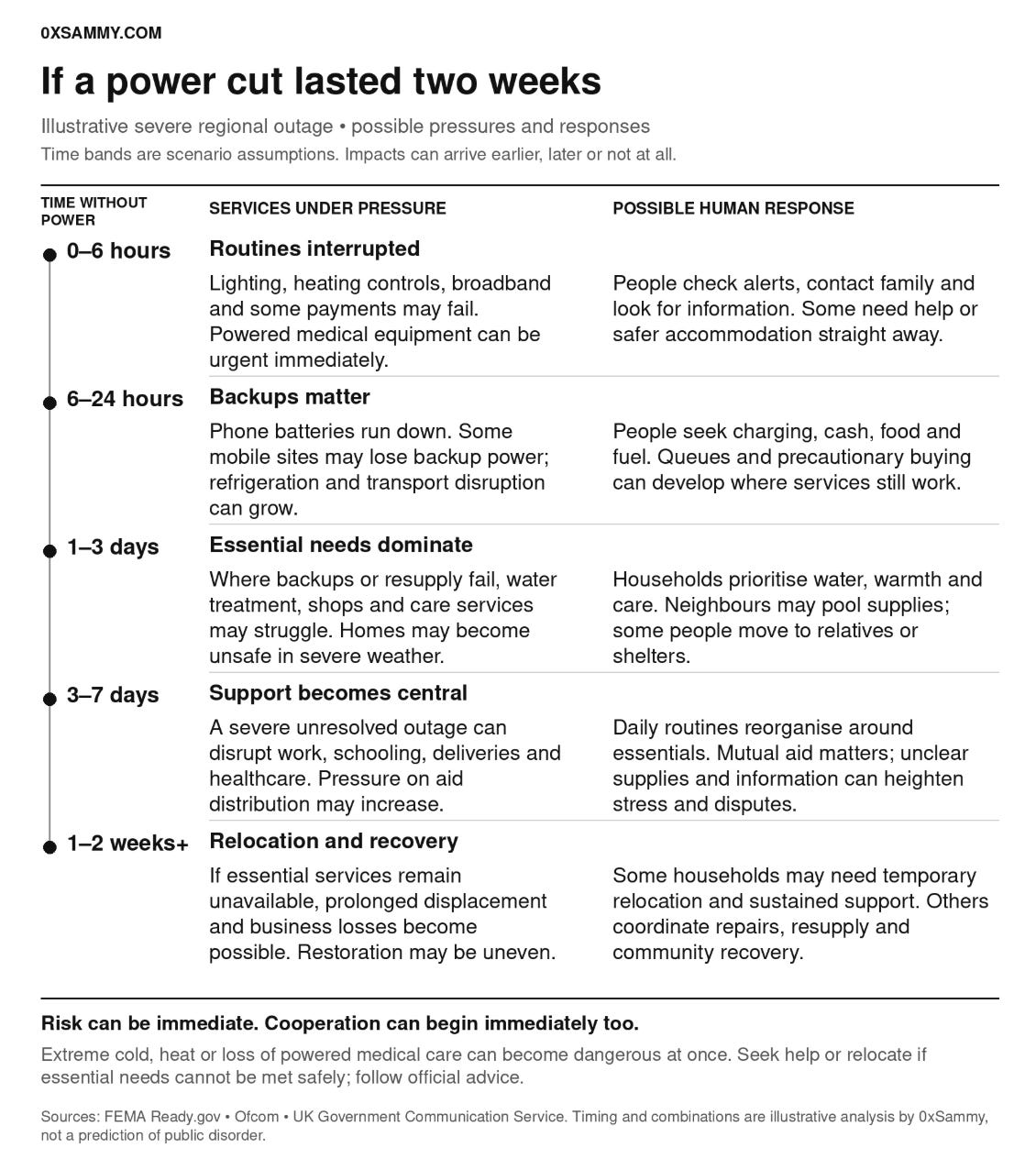
The timeline below explores a severe regional outage that continues for days. The time bands are illustrative assumptions, not official thresholds or a forecast. Weather, the area affected, backup capacity and the response from authorities can change both the sequence and severity.
By survival mode, I mean people redirecting their time and money towards water, warmth, food + protecting family. Uncertain supplies can bring queues and precautionary buying, while prolonged disruption can force households to seek help or move somewhere safer.
The research on crisis behaviour also finds that cooperation and mutual support are common. A useful scenario includes neighbours sharing resources and organised assistance, alongside the potential for stress and disputes. There is no reliable countdown to societal collapse:
My two week plan and the longer term move off grid
I’m aiming for around two weeks of basic household resilience.
That goes beyond the government’s three-day baseline and reflects my own preference, rather than an official prediction about how long an outage will last.
I’ve been researching a roughly £1,000 starting budget, including a Jackery-style battery and solar setup, plus a simple outdoor cooking option. The priority is equipment I can understand and test before I need it
My checklist starts with the government’s essentials, extended gradually to suit our household:
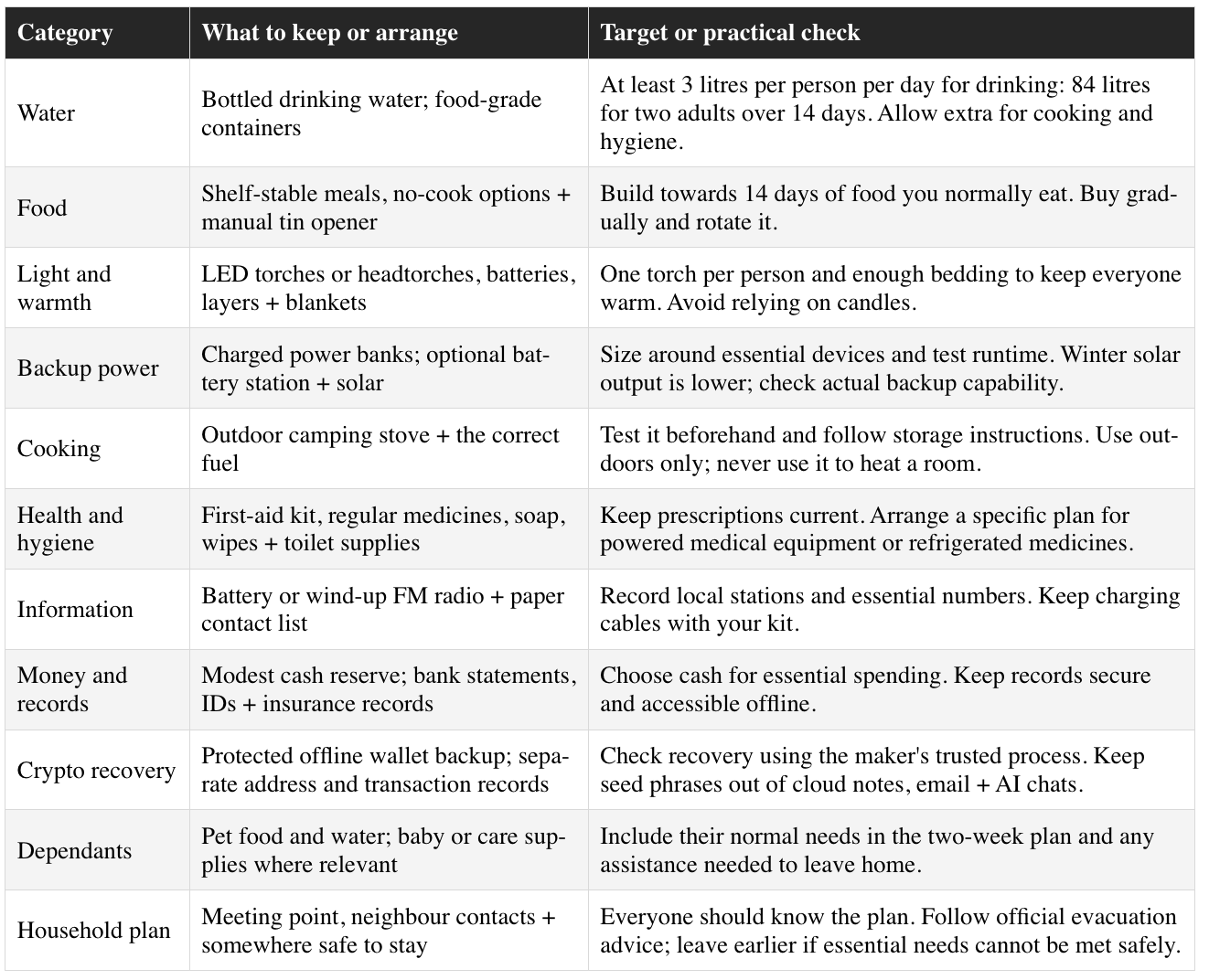
A portable battery also has a finite energy budget. I would size it around the devices that matter most and test their runtime. Keeping the router powered only helps if the broadband network outside the house is still working. Camping stoves and petrol generators belong outdoors, away from doors and windows.
Longer term, I want to move towards off-grid living supported by renewable generation and sustainable resources. That means thinking about year-round energy demand, storage, heating, water and food, alongside maintenance and the people nearby who could help.
There is a technical detail worth checking before buying solar: ordinary grid-connected systems often shut down during a power cut. Energy Saving Trust explains that backup operation needs the right equipment and configuration, even with a battery. UK winter generation is also much lower, so a summer demonstration tells you little about December independence
TLDR
This is a diversion from my usual coverage of crypto, AI + robotics development, but it matters as we move deeper into an AI-centric world
More of our lives depend on connected systems, and the consequences of those systems failing deserve some thought
There is no specific imminent blackout warning in the evidence covered here. AI can strengthen defences as well as attackers, and banks have recovery arrangements to restore services and records
My concern is being able to manage a disruption while those systems recover; I’m not a doomer; I’m being practical about a worst-case scenario.
A personal disaster recovery plan means knowing how your household would access water, food, warmth, information + money, and where you would go if home became unsafe
Use this as a practical guide and a prompt to think ahead (maybe print this off as a hard copy). AI capabilities could make parts of our infrastructure less reliable if defences fail to keep pace. Building a sensible buffer now gives us more options, helps us support others and creates a starting point for longer-term self-sufficiency.
Prepare for the worst, hope for the best…
That’s a wrap for this issue of Sammy’s Snippets. I hope you enjoyed it
Please leave me any questions or thoughts here - I will respond to everyone!
If you found this interesting, please consider subscribing to this Substack and following me on X for more related insights
Disclaimer: The content of this newsletter is for informational purposes only. I am commenting on the underlying activity of what I am observing in the market to keep my audience updated and informed.
Nothing in this newsletter constitutes financial advice or a recommendation to buy or sell any asset. Always do your own research before making any investment decisions.
I hold positions in many of the assets discussed in this newsletter. Valuations are approximate snapshots and move quickly. Verify all market data independently before acting