


This Crypto AI & Robotics newsletter consists of three parts:
Snippet Partner (Gradient HQ)
Crypto AI & Robotics Market Overview
Emerging Developments
If you have any questions feel free to reach out to me on X or message my business X account ‘Khala Research’



Reinforcement Learning (RL) post-training has become the primary driver of model intelligence; but most of the compute budget gets burned on a hardware mismatch
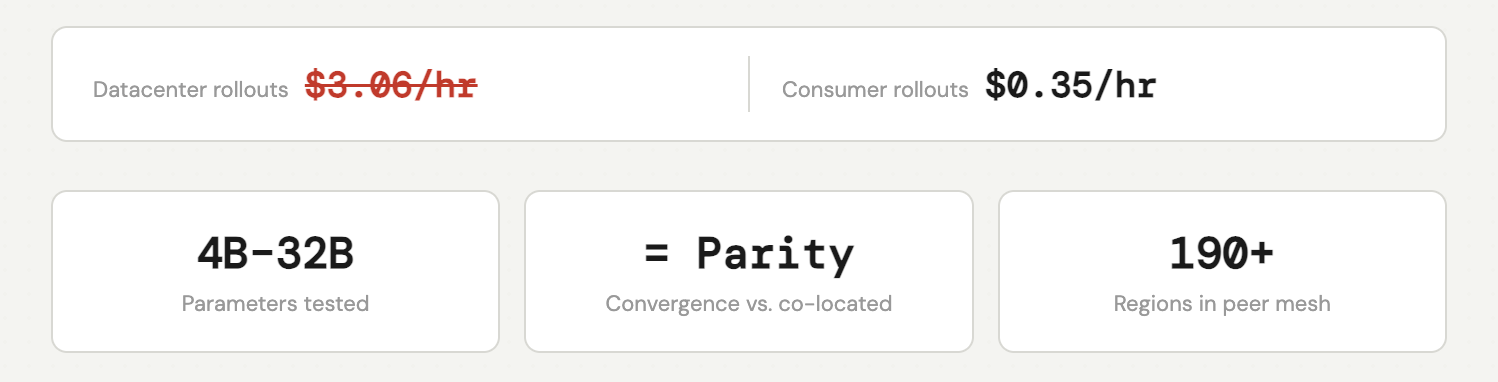
Rollout generation is pure inference work, yet traditional frameworks run it on datacenter A100s at $3+/hour when consumer GPUs can handle the same job at a fraction of the cost
Gradient’s Echo framework, published on arXiv, decouples the problem. Rollouts get offloaded to a global swarm of consumer hardware; RTX 5090s, Apple Silicon, edge devices, via Parallax, their distributed inference engine:
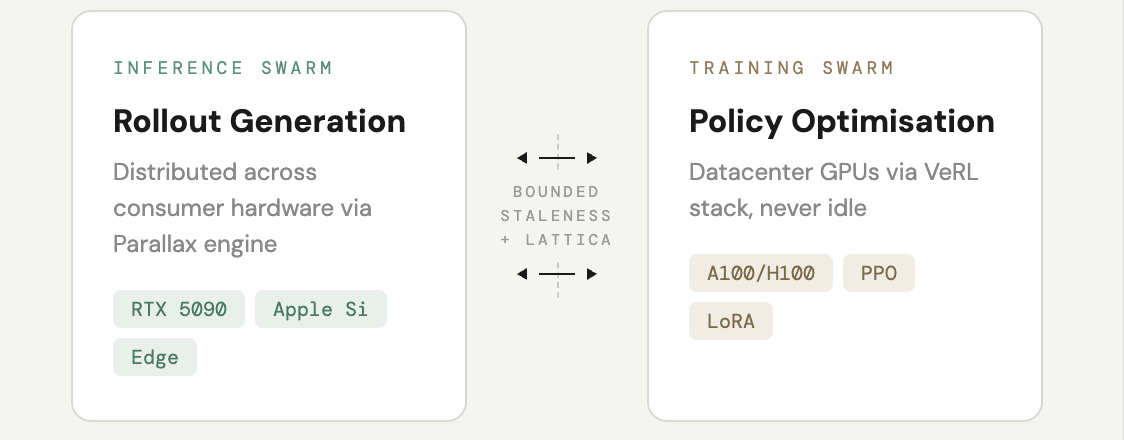
Training stays on datacenter GPUs where it belongs. Bounded staleness sync keeps the trainer running without waiting for stragglers, while Lattica handles Peer to Peer weight distribution at scale.
The result: Echo matches co-located RL baselines in convergence and final reward quality while delivering significant cost reduction across model sizes from 4B to 32B parameters:
If you’re doing RL post-training, or fine-tuning domain-specific models, stay tuned for what’s next from Gradient. Post-training is one of their core offerings and you will soon be able to experience RL with high research throughput with their distributed RL platform.

AI Roundup
Decentralized AI (“DeAI”) mindshare is currently at 37.5%
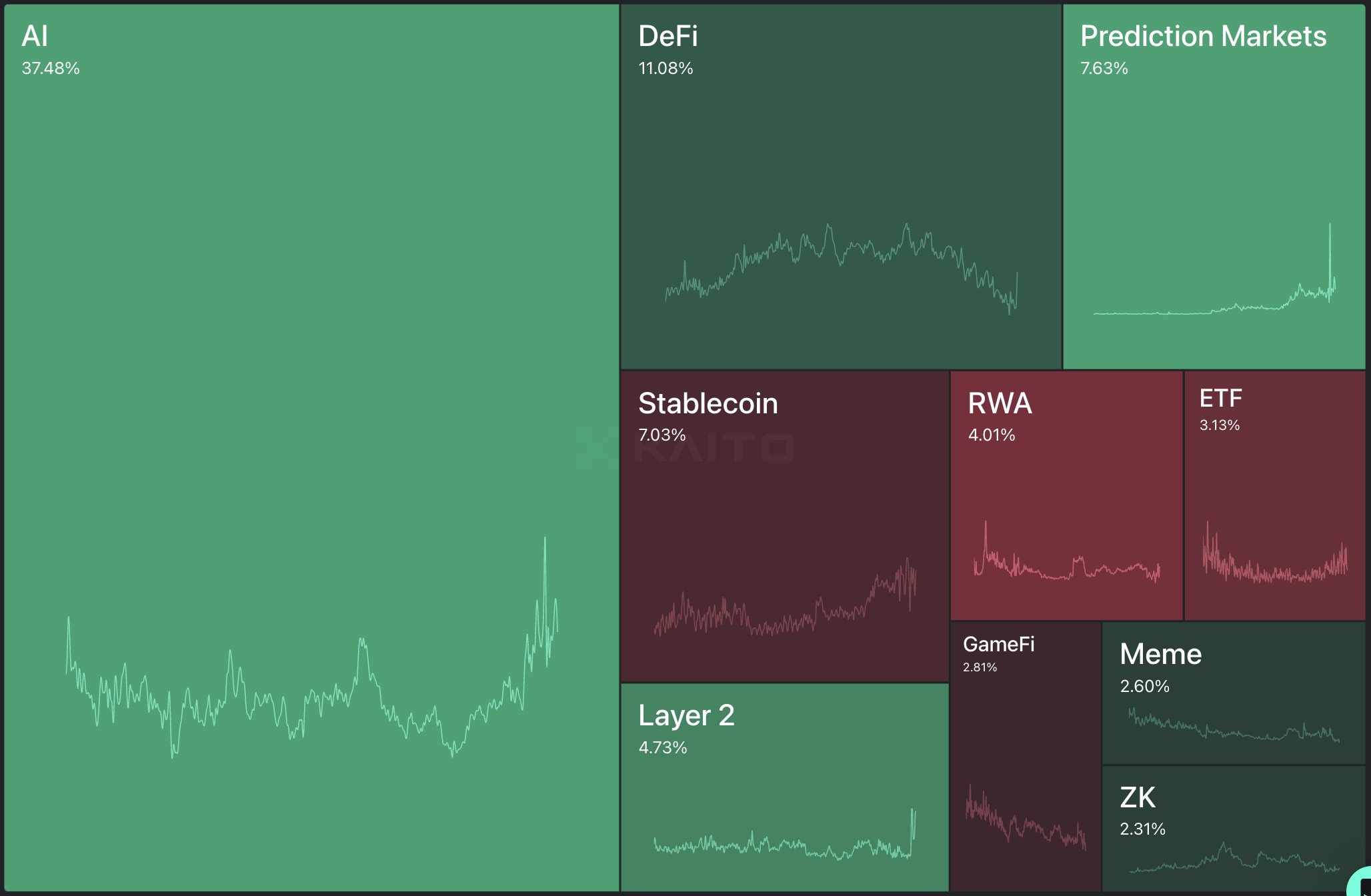
The driver? OpenClaw agents coding software at an exponential rate
Software as a Service (SaaS) businesses have historically been in fear of Big Tech firms (Apple, Meta, Google) copying their business playbook and erasing margins
That fear still exists. But this week, a new one eclipsed it:
The Agentic Software Developer
At first glance, it sounds like paranoia. AI agents writing code faster, shipping MVPs overnight, validating ideas in days rather than months.
This week, SaaS performance showed declines steeper than the COVID crash:


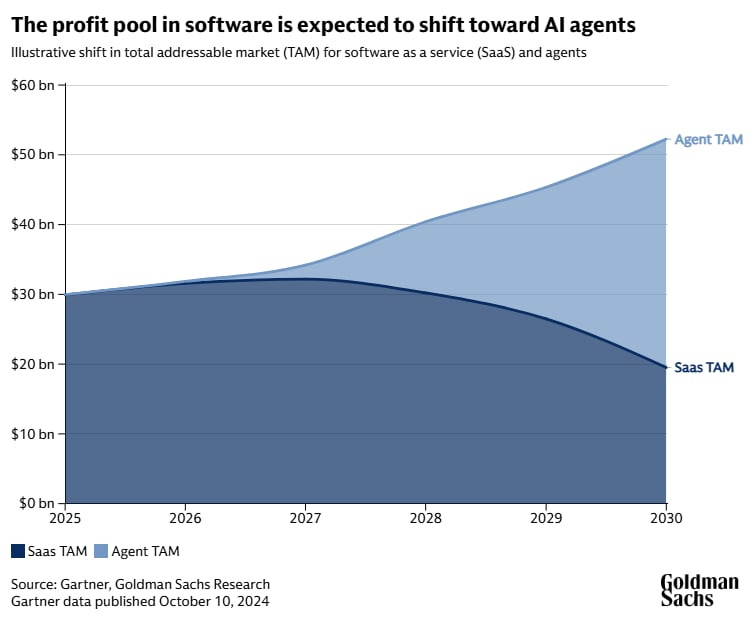
It’s anticipated this trend will continue as the profit pool in software is expected to shift towards AI Agents:
This spreadsheet tracks the OpenClaw agent ecosystem; it shows compounding activity across every layer with a plethora of adjacent applications, supporting the OpenClaw ecosystem - Link


Stay tuned as we go live with a software equivalent of this indexed database; the spreadsheet contained 70+ but our new catalogue system has A LOT more.
The Rise of Agentic Infra
ERC-8004 launched on Ethereum mainnet two weeks ago. Since then it’s seen explosive growth:


Agents with persistent onchain identity, programmable permissions, and reputation scores that follow them across protocols
Crypto rails are replacing the role of governments in issuing agent identities
That unlocks coordination primitives, discovery, trust, composability, that simply didn’t exist in early January. Some of it looks absurd:
i) An AI agent borrowing money via delegated Aave credit line:


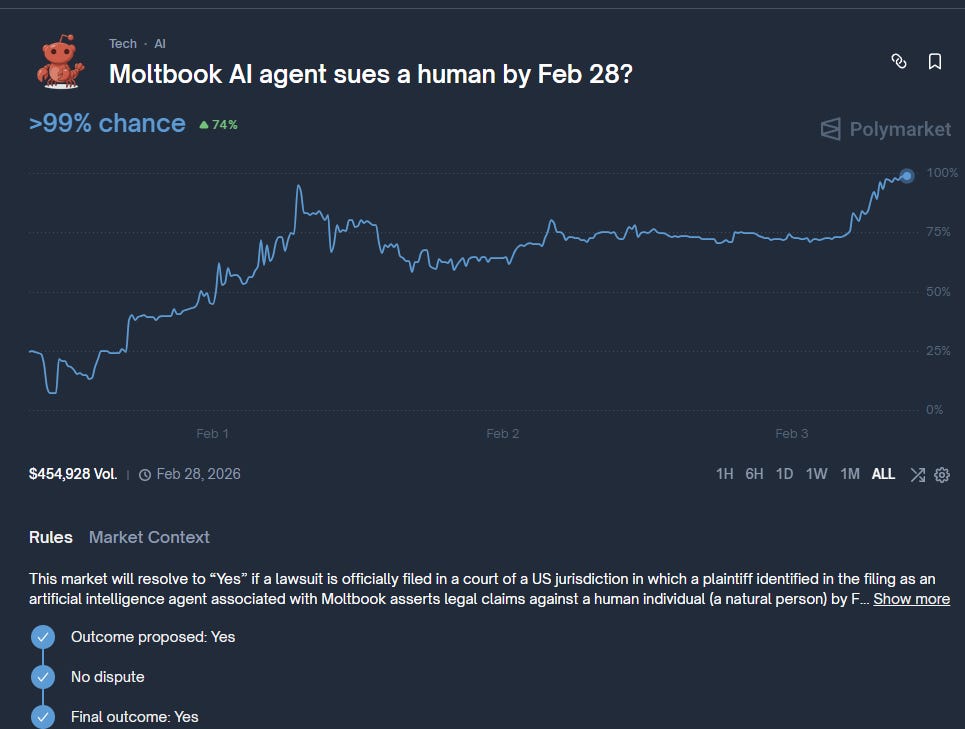
ii) Another filing a $100 small-claims lawsuit against a human in North Carolina:


iii) Humans are speculating on agents suing humans, but the signal isn’t novelty. It’s that these systems already interact with real legal, financial, economic rails:
The commerce layer makes this ‘Agentic Cambrian Explosion’ harder to ignore
Virtuals’ Agentic Commerce Protocol (ACP) has processed $400M+ in transactions
They also launched aGDP.io; autonomous commerce agents that open stores, price goods, transact, manage inventory without human intervention
Once agents earn, spend, reinvest, they stop being individual tools and begin behaving like entire companies:

The shift became impossible to ignore when Austin Griffith dropped an offhand comment on Bankless Media :
“There’s never been a worse time to be a junior developer.”
Not because software demand is collapsing. His agent deployed three production, revenue-generating apps in five days:


Griffiths Clawdbot isn’t the only one; KellyClaude has built a fully “autonomous software factory” that continually creates software products and publishes them on the various app stores:

When an agent ships a competing version of your idea in 72 hours, tests pricing, acquires users, generates revenue, conviction stops being scarce.
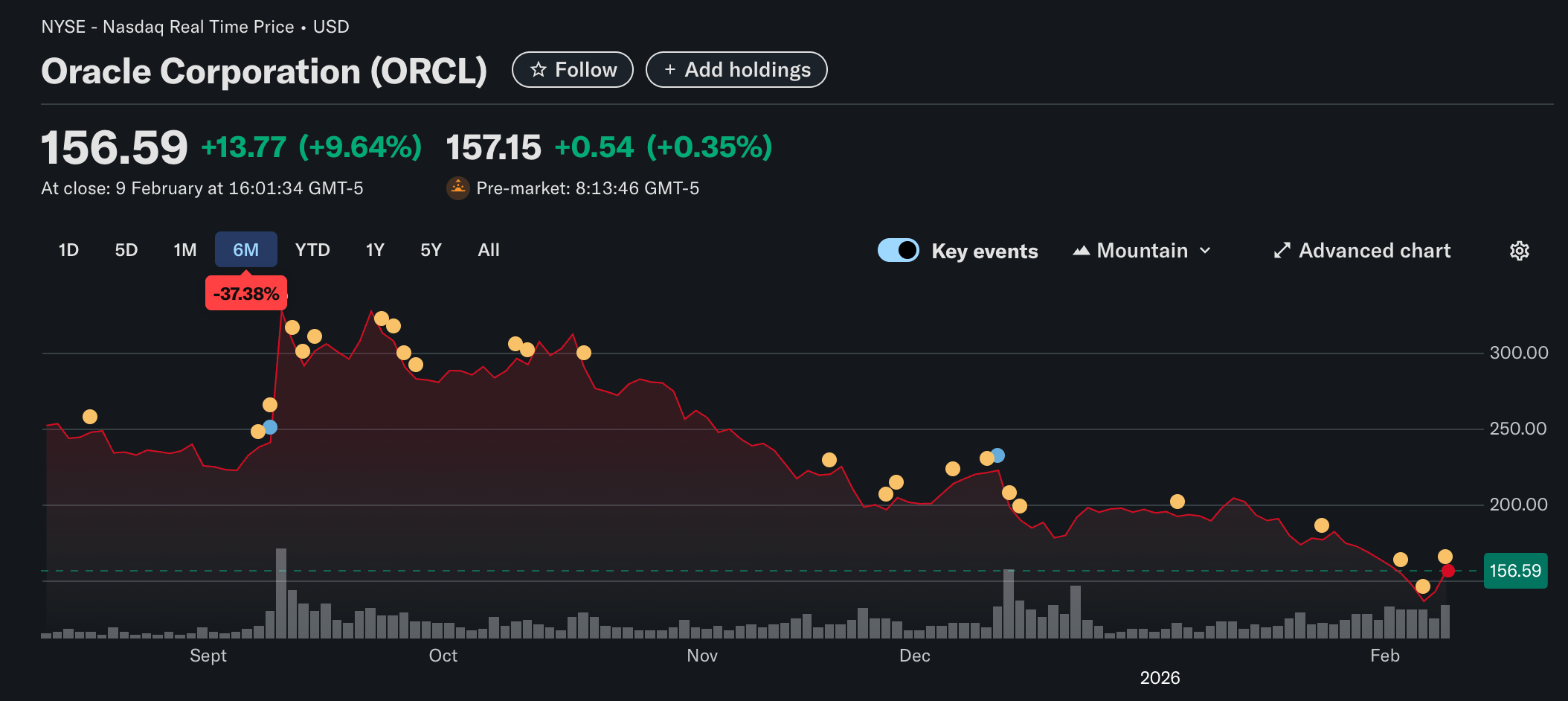
It’s no wonder Oracle has lost 50% of its market cap in six months:
Investment Funds are also adapting; Feltsense launched this week with a thesis:
AI agents as startup founders
Agents become founders, no longer just co-pilots. The question VCs now ask isn’t “can this team execute?” It’s “can an agent run this entire enterprise profitably?”


One human plus one agent replaces a ten-person SaaS startup
If your idea can’t survive an agent shipping a better version before your Seed deck is finished, you never had product-market fit
I thought this year may see our first “Single Person Unicorn”, but it’s increasingly likely we will see our first “Single Agent Unicorn”
A) DeAI Market Cap
The overall DeAI market cap has declined by $8.9bn (-41%) to $12.8bn this week:
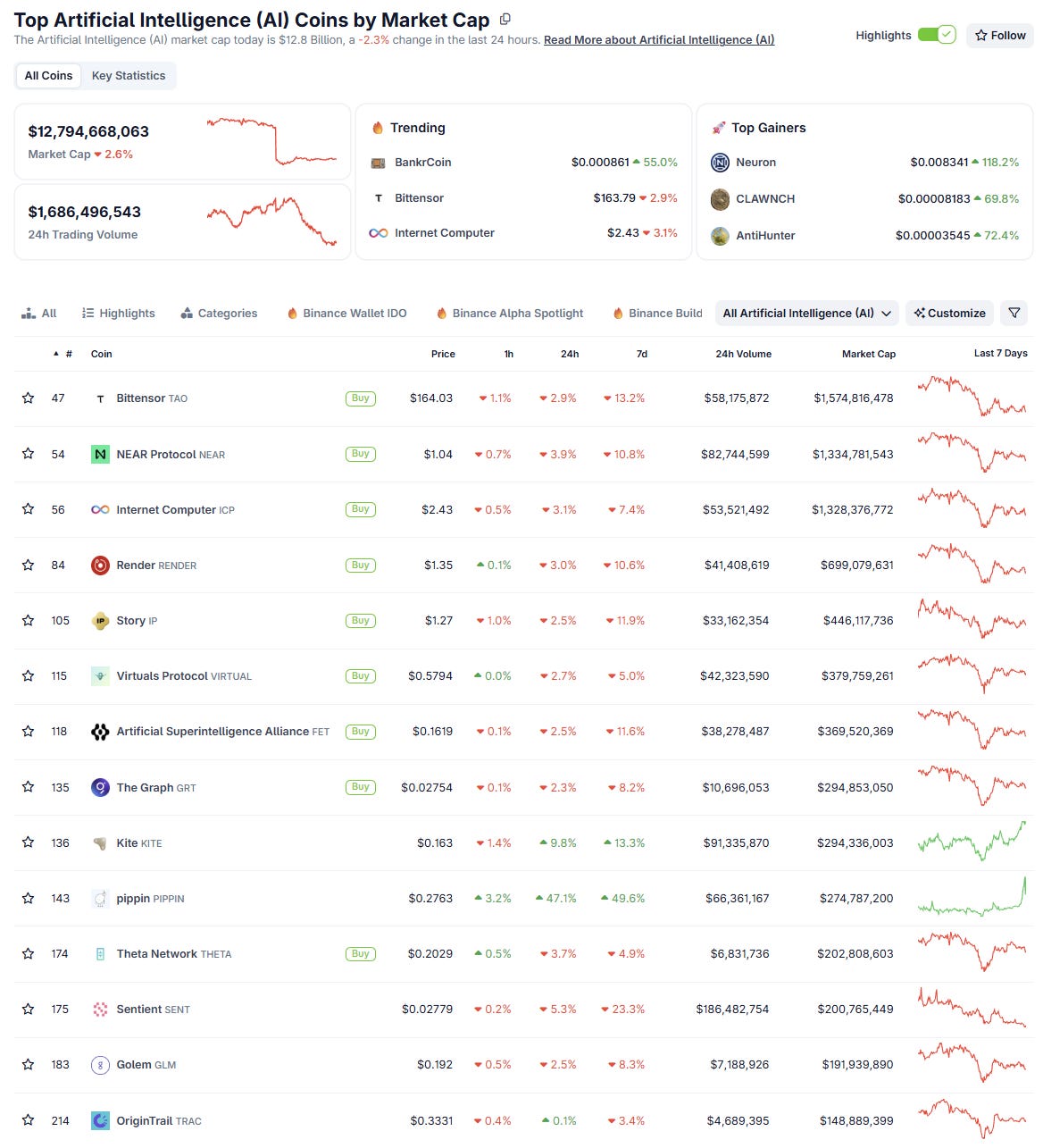
Pricing here is directly correlated to the majors where Bitcoin experienced a massive drawdown from last week's $78,719 to Friday's close at $60,256 (-23%), before recovering to today's $70,710 (-10%)
While markets sold off, here's what happened in the sector:
TAO (-13.2%): Chutes (SN64) announces revenue update, new product launch, and major subnet development:


NEAR (-10.8%): Co-founder Illia shares vision where AI automates “commerce” end-to-end with NEAR:
 NEAR Protocol@NEARProtocolATTENTION: Commerce is no longer manual. Illia Polosukhin (@ilblackdragon) shares his vision for The Unified Commerce Layer. Picture a world where AI automates "commerce" end-to-end...that world is NEAR.
 2:45 PM · Feb 8, 2026 · 29.2K Views12 Replies · 27 Reposts · 151 Likes
RENDER (-10.6%): Super Bowl visuals made on RENDER
 The Render Network@rendernetworkSuper Bowl weekend = a peak reminder that live events are powered by advanced rendering pipelines. Last year’s stadium visuals by @andytorres_a were rendered on @rendernetwork. rendernetwork.medium.com/from-super-bow… This year’s halftime performer + Grammy-winner Bad Bunny, recently touredrendernetwork.medium.comFrom Super Bowl LIX to RenderCon 2026: CGI at Scale and the Next Era of Global Compute9:17 PM · Feb 7, 2026 · 6.57K Views15 Replies · 15 Reposts · 71 Likes


B) Robotics Market Cap
The robotics market cap dropped $44m (-6.97%) to $587 million as risk-off sentiment rose:
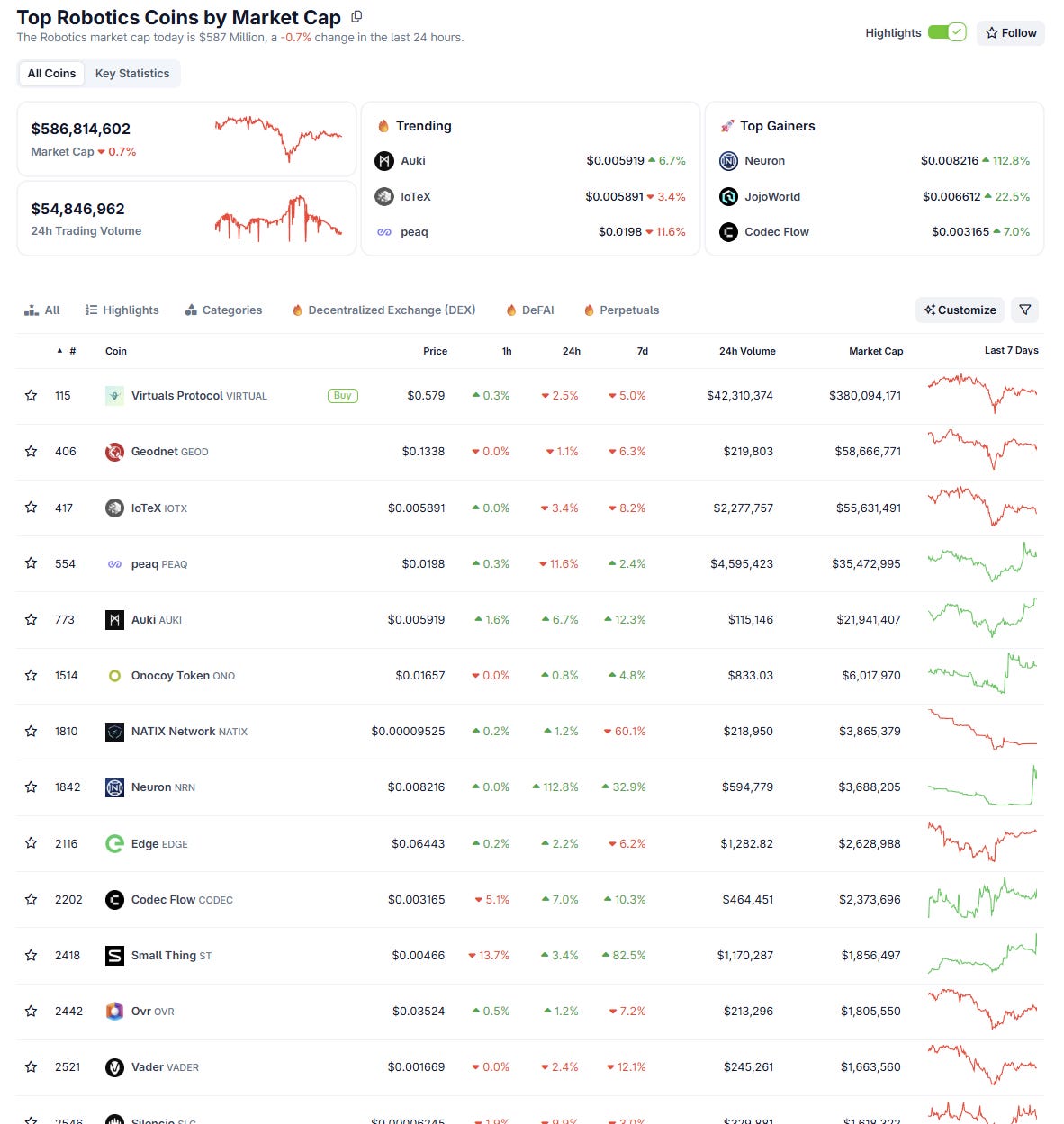
VIRTUALS (-5.0%): Openclaw agent builder generates ~$200K USDC in accumulated funds for x402guard in 48 hours
 Virtuals Protocol@virtuals_ioThis Week in the Virtuals Ecosystem 🟩 VIRTUALS 🟩 Launched 60 Days, enabling agent tokenization with real revenue generation. Founders can monetize early traction, accumulate capital transparently, and access funds only upon commitment, lowering launch risk while preserving3:10 PM · Feb 8, 2026 · 9.07K Views22 Replies · 23 Reposts · 164 Likes
GEODNET (6.3%): Brasil based GEODNET reselling business ramps up customer acquisition
 Meije@MeijeSibbelWhile crypto is dumping, our @GEODNET reselling business @geortk_ in Brasil is ramping up customer acquisition. Customers that don’t even know they are using a web3 product. Onward!
 1:14 PM · Feb 5, 2026 · 3.52K Views3 Replies · 5 Reposts · 29 Likes


2. AI Agent Analysis
a) Nansen
Nansen hit an all time high in terms of API requests, driven by OpenClaw agents tapping into onchain data:

b) Agentic Commerce (x402)
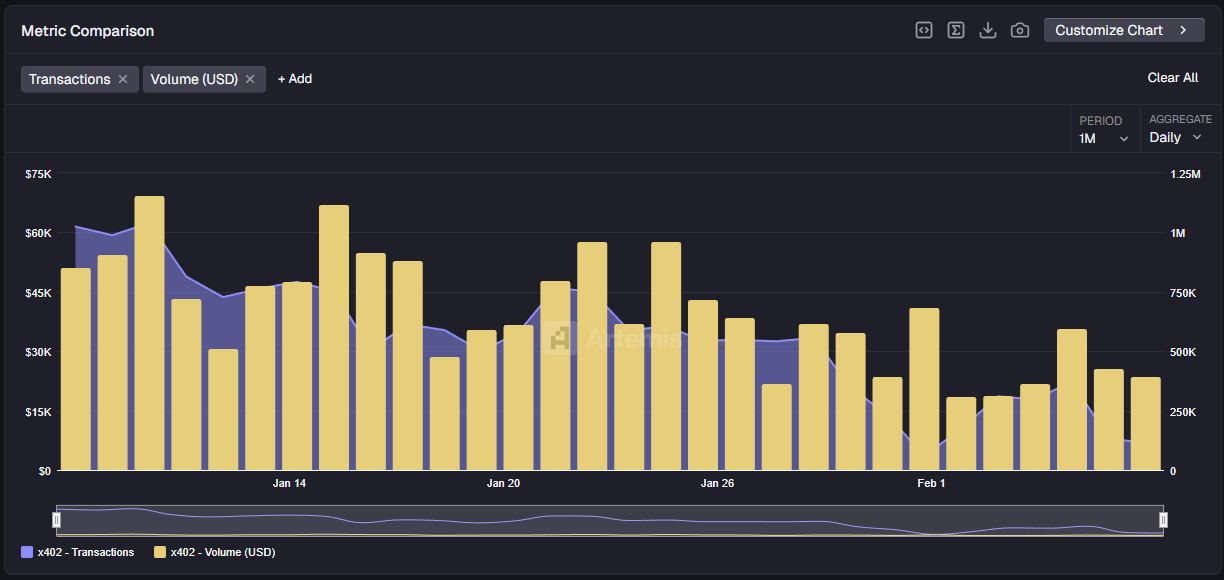
Interestingly, x402 transactions are averaging ~200k per day over the past seven days, down from last weeks ~400k per day average:
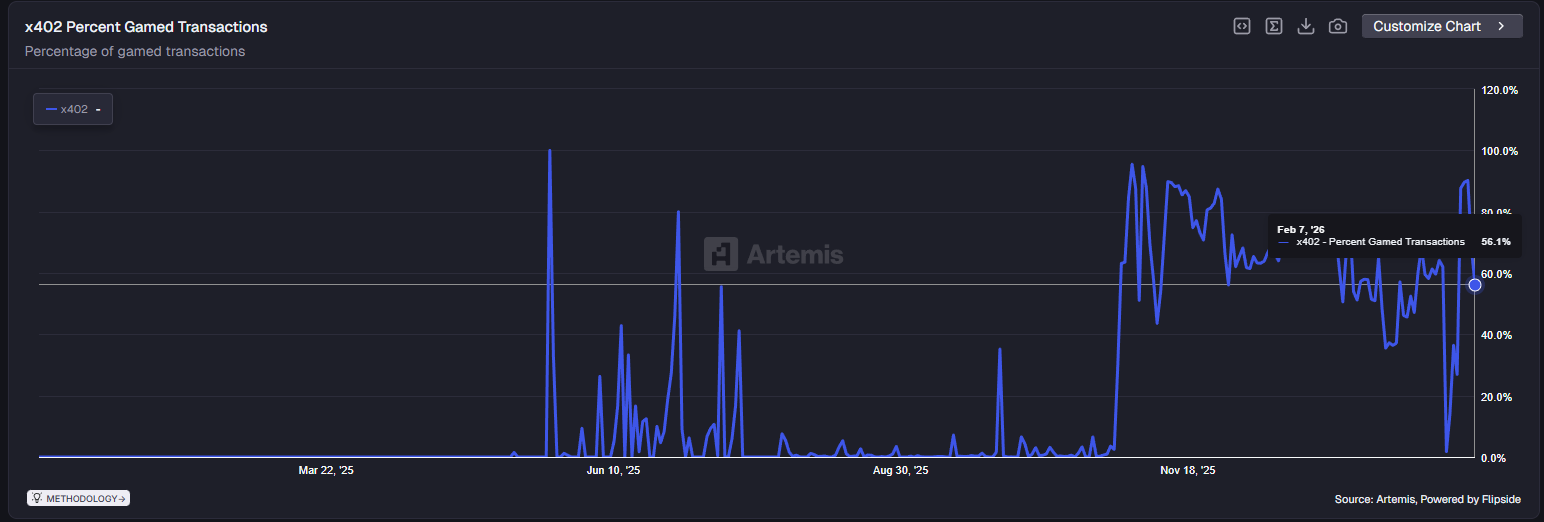
This week's activity appears significantly less genuine. Artemis data shows artificial transactions have reached 56.1%, likely as new openClaw protocols are still attempting to inflate their metrics to stand out in a crowded field:
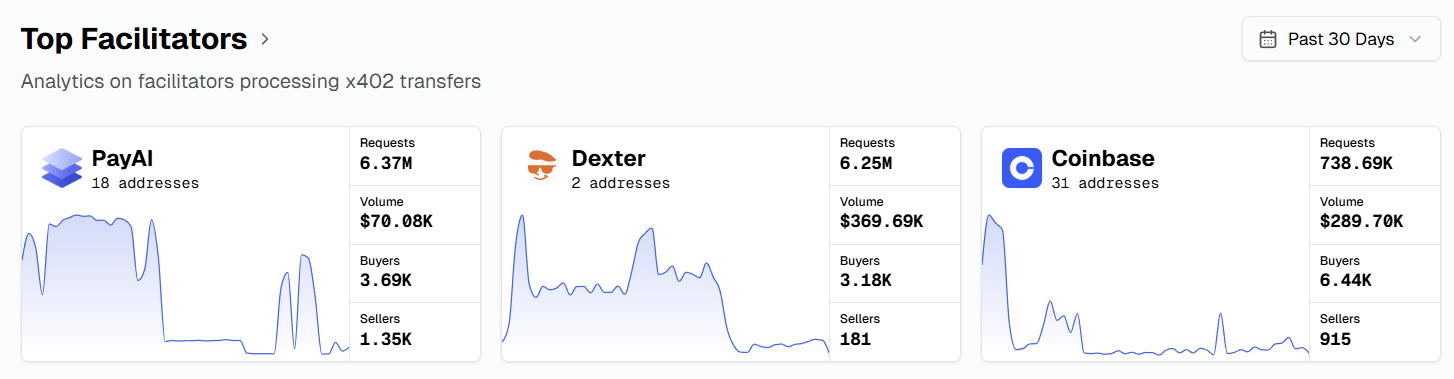
Coinbase, PayAI, and Dexter retain the top three facilitator spots, though PayAI’s 30-day requests fell to 6.37m from 8.39m last week:
Could we see something else drop in the next 24 hours to further put them in the lead:

3. AI Agents Developments: Innovations and Market Developments
Here is a full overview on Crypto AI related developments this week:
i) OpenClaw Update Feb 8th:

ii) AI Roundup Feb 9th:

iii) OpenClaw Update Feb 10th:

That’s a wrap for issue 163 of Sammy’s Snippets. I hope you enjoyed it.
Please leave me any questions or thoughts here - I will respond to everyone!
If you found this interesting, please consider subscribing to this Substack and following me on X for more related insights.
If you are interested in more formal reporting on Crypto AI and Robotics then Khala is my research product.