


This Crypto AI & Robotics newsletter consists of three parts:
Snippet Partner (GEODNET)
Crypto AI & Robotics Market Overview
Emerging Developments
If you have any questions feel free to reach out to me on X or message my business X account ‘Khala Research’


GEODNET is building the precision backbone for the physical AI economy.
While most drones still “drop parcels and hope,” autonomous systems actually need centimeter-level accuracy to operate safely.
That’s what GEODNET delivers: decentralized Real-Time Kinematic (RTK) positioning for robots, drones, autonomous vehicles, construction, and agriculture.
And this isn’t theoretical infrastructure. It’s live and monetizing.
• 21,000+ active satellite reference stations
• Coverage across 155 countries
• $8M ARR from real-world RTK data demand
• 80% of network revenue used for $GEOD buybacks
GEODNET replaces the legacy RTK subscription model, expensive hardware, annual lock-ins, feature paywalls, with a decentralized, globally distributed network that’s cheaper, scalable, and production-ready.
This week, the team doubled down on commercial traction at GeoWeek alongside Spexi, highlighting how imagery plus precision unlocks real enterprise workflows. Construction. Surveying. Agriculture. Drone logistics. These are industries where centimeters directly impact profitability.


The network effect is simple:
More stations → better coverage → more customers → more revenue.
As autonomous systems scale, precision becomes non-negotiable. GEODNET sits at the intersection of DePIN, robotics, and AI, and it’s already generating real revenue while doing it.
Learn more about GEODNET’s RTK network, explore how to operate a station, or access high-precision RTK data for your applications here.
This newsletter goes out weekly to 7k+ subscribers.
Please don’t hesitate to message me directly for sponsorship or partnership enquiries.

AI Roundup
Decentralized AI (“DeAI”) mindshare is currently at 42.38% (+4.5% on the week):
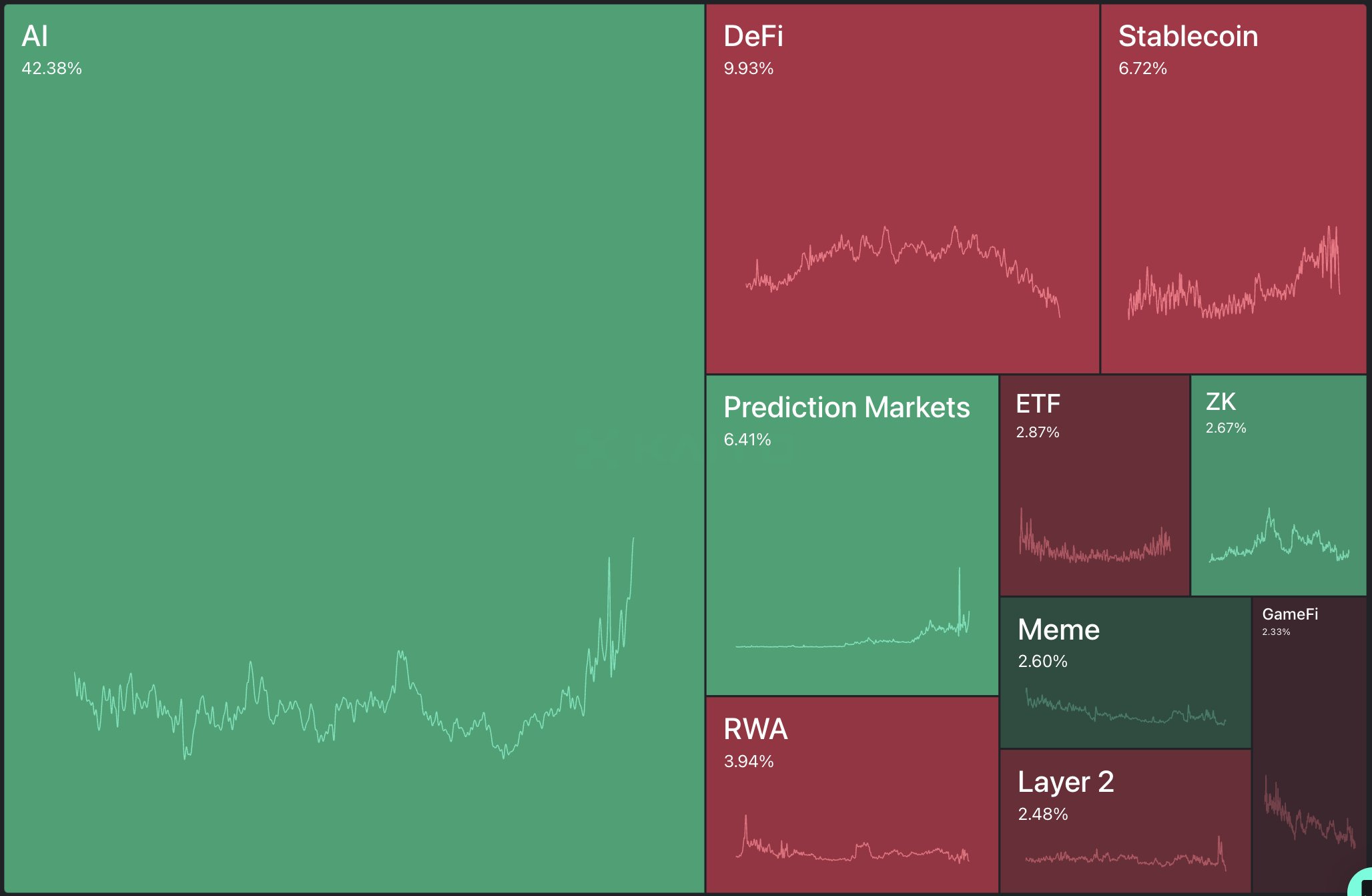
The mindshare spike is driven by continued attention around openClaw as it’s acquired by OpenAI, with the caveat of remaining open source (for now)
Could we be on the precipice of the “Autonomous Software Factory”?
Autonomous Software Factories
Coding productivity data metrics are going vertical; new websites, iOS apps, GitHub commits across US and UK all hockey-sticking at once:


Developers are building for OpenClaw faster than any other operating systems, ever. Faster than iOS. Faster than Facebook. Faster than the early internet.
Now, the caveat is obvious: OpenClaw launched with OpenAI’s existing distribution. iOS started from zero. OpenClaw started from millions.
But distribution explains the starting line. It doesn’t explain 5,000+ apps in 60 days. That’s not a developer community rallying around a new platform. That’s agents writing software for other agents:

As supply of software goes parabolic, choice could become too much. Maybe the short term sell off in software companies is an over reaction, at least until they pivot or accept the fate of many tech incumbents before them.
Adapt or Die: SaaS
Fiverr ($14.34) is down 95.6% from its all time high, with the largest decline as ChatGPT came to market in 2022. A marketplace built entirely on humans doing the work that agents now do overnight:
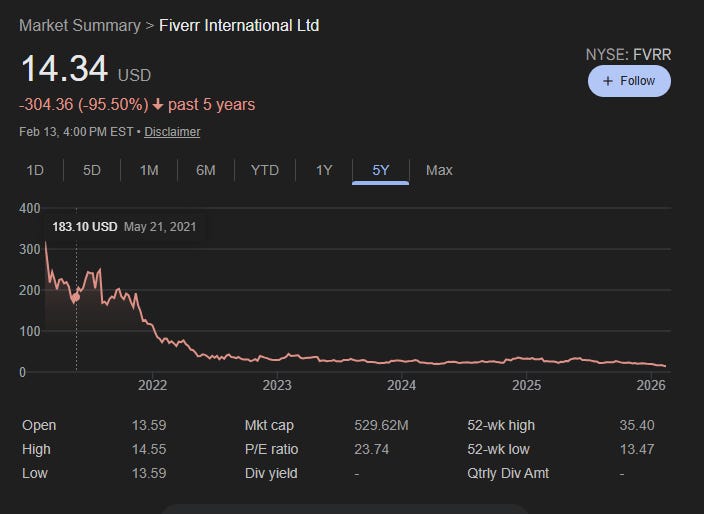
Here’s where it gets interesting for us, or at least those who embrace the AI tooling that is saturating the market, with new innovations evolving daily
“AI bifurcation” is the term of using AI or getting left behind, or the “K shaped Economy”:


While this is likely true, there are other layers that need to be considered, and this is where crypto comes into play; AI agents are becoming economic actors. They need:
Wallets and identity standards like ERC-8004 to prove they’re not spam
x402 payment rails to transact with each other
Compute subnets to exist at all
Every one of those layers has a token and each accrues value as agent activity scales.
You can’t buy equity in OpenAI’s payment processor.
You can’t stake into Google’s agent identity layer.
But you can hold the tokens that govern these rails. You can earn yield from the networks agents settle on. You can stake into the subnets they rent compute from.
The top of the K-curve will be the people collecting fees every time an agent moves capital, proves identity, or executes a transaction; the next gold rush will be figuring out where the value accrues in the future agentic economy.
Crypto looks to be an obvious value accrual mechanism to enable average people access to these opportunities without having to leverage nepotism to get access to the latest private round of openAI or Figure AI.
Mark Cuban put it bluntly on TBPN this week:
"Software is dead because everything's gonna be customized to your unique utilization. Who's gonna do it for them... And there are 33 million companies in the US."

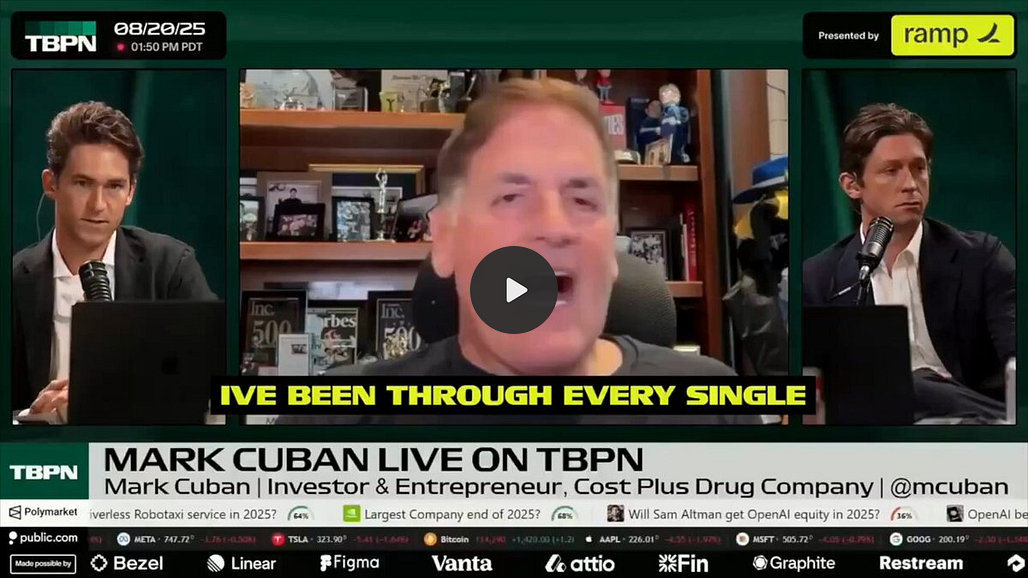
Cuban says to pick a vertical, and become the AI team that SMBs never hired.
You don’t need a degree; all you need is Claude Opus 4.6 or ChatGPT 5.3/Codex and you’re equipped with the tooling to jump ahead of 99% of the population.
But what Cuban’s describing from a labor perspective, crypto is enabling from an infrastructure perspective. The agents are going to need permissionless finance rails.
But here’s the tension nobody’s solving fast enough.
Autonomous Spam Factories
The same infrastructure powering autonomous software factories is also powering autonomous spam factories.
Nikita Bier dropped this prediction and it hit 9M+ views in days:

This is the part that should matter most to this audience: when every channel gets flooded with AI-generated noise, how do you filter signal from spam?
Crypto’s answer is emerging.
Davide Crapis and Vitalik co-authored “ZK API Usage Credits”, the proposal is elegant: replace identity-based API access with stake-based access:
Deposit once.
Make thousands of API calls.
Stay anonymous but If you abuse it, your stake gets slashed


When everything can be generated at near-zero cost, cryptographic proof of stake becomes the only spam filter that actually scales.
This is the exact same thesis that underpins ERC-8004 for agent identity, the x402 payment standard, and the entire agentic commerce stack we’ve been covering for months. The difference is that this week, Vitalik put his name on it.
The pattern is clear: agents are producing software faster than any human team ever could. But the platforms they operate on weren’t built to handle them.
The next phase will be won by whoever solves authentication, reputation, and identity at the speed agents operate.
The autonomous software factory is live. The only question left is who builds the trust layer on top of it, and whether you own a piece of those rails before the rest of the market figures out they need them.
A) DeAI Market Cap
The overall DeAI market cap has increased by $1.2bn (+9.3%) to $14bn this week:
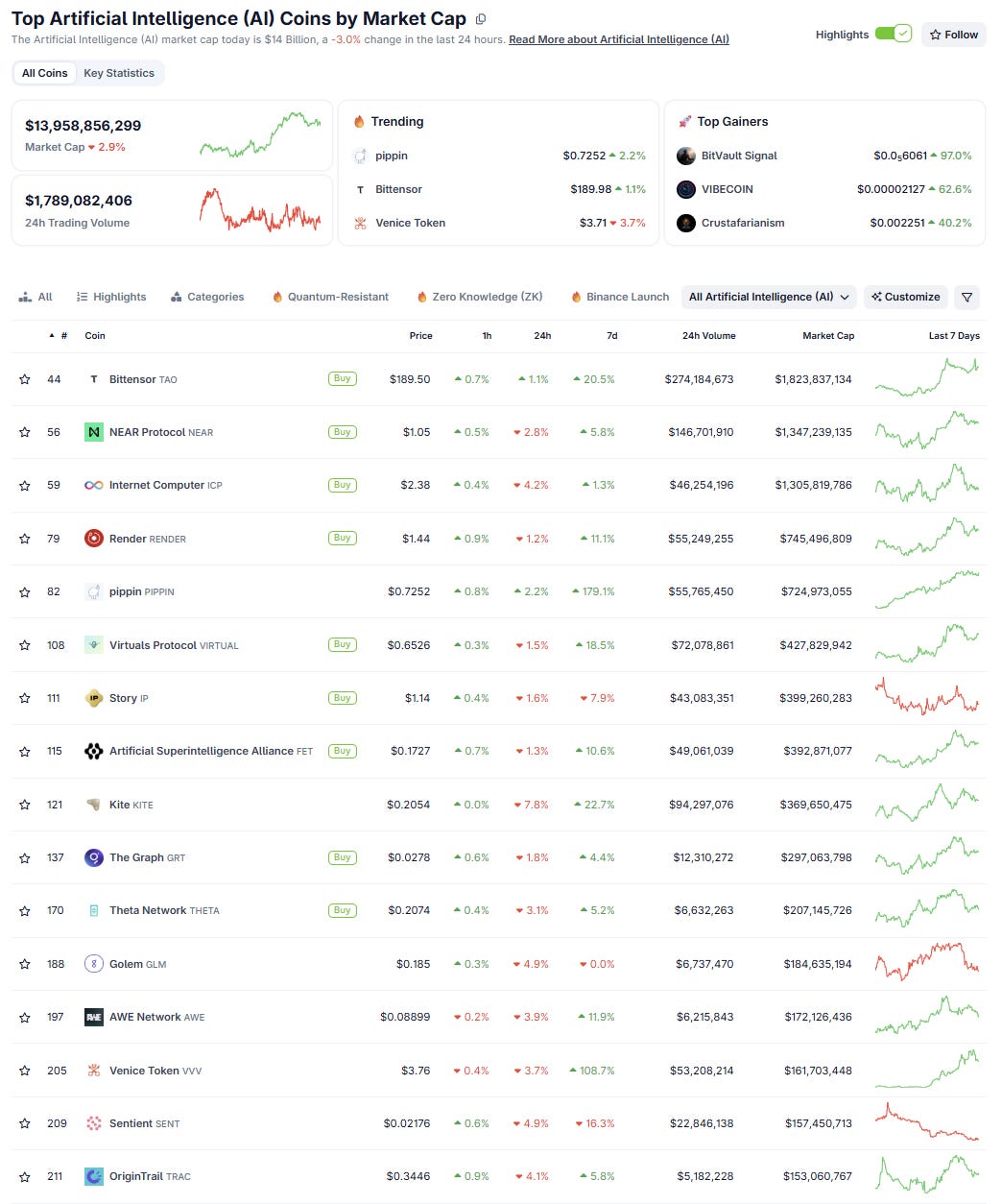
Channeling price action here is correlated to the majors with Bitcoin having a ~1% week-over-week move currently at $69,324 in comparison to last weeks, $70,710
While the market stayed stagnant, here is what happened in the sector:
KITE (+22.7%): Kite surpasses $2B FDV amid back-to-back conference appearances at ETHDenver and GWDC Hong Kong.


PIPPIN (+179.1%): This one is a doozy, while there is unusual chart action on $PIPPIN, it is not showing up on the net smart flows or net flows which suggests a likely chance of price manipulation
 Tradinator@Tradinator33$pippin chart is actually insane. And barely anyone on my TL is even mentioning it. Is this gonna go to $1B while everyone’s distracted?
 10:12 PM · Feb 16, 2026 · 7.43K Views14 Replies · 15 Reposts · 79 Likes
NEAR (+5.8%): NEAR unveils Ironclaw, a security-first fork of OpenClaw.
 Illia (root.near) (🇺🇦, ⋈)@ilblackdragonPeople are loosing their funds and credentials using @openclaw. A number of people have stopped using it as afraid it will leak all of their information. We started working on security-focused version - IronClaw. It's Rust-based, all tools run in isolated WASM environment.7:10 PM · Feb 9, 2026 · 97.4K Views104 Replies · 84 Reposts · 650 Likes
VIRTUALS (+18.5%): Virtuals rolls out agdp.io, committing up to $1M monthly to fund autonomous agents-for-hire.


B) Robotics Market Cap
The robotics market cap increased by $63m (+10.7%) to $650 million this week
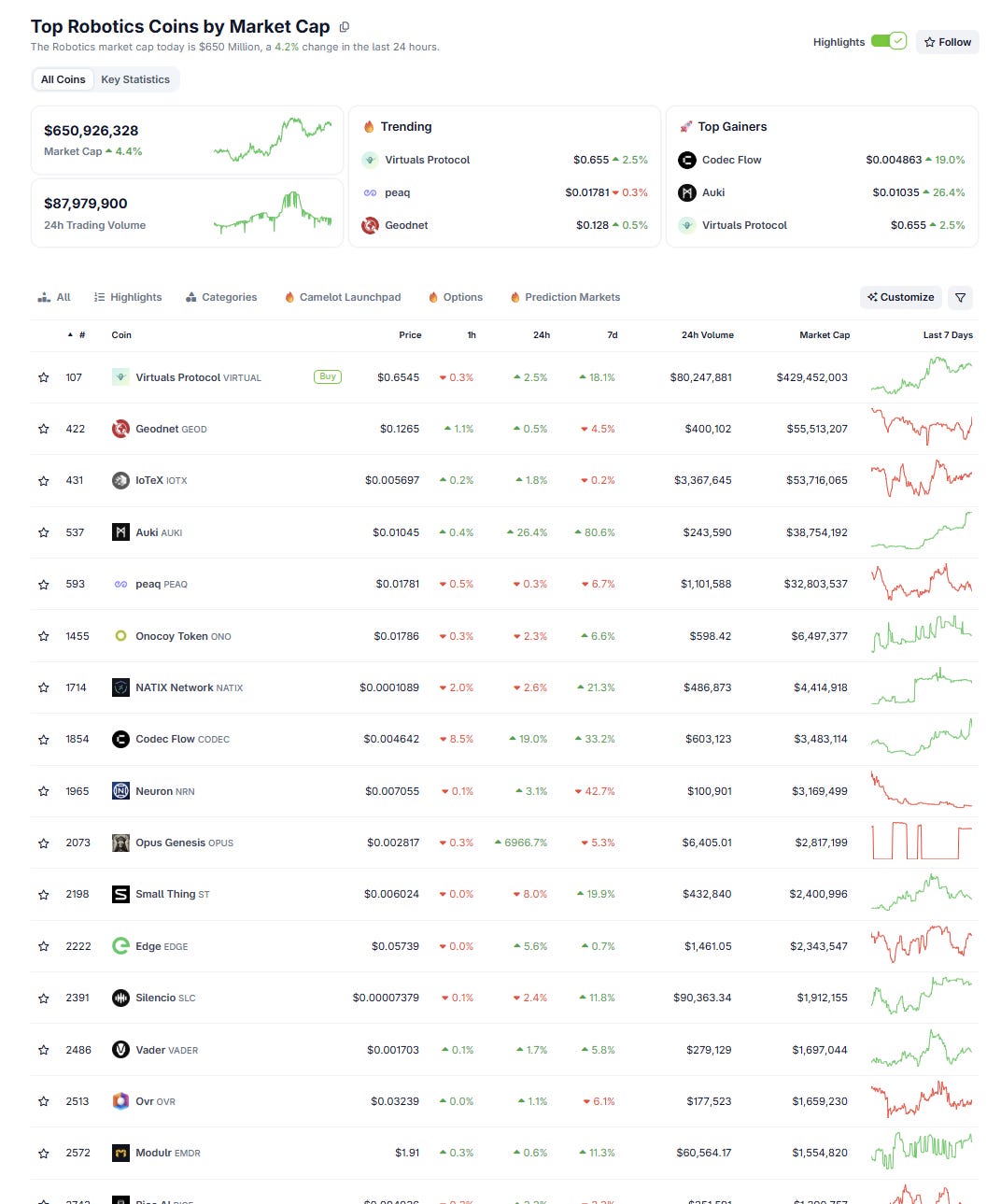
Here is what happened in this sector last week:
GEODNET Info (-4.5%): Updates their GEO-Measure mobile app

IOTEX (-0.2%): Maps out their worldwide statistics

AUKI (+80.6%): Auki spikes 80% week-over-week after reinforcing its robots-as-infrastructure thesis and teasing scaled real-world deployments
 Auki@AukiAuki Community Update Feb 14 https://t.co/39F9ZIIqiv4:48 PM · Feb 14, 2026 · 3.73K Views3 Replies · 14 Reposts · 69 Likes

2. Crypto AI Agent Analysis
a) Nansen Smart Capital Flow Analysis

This week’s smart capital inflows were led by just $VIRTUALS likely benefitting from their “Agent-for-hire” program that lets your AI agents get paid.
b) Agentic Commerce (x402)
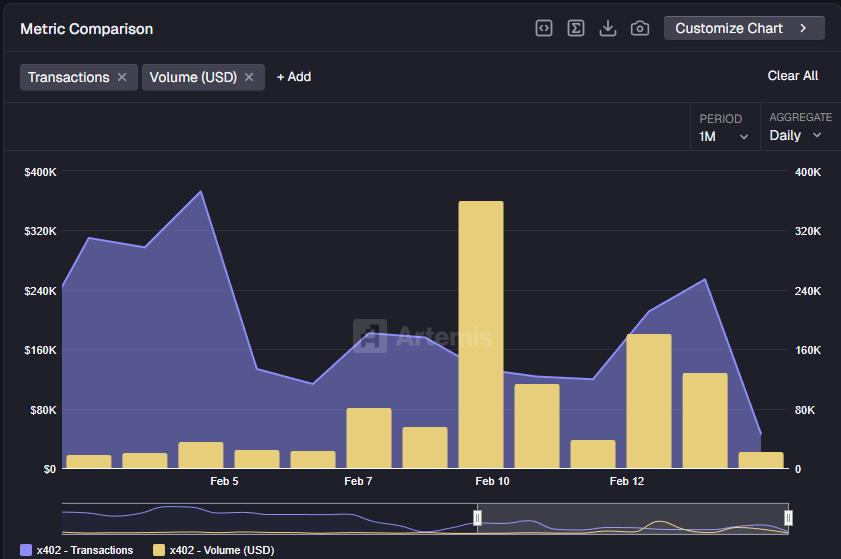
Interestingly, x402 transactions are averaging ~185k per day over the past seven days, down from last weeks ~200k per day average:
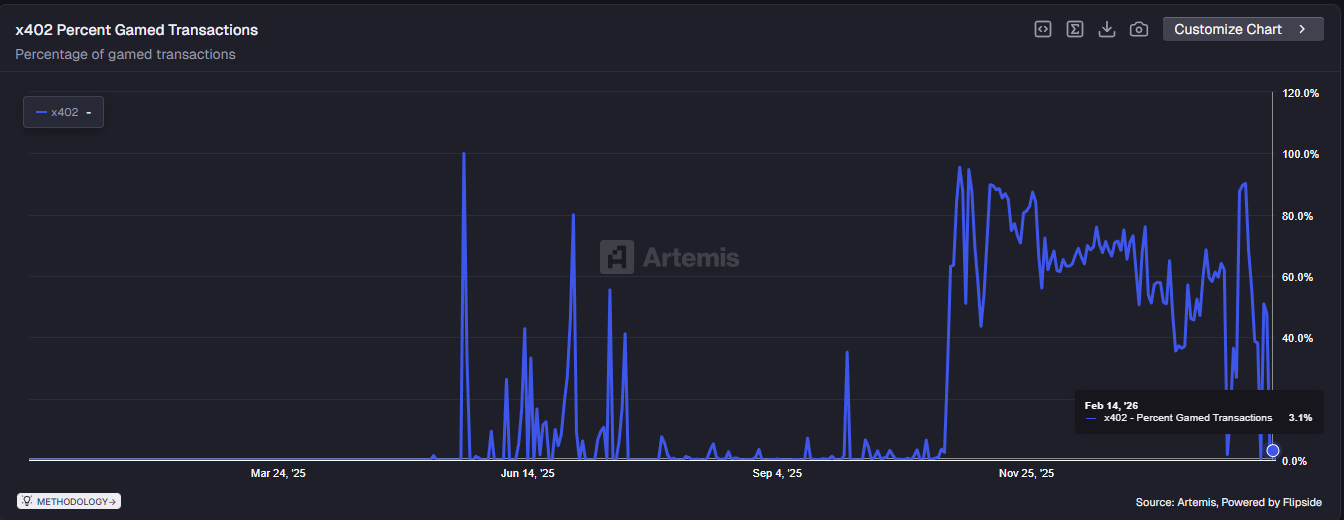
This weeks activity is a steep dropdown to reality with percent gamed transactions being 3.1% compared to last weeks 56.1% of gamed transactions. Reasoning may be because OpenClaw protocols are now more set in stone compared to the last 7 days.
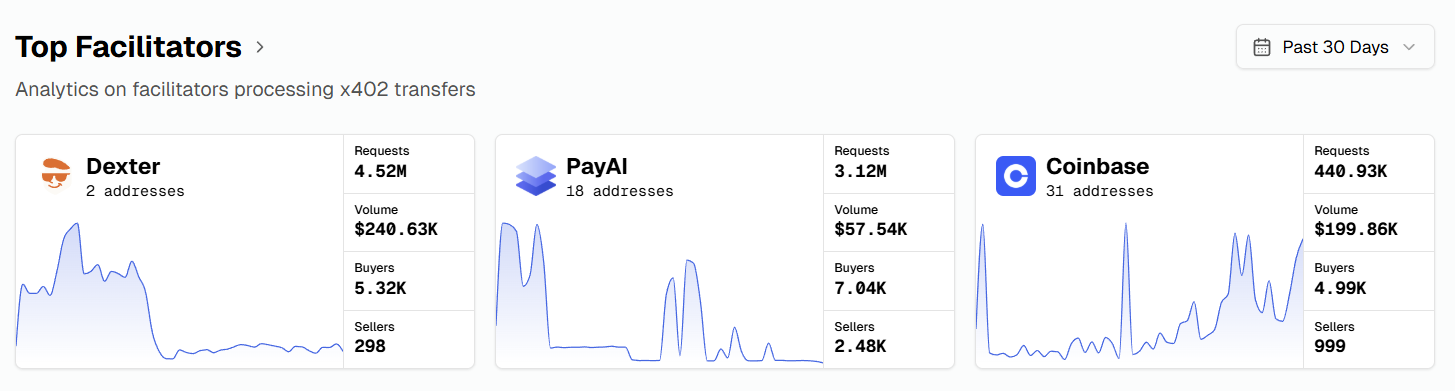
Dexter completely flips PayAI for the top spot in faclitators processing x402 transfers, though Dexter’s 30-day requests fell to 4.52m from 6.25m last week:
3. AI Agents Developments: Innovations and Market Developments
Here is what happened on Crypto AI related developments this week:
i) OpenClaw Update Feb 16th:


OpenClaw roundup: Feb 13th
ii) AI Roundup Feb 17th:

That’s a wrap for issue 164 of Sammy’s Snippets. I hope you enjoyed it.
Please leave me any questions or thoughts here - I will respond to everyone!
If you found this interesting, please consider subscribing to this Substack and following me on X for more related insights.
If you are interested in more formal reporting on Crypto AI and Robotics then Khala is my research product.
Disclaimer: The content covered in this newsletter is not to be considered investment or financial advice. It is for informational and educational purposes only.
Disclosure: I hold some of the assets and have partnerships with some of the projects mentioned in this newsletter.
Thanks. Saves me a ton of time.