


This Crypto AI & Robotics newsletter consists of three parts:
Snippet Partner (Nunet)
Crypto AI & Robotics Market Overview
Emerging Developments
If you have any questions feel free to reach out to me on X or message my business X account ‘Khala Research’


NuNet is a peer-to-peer protocol for discovering, orchestrating, and settling compute across distributed infrastructure
Think of it as the “Limewire for Compute”
Where most projects in the decentralized compute space are GPU marketplaces or cloud wrappers, NuNet built a complete orchestration and coordination layer from first principles over four and a half years of R&D
On March 2, 2026, NuNet launched Network Live: a production decentralized compute network where software finds compute autonomously across any device from edge to cloud, every machine carries a cryptographic identity verified at every interaction, and orchestration and value exchange are unified in a single system
This is live infrastructure with real AI workloads running on it today:
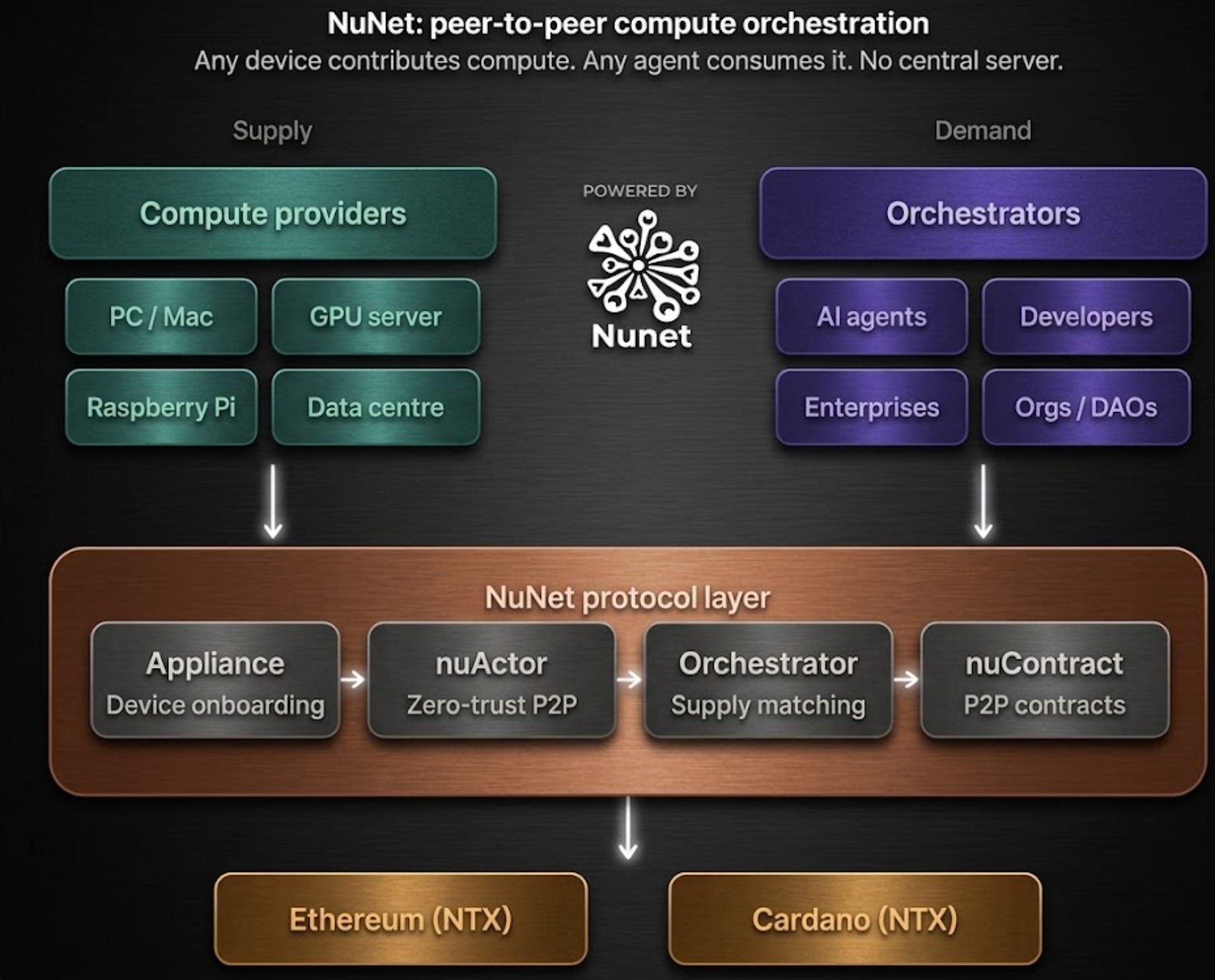
What has been shipped with Network Live:
Multi-chain settlement: NTX transactions flow natively on both Ethereum and Cardano. Compute providers select their preferred chain when entering contracts. No bridges or wrapped tokens
Open provider access: The NuNet Appliance runs on a PC, dedicated server, Raspberry Pi, cloud instance, or data centre hardware. If a machine has compute to contribute, it can be onboarded
Real AI deployments already running: Private AI agents via OpenClaw with Qwen and Ollama (fully private, no cloud APIs), one-click LLM deployment with Hermes Agent on consumer GPUs (RTX 3060 running Google’s Gemma 4 26B), workflow automation via n8n, and ASI:Chain validator node deployment
NuNet has active partnerships across six verticals:
smart infrastructure (paid innovation contract with AL’MA Action Logement covering 1M+ homes),
edge AI and DePIN (Auki Labs/Posemesh PoC delivered),
robotics (Intercognitive Foundation founding member),
private agentic AI,
Web3 compute (10 Cardano SPO partnerships), and
sovereign compute.
NuNet is a member of the Linux Foundation. NTX is the utility token facilitating peer-to-peer compute settlement on the live network.
Learn more: NuNet Docs | Live Dashboard | Download the Appliance
This newsletter goes out weekly to 7.2k+ subscribers.
Please don’t hesitate to message me directly for sponsorship or partnership enquiries.

1. Crypto AI & Robotics Market Overview
The Covenant AI Exit: What Happened, What It Means
This is the section I would normally save for Emerging Developments, but the scale of this event warrants leading with it
On April 10, Covenant AI founder Sam Dare published a public statement announcing the immediate withdrawal of all three Covenant subnets from Bittensor: Templar (SN3), Basilica (SN39), and Grail (SN81).

The same team that trained Covenant-72B, the 72-billion-parameter model across 70+ contributors on commodity hardware that triggered TAO’s 90% March rally, Jensen Huang’s public endorsement, and the Grayscale ETF filing momentum.


Dare accused Bittensor co-founder Jacob Steeves (Const) of maintaining centralized control over what is marketed as a decentralized network
The specific allegations include:
suspension of emissions to Covenant’s subnets,
stripping moderation access over Covenant’s own community channels,
unilateral deprecation of subnet infrastructure, and;
strategically timed token sales used as economic pressure
But Const has responded to all allegations and highlighted that this will strengthen the network in the long term:


Dare simultaneously sold 37,000 TAO (approximately $11M) across the three subnets, intensifying the selloff.


The Tao Papers
On the same day, a whistleblower site called Tao Papers went live, publishing internal documents, chat transcripts, and on-chain forensics from multiple sources inside the Bittensor ecosystem.
The most damaging claim: of 41 Bittensor network upgrades between 2023 and 2026, 38 were proposed, first-signed, and deployed from infrastructure controlled by Steeves, with the other two multisig signers co-signing within minutes and without public discussion
This directly challenges the “triumvirate” governance narrative Bittensor has promoted to institutional allocators
Steeves’ Response
Steeves responded publicly, denying the ability to suspend subnet emissions and stating that his token sales amounted to less than 1% of his total investment in Covenant-related subnets
On Discord moderation, he claimed Dare himself deprecated his own channels and that moderation access was temporarily restricted because Dare was removing genuine criticism, then restored
On infrastructure deprecation, Steeves stated he was unsure what the allegation referred to
My Take: The Bittensor ecosystem lost a team with misaligned interests.
Covenant trained a 72B parameter model using Bittensor emissions and network compute, built the narrative that repriced TAO from $180 to $380, and then walked away with 8 figures in capital
The governance allegations are a sideshow to the structural problem: there is limited in the protocol today that prevents this from happening again
The biggest friction point to institutional adoption of the Bittensor subnet ecosystem is the misalignment between subnet founders and network stakeholders
Very few institutions will deploy serious capital into subnet alpha tokens until a tangible solution is in place
A founding team can farm emissions, build on network resources, extract value, and leave. The 37,000 TAO dump ($11M) is the cost the ecosystem paid for learning this lesson in production
TAO crashed 27% on the news, dropping from above $340 to $253. Over $9M in long positions were liquidated. There has been no meaningful recovery. As of writing, TAO sits at $253, still pinned near the lows
The Potential Solutions
I published a thread with 10 suggestions for how the protocol could address this:


TAO Institute Goes Live This Week
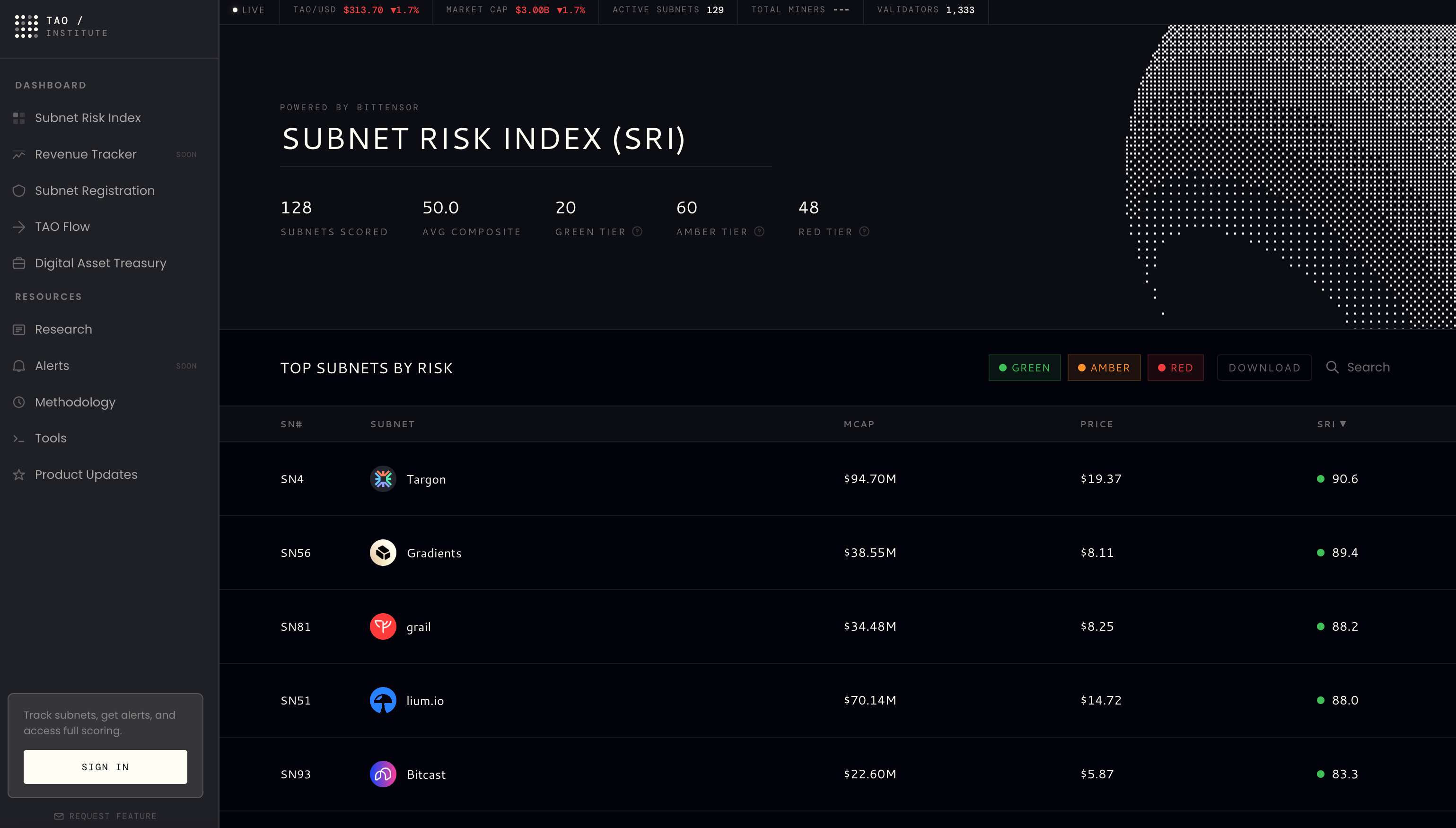
This brings me to TAO Institute. We are launching the Subnet Risk Index (SRI) this week; the first institutional-grade risk evaluation framework for Bittensor subnets

Pitfalls like the Covenant debacle illustrate the need for tooling that helps investors form decisions around associated subnet risks.
The SRI provides that lens. More details on launch day.
A) DeAI Market Cap Analysis
The overall DeAI market cap sits at $21.6B (+3.4% 24h):
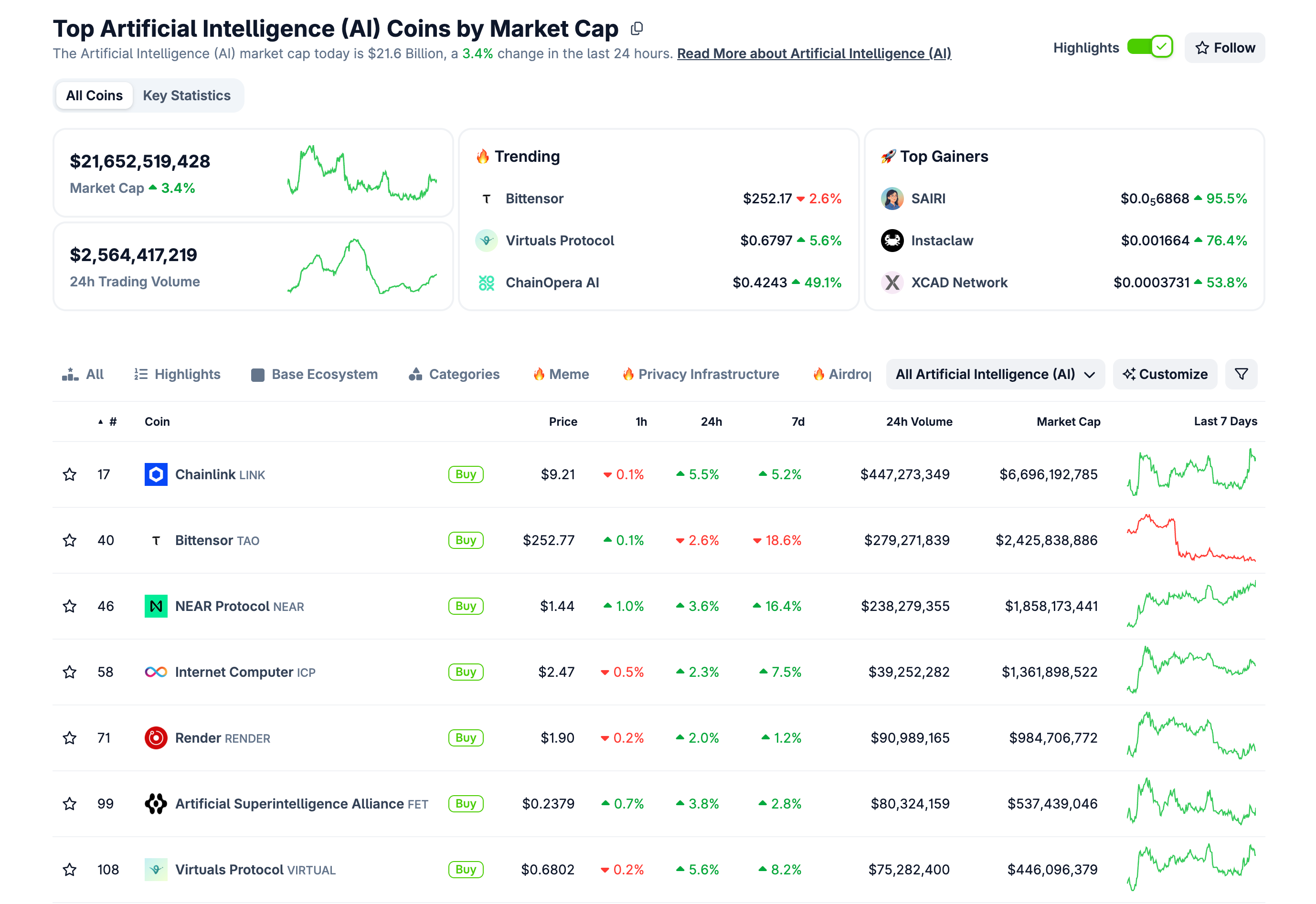
Bittensor is trending, though this time for the wrong reasons.
The broader AI category is showing resilience with a 3.4% 24h uptick, but the 7d picture tells a more nuanced story.
TAO (-18.6% 7d, $252.77, $2.43B mcap): The Covenant AI exit and simultaneous 37,000 TAO dump extracted roughly $10M from the ecosystem and cratered the price from $340+ to $253. No meaningful bounce. Over $9M in long liquidations. Covered in depth above.
The Grayscale ETF filing (GTAO on NYSE Arca) and 43% allocation within Grayscale’s DeAI Fund remain live catalysts, but governance risk now directly competes with the institutional narrative
NEAR (+16.4% 7d, $1.44, $1.86B mcap): The week’s best performer among large caps. Strong momentum with $238M in 24h volume suggesting real capital rotation rather than a low-liquidity drift; could this be AI capital rotating from TAO?
RENDER (+1.2% 7d, $1.90, $984.71M mcap): Holding steady. RenderCon 2026 momentum continues but the token is treading water relative to the broader sector’s bounce
VIRTUAL (+8.2% 7d, $0.6802, $446.10M mcap): Bouncing back after last week’s dip. Eastworld robotics positioning and ACP facilitator activity providing a bid. The x402 usage-based pricing shift from Coinbase could re-ignite interest given Virtuals ACP is one of the largest x402 facilitators
Bittensor Subnet Ecosystem
The Bittensor Subnets market cap has decreased to $1.03B (-1.8% 24h):
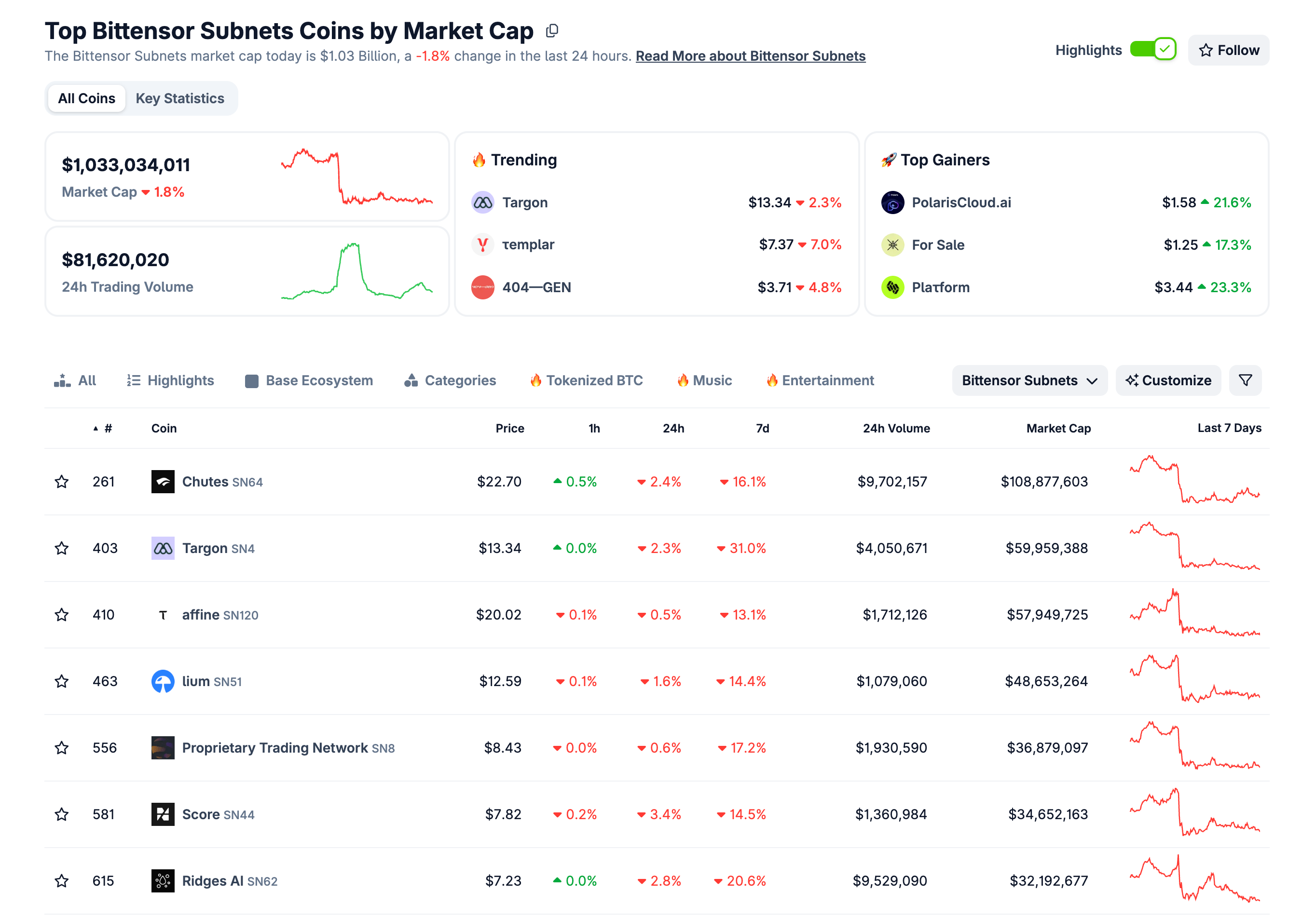
The subnet ecosystem has taken a significant hit. Total market cap down from $1.36B last week to $1.03B, a roughly 24% decline.
TLDR: The Covenant exit triggered a sector-wide repricing across the subnet ecosystem. The question now is whether this stabilizes as an isolated governance event or whether other subnet operators begin to echo Dare’s concerns.
The contagion effect has pulled essentially every subnet into the red on the week:
SN64 / Chutes remains the dominant subnet at $108.88M mcap ($22.70, -16.1% 7d). Down from $129M last week as the broader TAO selloff dragged it lower. OpenRouter default routing and approaching $10M ARR remain strong fundamentals + hints at training a trillion parameter model next week:

SN4 / Targon at $59.96M ($13.34, -31.0% 7d). The hardest hit major subnet, giving back the Intel partnership pump from two weeks ago
B) Robotics Market Cap Analysis
The Robotics market cap has increased to $674M (+4.4% 24h):
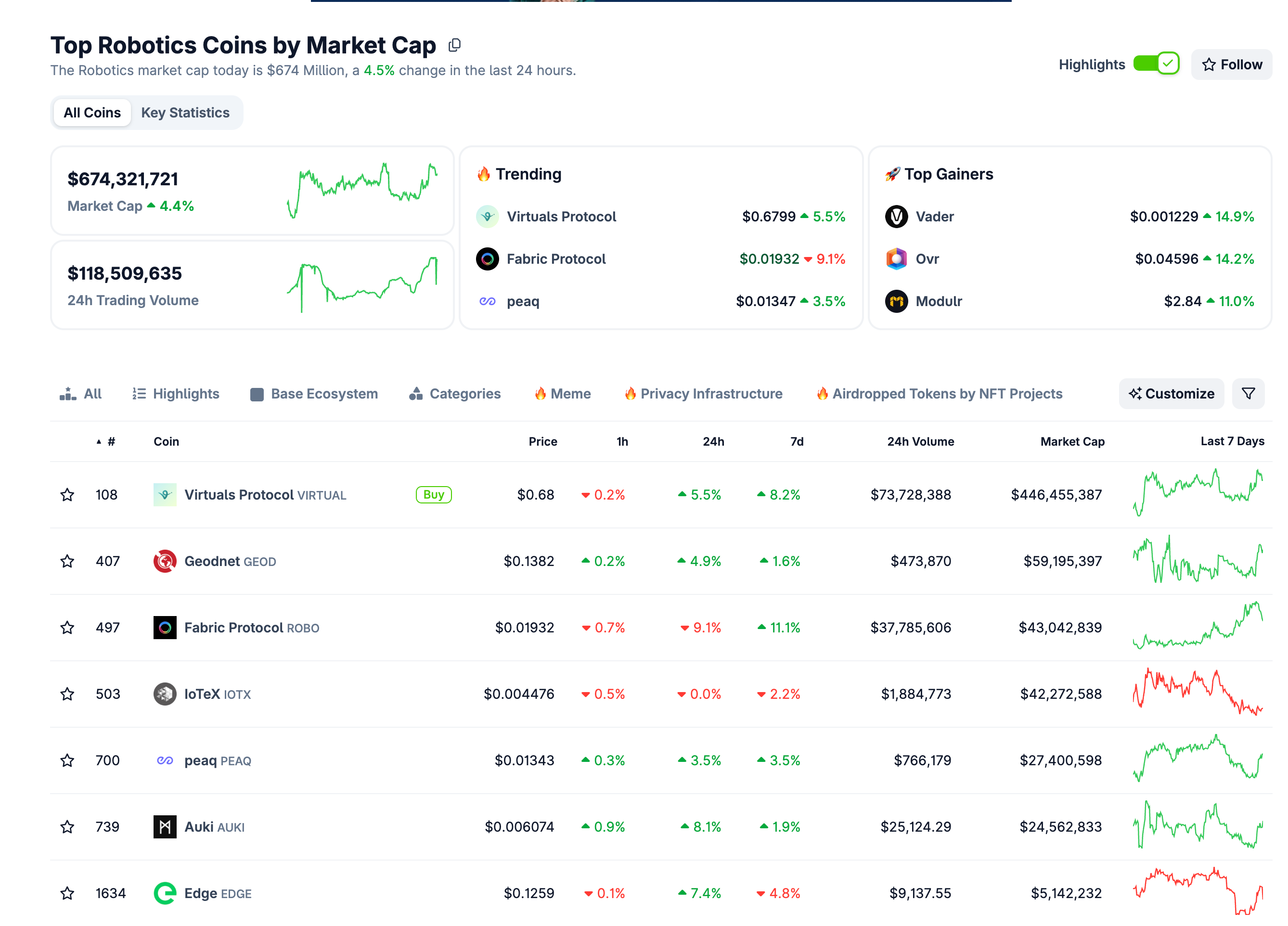
A recovery week for robotics after last week’s broad selloff. The category is up 4.4% and showing green across most assets, with the notable rally from Fabric Protocol
VIRTUAL (+8.2% 7d, $0.68, $446.46M mcap): Leading the robotics category recovery. Eastworld robotics positioning and ACP facilitator activity providing sustained interest
GEOD / Geodnet (+1.6% 7d, $0.1382, $59.20M mcap): Slight green on the week. Continues executing with 20,000+ stations across 150+ countries
ROBO / Fabric Protocol (+11.1% 7d, $0.01932, $43.04M mcap): Bouncing back after last week’s brutal -26.6% decline. Still down from recent highs but showing signs of a relief rally
IOTX / IoTeX (-2.2% 7d, $0.004476, $42.27M mcap): Slight red on the week
PEAQ (+3.5% 7d, $0.01343, $27.40M mcap): Recovering from last week’s -9.2% decline
AUKI (+1.9% 7d, $0.006074, $24.56M mcap): Also recovering after last week’s -19.8% drawdown
2. AI Token 7-Day Analysis
The 7D relative performance chart tells the story of the week in a single image. From April 7 through April 9, the top six AI large caps (LINK, TAO, NEAR, ICP, RENDER, FET) were clustered between 0% and +10%, moving in broad correlation
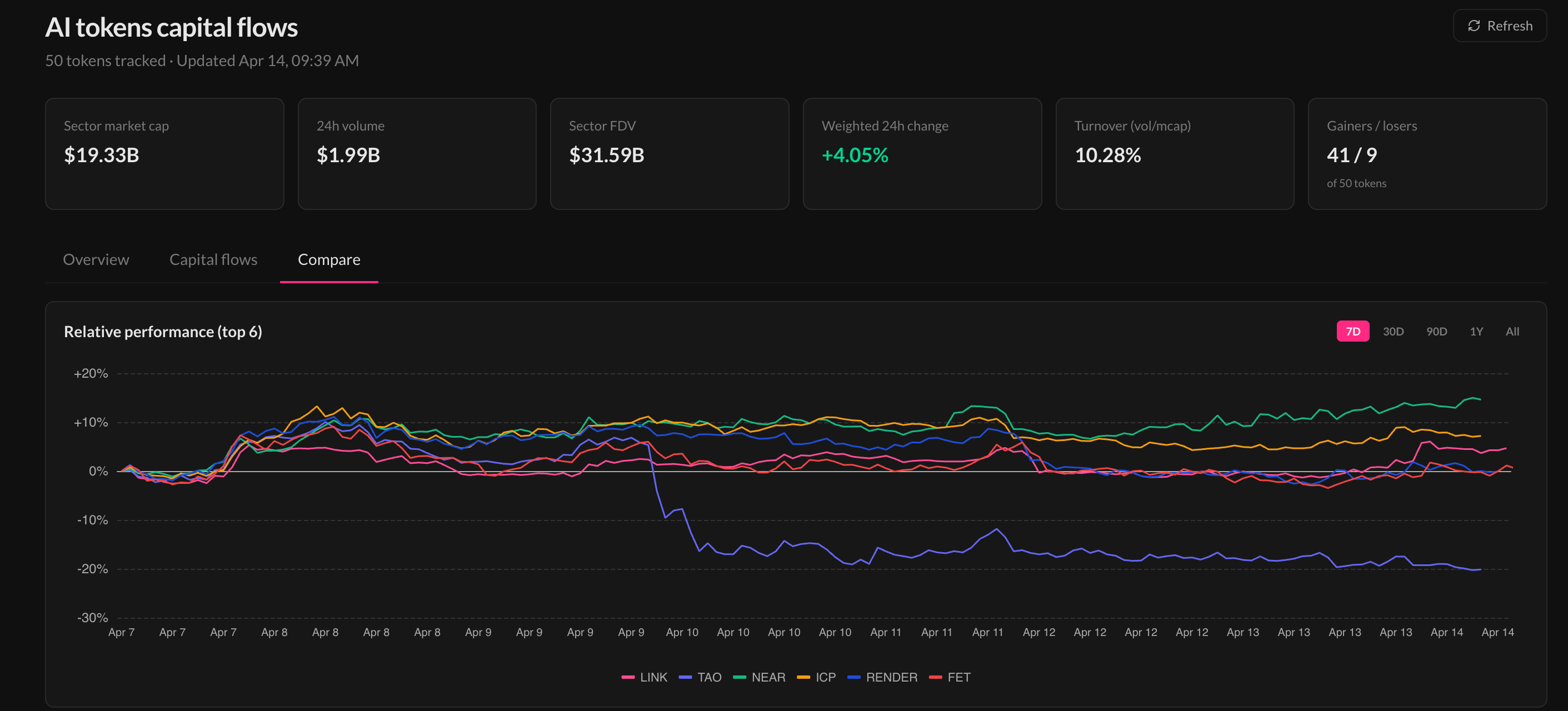
Then April 10 hits and TAO falls off a cliff, dropping to -20% while every other asset holds its range or continues higher. NEAR pushes to +10%, LINK and ICP remain flat-to-positive, RENDER and FET hold steady.
The divergence is entirely Covenant-driven; TAO decoupled from its peer group on a single catalyst: Sam Dare’s public exit statement, the 37,000 TAO dump, and the Tao Papers whistleblower site launching simultaneously. The rest of the AI sector barely registered the event
That isolation is both reassuring for the broader category (no contagion) and damning for TAO specifically (the market is treating this as a Bittensor-specific governance problem, not a DeAI narrative risk)
x402: The “Upto” Scheme and Why It Matters


The most significant x402 development this week: Coinbase Developer Platform shipped the Upto scheme, a new billing primitive that allows variable-cost settlement within a single HTTP request cycle.
Until now, x402 only supported exact, fixed-price payments
A client knew the price before making a request, paid it, and received the response. This works well for deterministic API calls with predictable costs, but it blocked an entire category of services where the cost depends on usage:
LLM inference (token count varies per prompt)
compute tasks (processing time varies by complexity), and;
data queries (result size unknown upfront)
Upto solves this by letting the client authorize a maximum spend per request
The server processes the work, determines the actual cost, and settles only what was consumed. Unused funds remain in the client’s wallet
The diagram in the screenshot illustrates this cleanly: client authorizes max, server settles exact use ($0.42 in this example), funds remain in wallet
Competition is Ramping Up (MPP vs x402)
This is a direct response to the scaling critique that Stripe’s Machine Payments Protocol (MPP) posed to x402
MPP, co-authored by Stripe and Tempo and launched on March 18, introduced “sessions” as its core primitive
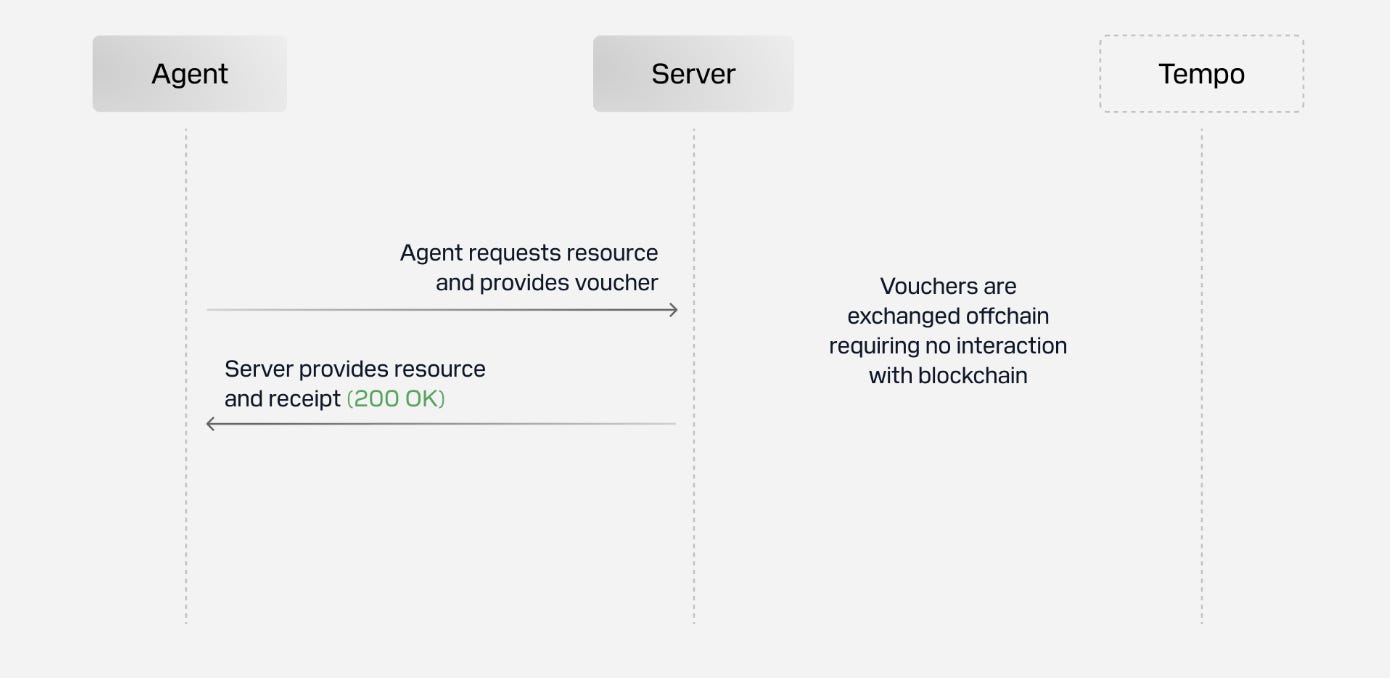
An agent pre-authorizes a spending limit once, then streams micropayments against that session continuously using lightweight off-chain vouchers, settling in bulk rather than per-request on-chain
For high-frequency scenarios (an agent querying a data feed thousands of times per hour), MPP’s session model avoids the gas overhead of per-request on-chain settlement that was a real constraint in x402’s original fixed-price design.
The Comparison:
Upto does not replicate MPP sessions. It remains a per-request model. But it closes the gap meaningfully for the most common agentic workload pattern today: one prompt, one response, variable cost
For LLM inference, where each call generates a different number of tokens and the cost is only known after completion, Upto removes the need to either overpay via a padded fixed price or open a full MPP session for a single request.
Our definitive institutional breakdown of x402 remains the most comprehensive resource available: Khala Research x402 Report
3. AI Agents Developments: Innovations and Market Developments
Here is what happened on crypto AI & robotics related developments this week:


That’s a wrap for issue 172 of Sammy’s Snippets. I hope you enjoyed it.
Please leave me any questions or thoughts here - I will respond to everyone!
If you found this interesting, please consider subscribing to this Substack and following me on X for more related insights.
If you are interested in more formal reporting on Crypto AI and Robotics then Khala is my research product.
Disclaimer: The content covered in this newsletter is not to be considered investment or financial advice. It is for informational and educational purposes only.
Disclosure: I hold some of the assets and have partnerships with some of the projects mentioned in this newsletter.
x402 shifting to usage-based pricing is a significant design decision that doesn't get enough standalone coverage. Moving from flat subscription pricing to per-request usage billing is exactly the right model for AI agent workloads because agent activity is inherently bursty and unpredictable. An agent might call a data API 3 times in one hour and 3,000 times the next. Traditional subscription tiers don't map well to that consumption pattern. Usage-based pricing via x402 also creates a natural align between the value delivered and the cost charged, which is the pricing model that scales cleanly as agent workflows get more complex. The Bittensor situation and the $900M wiped in hours is a separate but related data point: decentralized AI networks are highly sensitive to key operator departures, and the TAO Papers whistleblower launch suggests internal trust issues. The juxtaposition with x402 scaling is a useful reminder that infrastructure legitimacy and ecosystem trust are built together, not independently.