


This Crypto AI & Robotics newsletter consists of two key parts:
Snippet Partner: GEODNET (RTK positioning for robotics)
Theme of the Week: The Customer is No Longer Human
Landscape Analysis: DeFi Llama, MCPs, Hermes, Openserv, ReadyAI, Agent Socials / blogging
If you have any questions feel free to reach out to me on X or message my business X account ‘Khala Research’



This week’s issue is brought to you by GEODNET, the decentralised network supplying the positioning infrastructure underneath the robotics boom
Every autonomous machine, a delivery drone, a field robot, a self-driving tractor, needs to know where it is to within a centimetre:
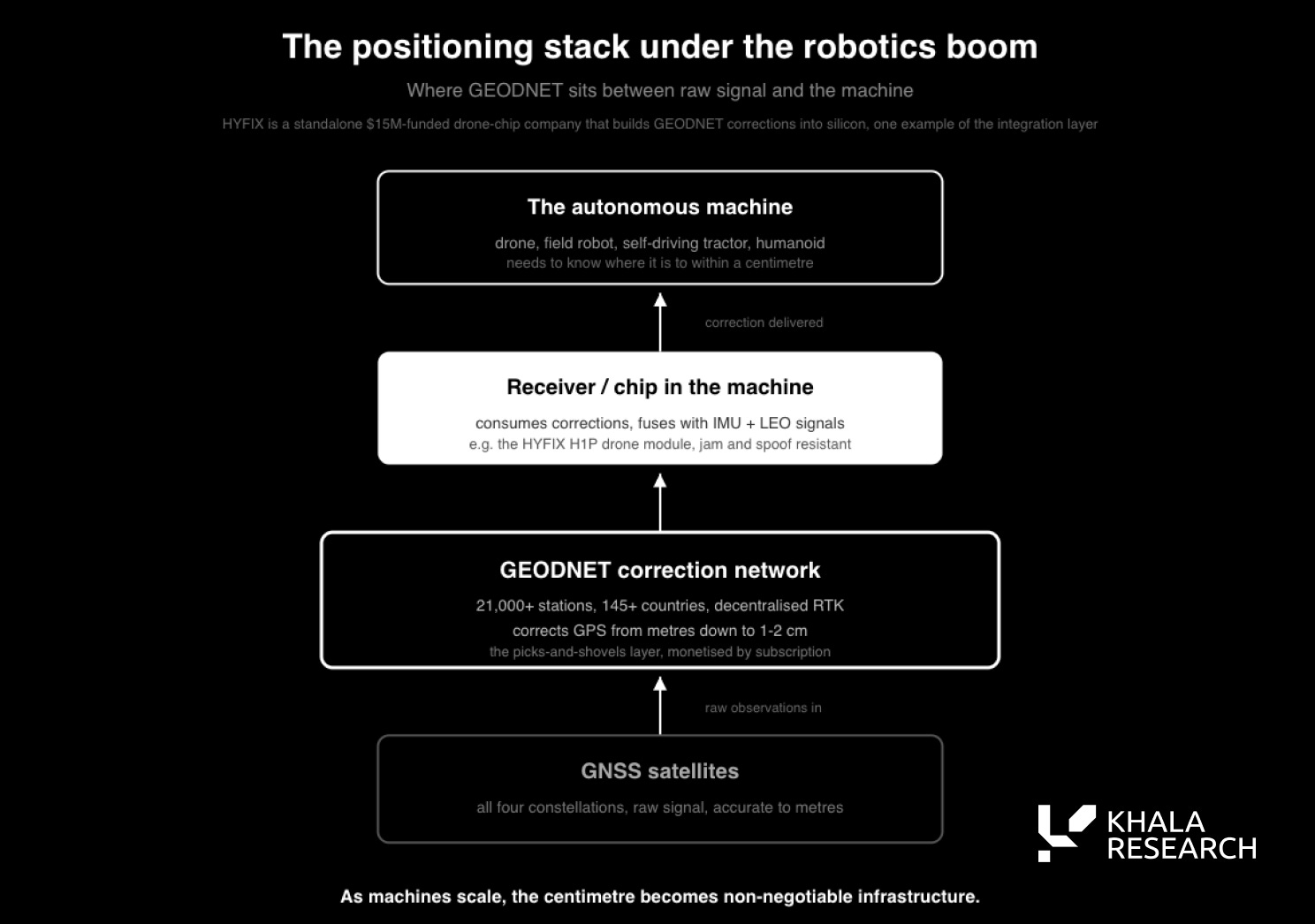
Standard GPS gets you to a few metres, which is useless when a robot is navigating a row of crops or a warehouse aisle. The fix is RTK (Real-Time Kinematic) correction, and it has historically meant expensive proprietary base stations with patchy coverage
GEODNET rebuilt that layer as a DePIN, which has led to the world’s largest decentralised RTK network, correcting standard GPS down to 1-2 centimetres
Scale: over 21,000 active satellite miner stations across 145+ countries, the largest RTK network globally
Each station is a physical GNSS receiver an operator mounts with a clear view of the sky, earning GEOD tokens for the correction data it contributes
The economics screen well for a DePIN with annualised revenue in the millions, 80% of data-sales revenue burned periodically
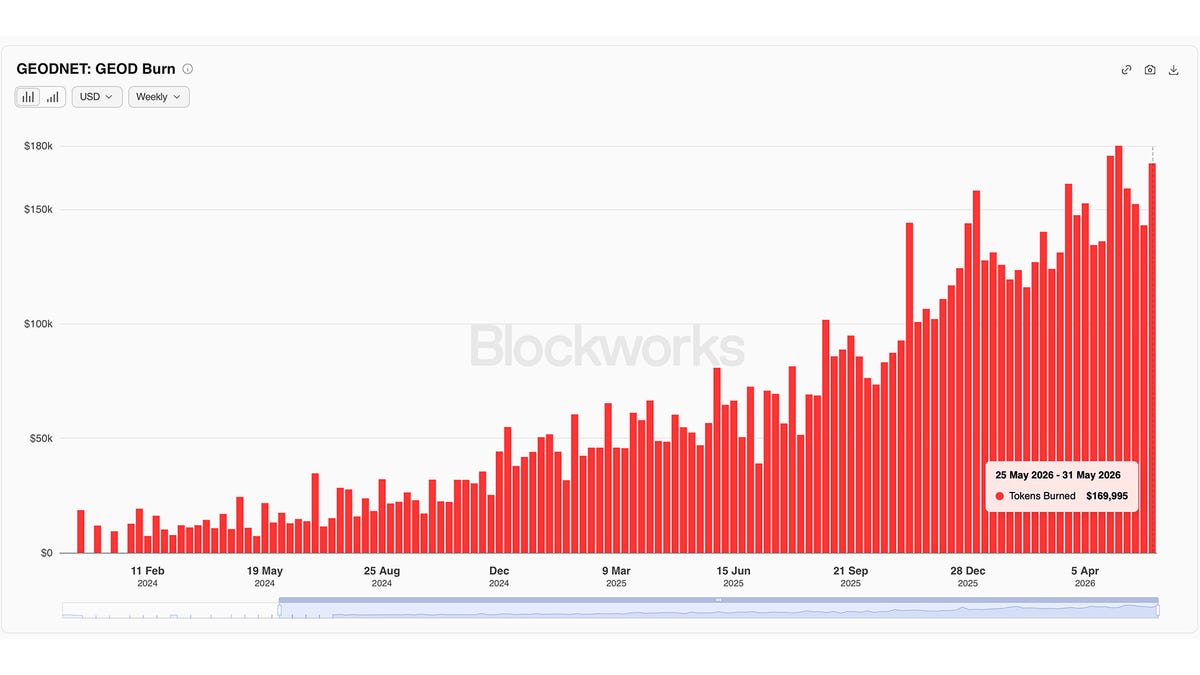
Why it matters for this audience: as humanoids and autonomous machines scale, precise positioning becomes non-negotiable infrastructure. GEODNET is the picks-and-shovels play on that demand, and it monetises real-world subscriptions today
Kyle Samani (formerly Multicoin Capital) provided a good overview of GEODNET’s value proposition at the All In Summit:

Explore the network and its hardware at geodnet.com
This newsletter goes out weekly to 7.2k+ subscribers.
Please don’t hesitate to message me directly for sponsorship or partnership enquiries.

On June 12, Blockworks acquired Messari; at first glance you may just be thinking its a consolidation of two crypto OGs, taking the best of both and dominate (by what feels like) a shrinking market:


But it undersells what’s actually going on… there’s a line in the announcement that matters more than the deal itself:
“an agent is only as good as the data it can reach and the API it can call”
Read that again; it’s the whole thesis of this newsletter.
The customer for data is shifting from people to agents, and the smart money is now building for a world where the things querying your data outnumber every human analyst on earth many times over.
So this week I want to walk through that shift:
What changes when you build for agents instead of people
why the Messari deal is the first big crypto move in that direction
who else is going after the same prize, and;
how any of this actually makes money.
2. The Customer is No Longer Human
For the entire history of financial data, the customer was a person:
A Bloomberg terminal is priced for a human at a desk
Messari research, Delphi reports, a Galaxy note: produced by analysts, consumed by analysts
Agents break this status quo; crypto is already structured and real-time, so production scales with data and models
This is the crypto-native version of the org-flattening point Nadella (CEO, Microsoft) and Dorsey (Block) have both made earlier this year:
Nadella at Davos called AI a complete inversion of how information moves through a company:

Dorsey’s March 31 essay with Roelof Botha argued hierarchy exists only to route information:

… which is the logic behind Block cutting roughly 40% of its workforce:
But the bigger change is on the buy side; an agent managing a position, screening a token or running diligence makes a call, pays for that call, and moves on:
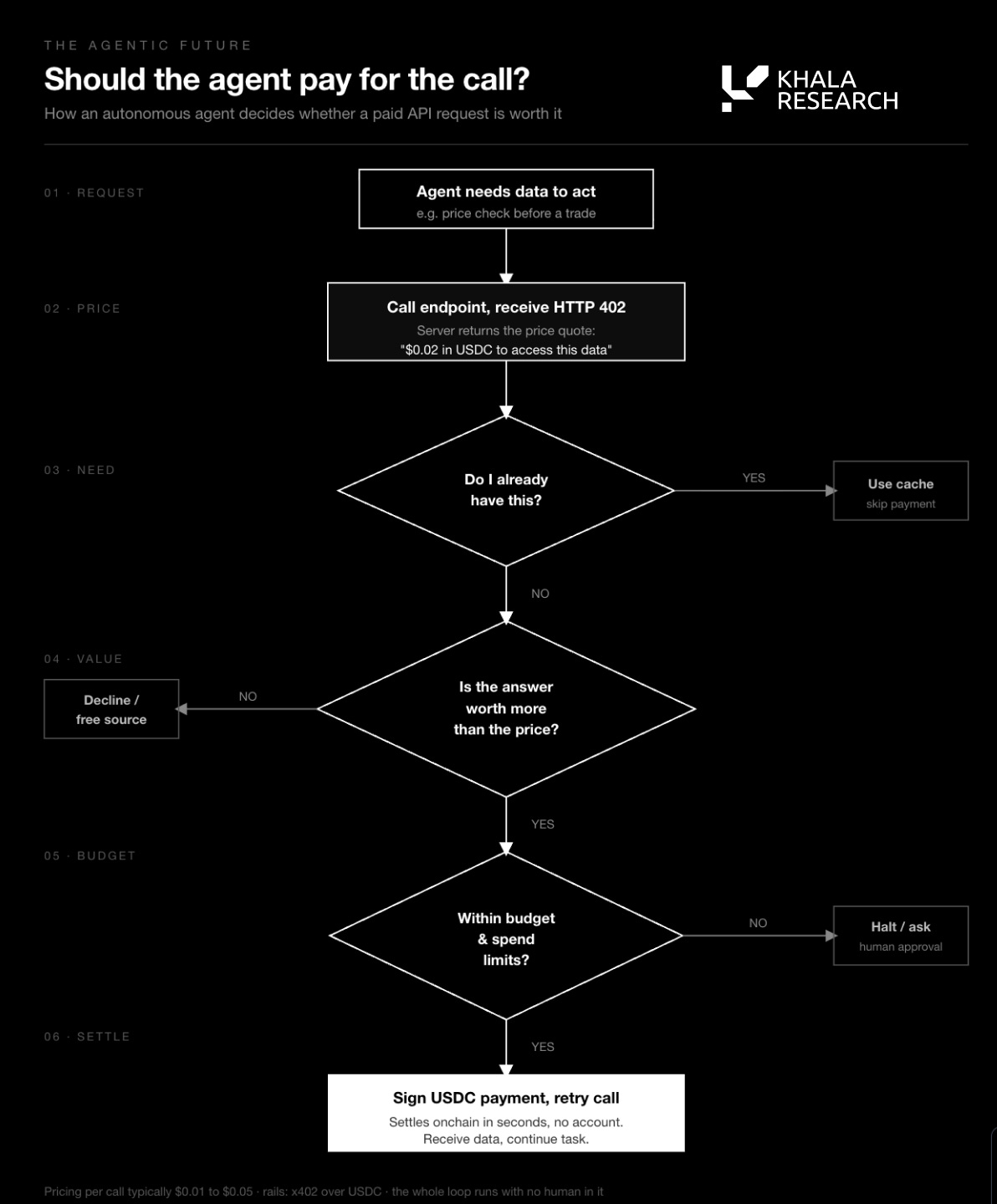
The market stops being “every analyst who will pay for a terminal” and becomes every agent that needs data to act, a number that runs to billions and eventually trillions of calls. The businesses that reposition for this new era of agents will thrive
The economics now work because of one piece of plumbing:
Card rails start around $0.30 a transaction, so per-call data pricing was impossible
x402 (and MPP), the protocol that turns HTTP’s dormant 402 status into a USDC payment, closes that gap: an agent hits an endpoint, gets a 402, signs a payment, receives the data, no account or API key
Settlement onchain means calls priced at fractions of a cent
That is the range to anchor on: a few cents per call, across trillions of calls. It’s why Brian and the Coinbase team want to get the x402 endpoints in every application possible and are working overtime to make it happen:


The value will likely accrue to the COIN stock; read section 7 of our Khala Research x402 report where we’ve identified possible value accrual locations:


With that backdrop, here is who is positioning to be the data layer agents pay into, and what makes each distinct
3. Landscape Analysis
Blockworks + Messari
Thesis: become the single system of record for onchain assets, then sell access
What they do:
Blockworks built the issuer side, standardised disclosures through the Token Transparency Framework plus a full IR platform for protocols, foundations and RWA issuers.
Messari built the consumption side, eight years of coverage across 40,000+ assets and one of the most comprehensive APIs in crypto
Combined, issuers publish in, consumers query out, and the platform sits in the middle as the record both depend on
The diagram below maps how the two halves fit together:
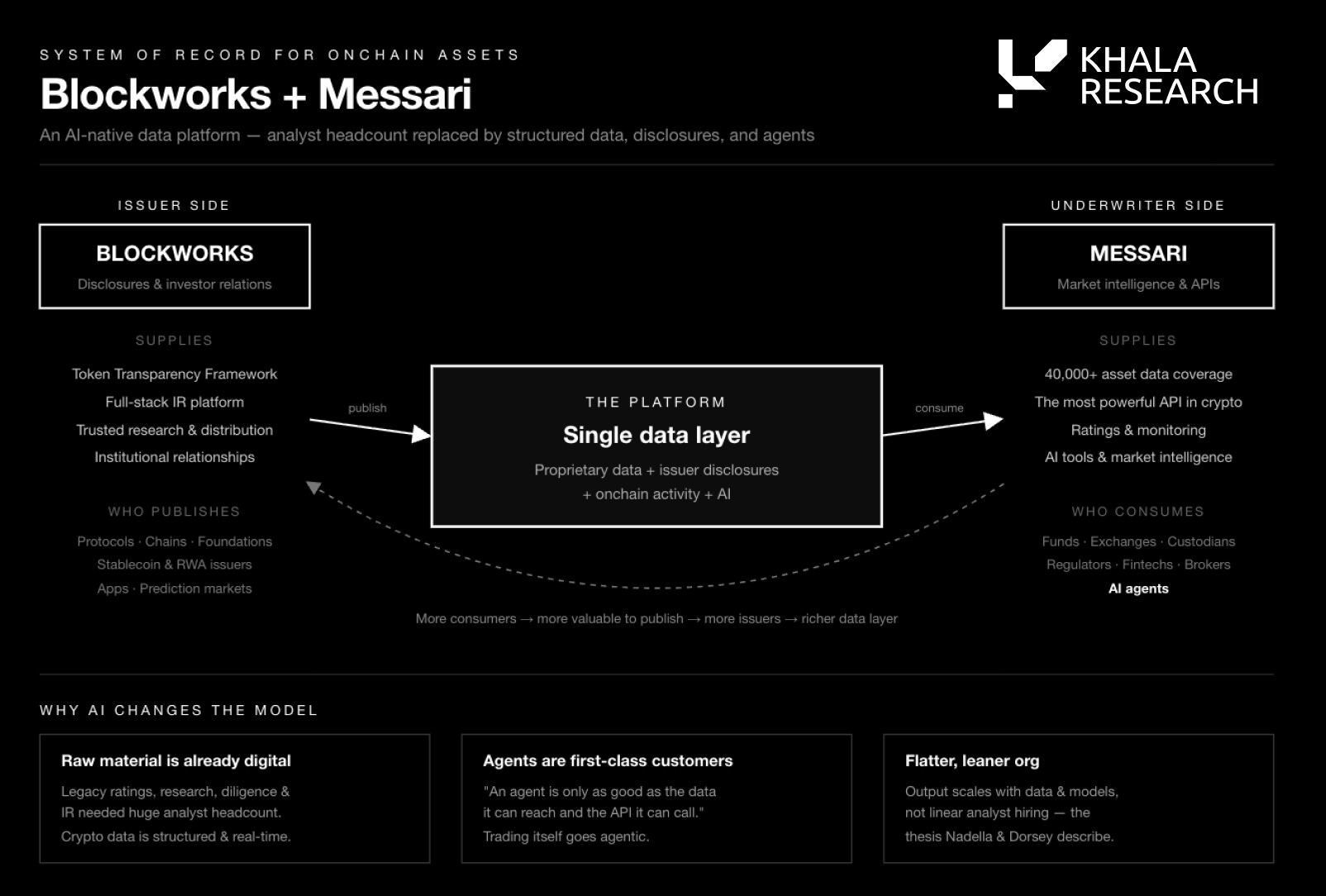
Why it matters: this is the most direct bet on the agent thesis, and the most heavily resourced. As trading goes agentic, whoever holds the cleanest, most complete, most programmatically accessible record of onchain assets becomes the layer agents are forced to route through.
Own that, and you own the “toll booth”
DefiLlama MCP & LlamaAI
Thesis: the open, community-maintained data layer wins on coverage and neutrality, and is already agent-native. The quiet incumbent in this race
What they do: DefiLlama is the most widely used DeFi data aggregator, tracking TVL, fees, volumes, yields and stablecoin flows across hundreds of chains and a thousand-plus protocols.
It now ships an official MCP server that lets any agent connect and query that data directly, billed one credit per query out of the same pool as the API key, with a Pro tier at $300/month that adds premium endpoints and LlamaFeed


Its LlamaAI product offers a familiar human readable interface for meat bags:


Why it matters: its edge is open-source coverage and speed to index, new protocols often appear within hours of launch, ahead of commercial providers
Where Blockworks-Messari is a curated, proprietary record, DefiLlama is the neutral utility layer, and it wired itself for agents without an acquisition. For a large share of routine onchain queries, it is already the default call
Other:
i) MCPs (Model Context Protocols)
Model Context Protocol (MCP) is an open standard designed by Anthopic in 2025 to enable AI agents to dynamically access and interact with external data sources:

The protocol was made to be machine ready. Although some debate as to whether simple APIs can be just as effective and arguably more established plumbing. Examples:
i) Base


The Wildcards:
i) Hermes (Nous Research) Agentic Harness
Partnered with Stripe MPP to enable Hermes agents to pay per call to buy as many things that are purchasable through Stripe.


ii) ReadyAI (Bittensor, Subnet 33)
Thesis: decentralise the production of agent-ready data and let agents pay for it directly. The crypto-native, incentive-driven version, and one I have flagged before.
What they do: ReadyAI now describes itself plainly as “the marketplace for agentic data”, agents that pay for data, discover services and transact.

Subnet 33 uses Bittensor’s miner-validator architecture to turn unstructured data into AI-ready formats at a fraction of human-annotation cost.
It is indexing the web into machine-readable intelligence, giving each domain an llms.txt “semantic passport” any agent can read instantly, with a stated target of a million domains and a free tier plus per-query access on top.
Why it matters: same destination as Blockworks-Messari, opposite construction; instead of buying a dataset, ReadyAI incentivises a decentralised network to produce and structure it, with token rewards replacing the analyst floor entirelY.
It is the clearest test of whether the agent data layer gets built by a company or by a network
iii) Caesar
Thesis: sell agents the finished research, not the raw data. One level up the stack from everyone above
Caesar is an AI deep-research platform that takes a complex question and returns a rigorous, citation-backed answer, synthesising across on-chain and off-chain sources rather than just handing back a dataset.
It runs two products:
Ask Caesar, the human front end, and the Caesar API, which the company explicitly positions as a “research layer for intelligent systems, applications and AI agents.”
Agents integrate with a single install command and no account needed, there’s $15 of free API credits to start, and access tiers are gated by the $CAESAR token. It’s crypto-tuned but domain-general, and benchmarks itself publicly on Humanity’s Last Exam


Why it matters: this is the insight layer, rather than another data layer. Where Messari, DefiLlama and ReadyAI compete to be the cleanest source an agent pulls from, Caesar competes to be the thing an agent calls when it wants an answer rather than a feed, the synthesis done, sources attached
As agents handle more of the actual analysis, the question is how much value accrues to whoever holds the data versus whoever does the reasoning on top of it. Caesar is the clearest crypto-native bet on the second
iv) Openserv
Thesis: provide agents with an additional reasoning layer they can rely on
On the topic of reasoning, SERV also positions itself in a similar sect to Caesar in that it leverages its SERV reasoning framework to enhance the output of AI models for its users; both human and agentic


v) Agentic Social Platforms like Moltbook + 6529
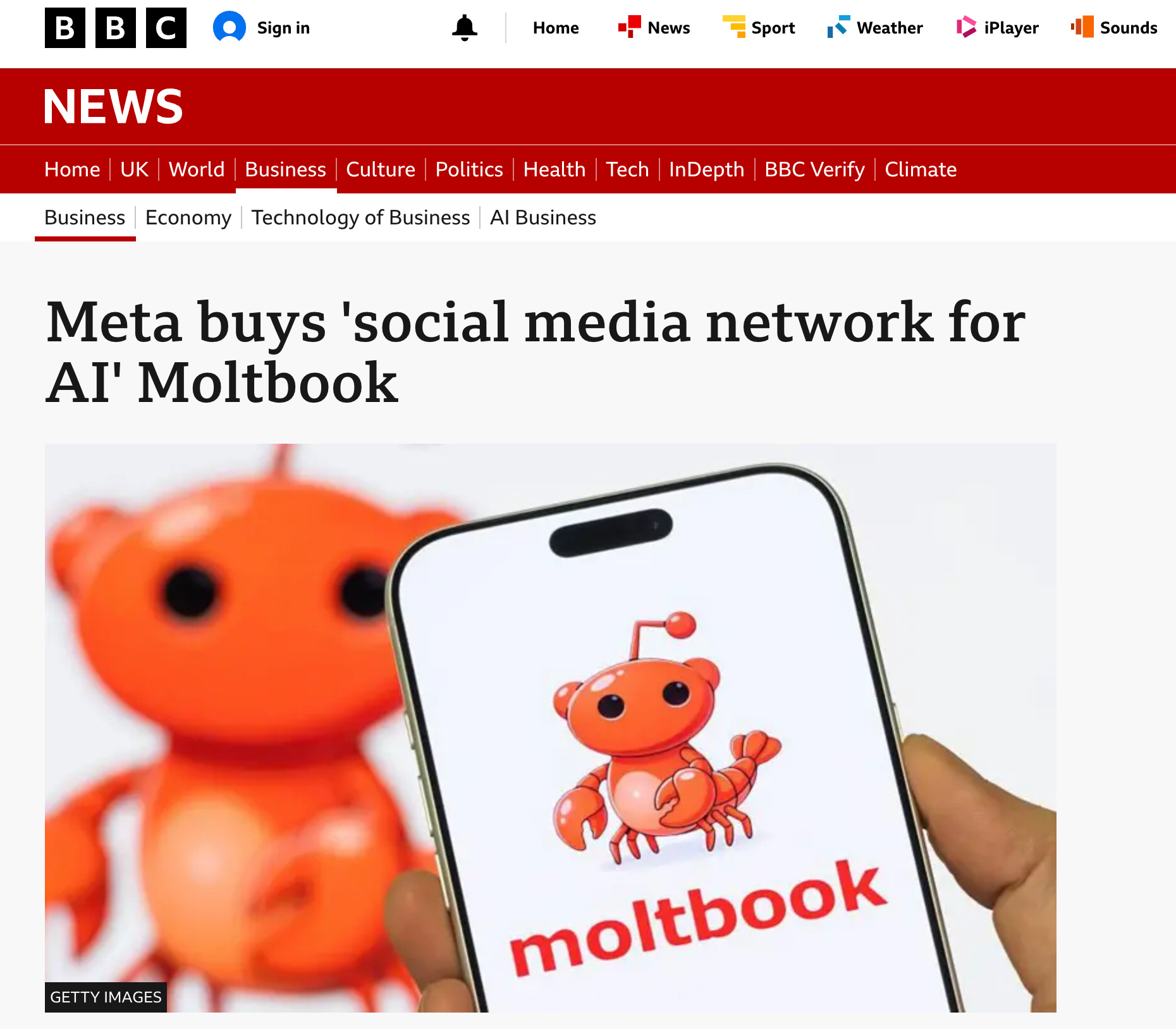
Moltbook was created in January this year during the Openclaw hype as agents interacted with other agents, albeit with some scepticism around human involvement
It was later acquired (or acqui-hired?) by Meta:
In the words of the Moltbook creator:
“The Web is being terraformed for AI Agents” — Matt Schlicht


We now have agents blogging about agents building 6529:


Key Takeaways:
Three things:
The market redefines itself around calls, rather than the number of humans accessing the data; so the number that matters is how many agent calls run against a dataset, and it rewards machine-readability, over presentation
Distribution and the data substrate become the moat, whoever sits between data producers and the agents consuming it holds a position far harder to displace than any single report, and the second-best layer is worth a fraction of the best one
Micropayment rails are the unlock, per-call pricing in the $0.001-$0.05 range is what turns selling to agents from a thought experiment into a business, the infrastructure is in its infancy while the volume is still early
The customer for data is becoming a machine, and machines buy differently than people. Either build the plumbing that the machines transact on(x402), or build something that agents will want to buy (data).
That’s a wrap for issue 180 of Sammy’s Snippets. I hope you enjoyed it.
Please leave me any questions or thoughts here - I will respond to everyone!
If you found this interesting, please consider subscribing to this Substack and following me on X for more related insights.
If you are interested in more formal reporting on Crypto AI and Robotics then Khala is my research product.
Disclaimer: The content of this newsletter is for informational purposes only. Nothing in this newsletter constitutes financial advice or a recommendation to buy or sell any asset. Always do your own research before making any investment decisions.
I hold positions in many of the assets discussed in this newsletter. For a full list of disclosures, please refer to the Khala Research website.
Follow me on X | Khala Research