


This Crypto AI & Robotics newsletter consists of three key parts:
Snippet Partner: Axis Robotics
Theme of the Week: Intelligence Is Becoming an Open Commodity
Landscape Analysis: TAO (Macrocosmos, Chutes, Targon, Engy AI), TIG, Walrus + more
If you have any questions feel free to reach out to me on X or message my business X account ‘Khala Research’


This week’s issue is brought to you by Axis Robotics, who just raised a $12 million seed round
Language models could learn from an internet already filled with text, images & video. But robots don’t have the same luxury; physical AI needs billions of motion trajectories across different objects, environments & robot bodies
Axis is buildin a compounding data engine around this bottleneck; Its browser-based simulation platform allows distributed contributors to teleoperate robots and generate training trajectories, while its mobile capture product converts human movement into real-world egocentric data
It just revealed its roadmap for the next 12 months:


As traditional robotics labs begin to IPO we could see eye watering capital raises feed what is going to become the largest revamp of the global labour force
This newsletter goes out weekly to 7.2k+ subscribers.
Please don’t hesitate to message me directly for sponsorship or partnership enquiries.

Intelligence Is Becoming an “Open” Commodity
First Jensen Huang, now Sam Altman & Dario Amodei (kind of) came out in support of open weights (open source AI models)
Within a few days NVIDIA argued that open-weight models are strategic infra for US AI leadership:


Anthropic described capable, but non-dangerous open weights as a “public good” & Moonshot released the largest open-weight model to date
These aren’t fringe open-source advocates:
NVIDIA sells the infrastructure beneath the entire AI economy, and;
Anthropic operates one of its most valuable closed model businesses
Both now agree that broader access to model weights increases competition, gives customers greater control and reduces dependence on a single AI lab
The significance for crypto AI is what I believe is underestimated…
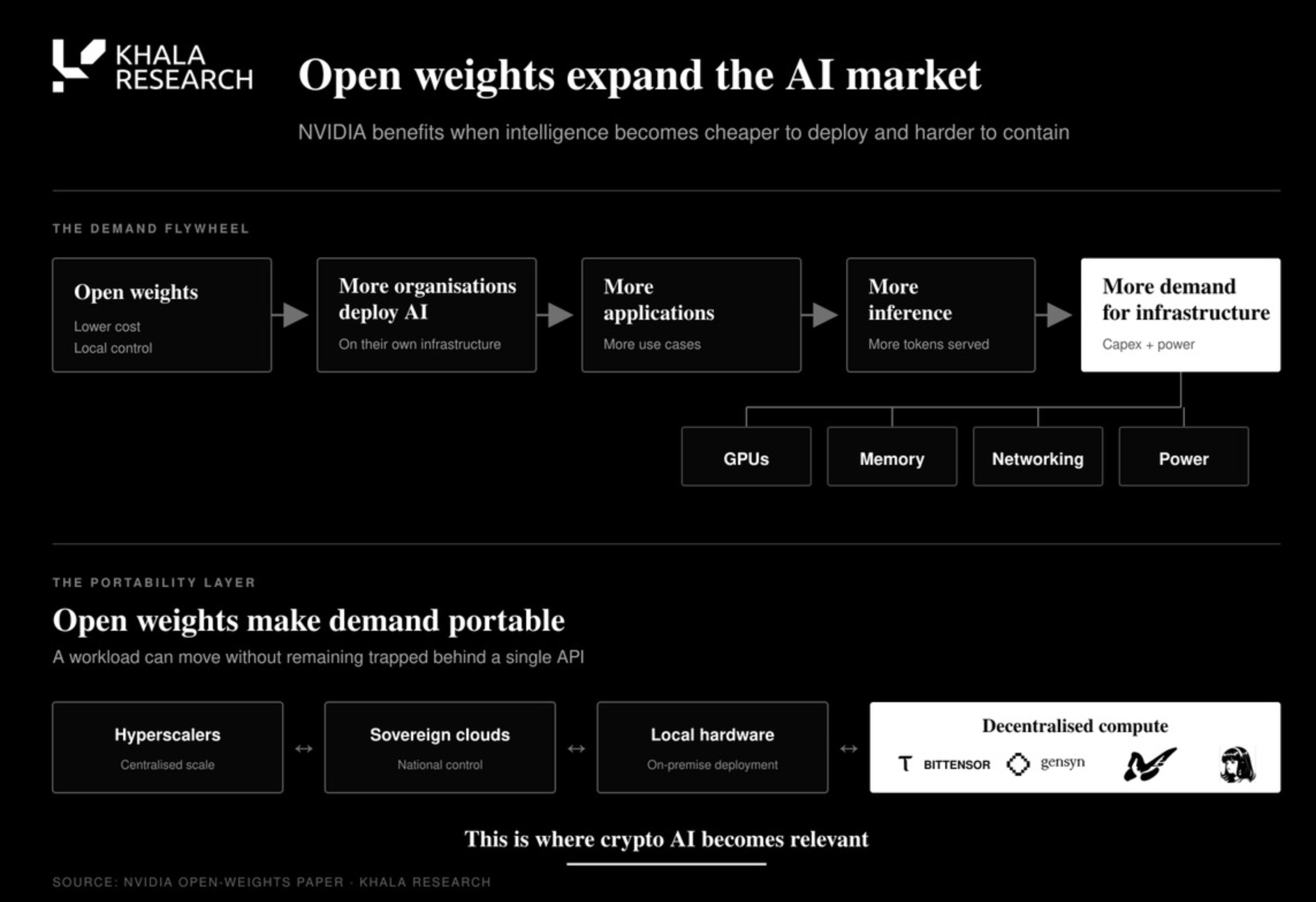
If intelligence becomes easier to download, adapt and deploy, value moves toward the scarce inputs required to run and improve it: compute, inference, proprietary data, memory, verification, coordination + payments
Open weights become a strategic issue
NVIDIA’s open-weights paper argues that AI leadership should be measured by whether an ecosystem can diffuse intelligence across startups, universities, factories, hospitals and public institutions
Open weights let organisations inspect a model, fine-tune it and run it on the infra it controls. That makes AI cheaper for many tasks & prevents the knowledge built on top from becoming trapped inside a single provider
Dario Amodei’s response was more cautious on safety, but agreed (albeit hesitantly) with the core economic point:
“Open weights expand access to the AI economy, they strengthen competition … and they give customers greater control.”
Anthropic still wants mandatory testing for sufficiently capable models and targeted action against industrial-scale distillation
Even the leading closed-model lab now accepts that open weights create genuine public and economic value
Kimi K3 made the argument tangible
Moonshot released a 2.8T parameter open-weight model… essentially making a competitive frontier model from Asia a public good:


Frontier labs still retain distribution, safety infrastructure, proprietary data & the ability to spend billions training the next generation
Builders will be able to choose between closed frontier models, open general models and smaller specialised models depending on cost, latency, privacy and control turning model access from a permanent moat into a much more competitive market
NVIDIA understands the flywheel
You’d be mistaken if you believed NVIDIA was supporting open weights as an act of charity…
It expands the number of organisations able to deploy AI on their own infrastructure meaning A LOT more customers to supply compute to:
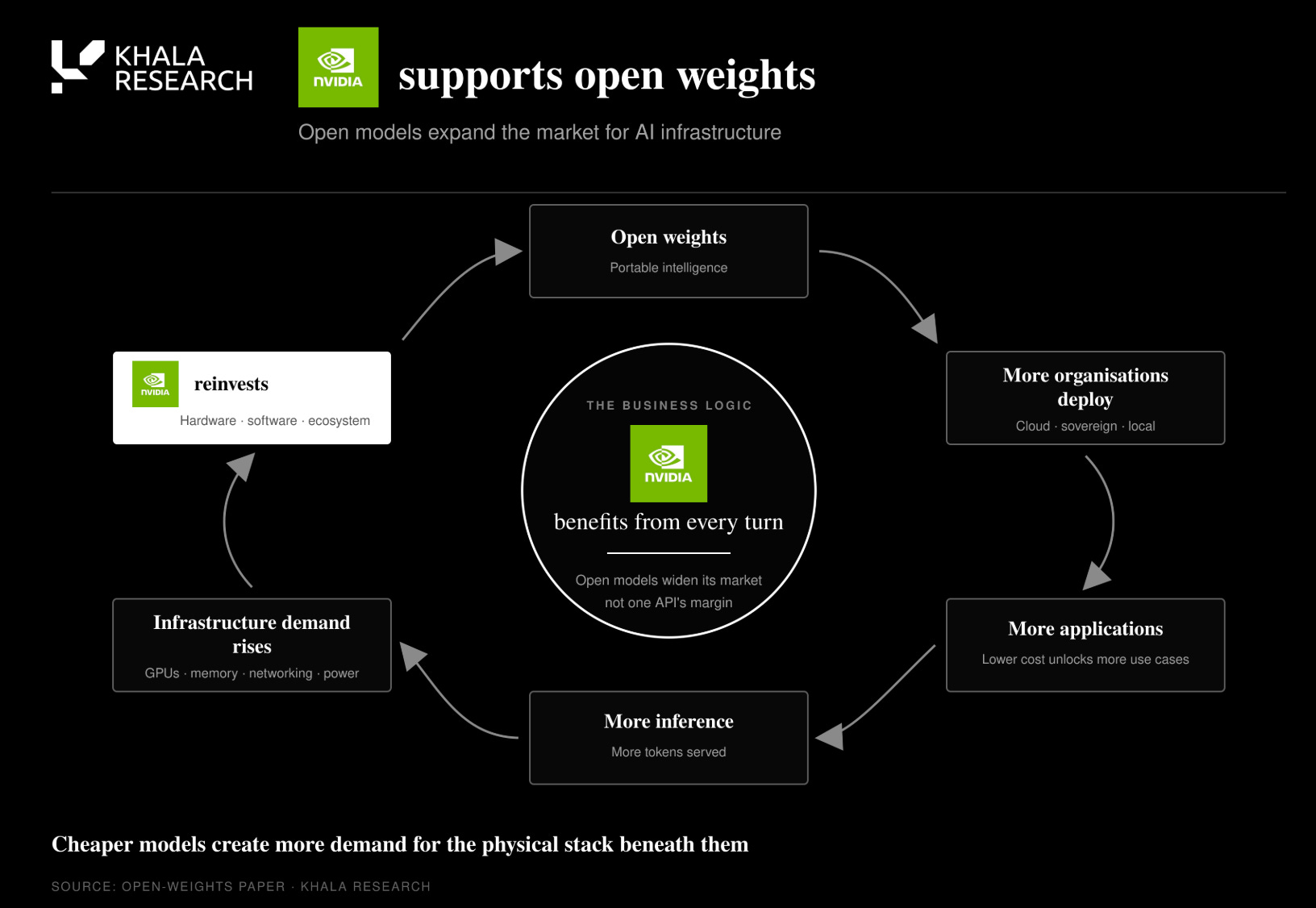
Cheaper models create more applications, more applications create more inference, more inference creates demand for GPUs, memory, networking & power:
Open weights also make that demand portable, so a model can move between hyperscalers, sovereign clouds, local hardware + decentralised compute networks rather than remaining tied to one API
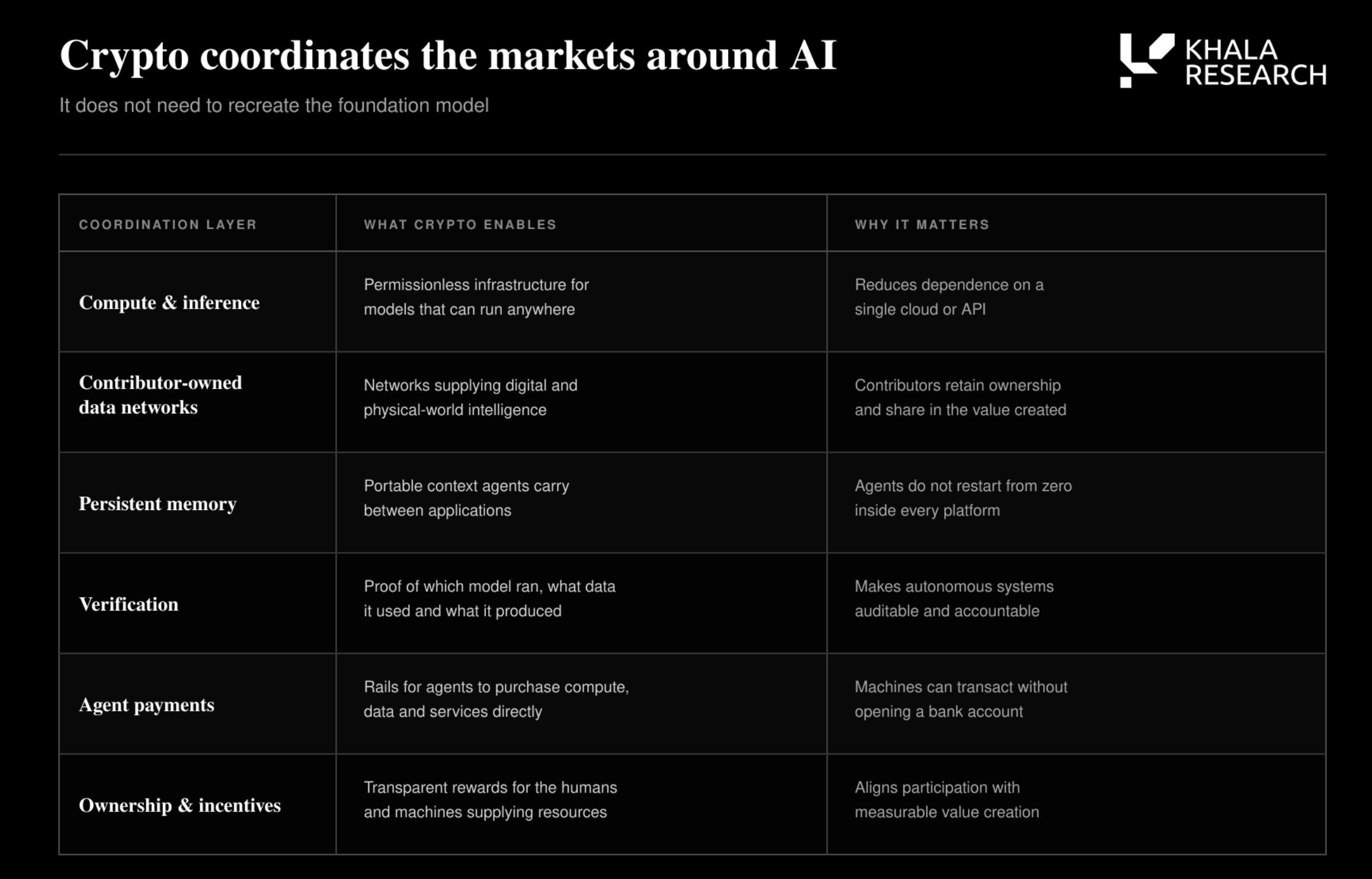
This is where crypto AI becomes relevant… it coordinates the fragmented markets forming around it, and open intelligence needs open, premissionless infrastructure:
Landscape Analysis: Bittensor, TIG and the Open Intelligence Stack
i) Bittensor (TAO) is commercialising open intelligence
Until recently, the crypto AI response to open weights has been theoretical: decentralised compute and data networks would become useful once high-quality models could move freely between providers
Bittensor has spent the past few years building specialised markets beneath it.. the TAO eco is an incentive framework where subnets define a digital commodity, miners produce it, validators score the output and TAO rewards the contributors judged to be creating value
For those wanting a crash course in how TAO came to be, we’ve reported on the ecosystems investible history here:


Open weights make this structure much more important because training, serving, data collection, verification and privacy can each become competitive markets. We can touch on several eco examples:
a) Training: Macrocosmos IOTA, Subnet 9
Macrocosmos has now started Orion-16B, a single 16 billion parameter model training live across heterogeneous GPUs on three continents.


IOTA splits model layers across permissionless contributors, so no miner holds the full model and no operator controls the run
b) Inference: Chutes, Subnet 64
Open weights are only economically useful if somebody can serve them cheaply and reliably
Chutes turns distributed GPUs into a serverless inference platform where developers can deploy open models behind an API without managing the underlying fleet
The important shift is that Chutes is now being measured on revenue quality rather than subsidised token volume with revenue efficiency improving:
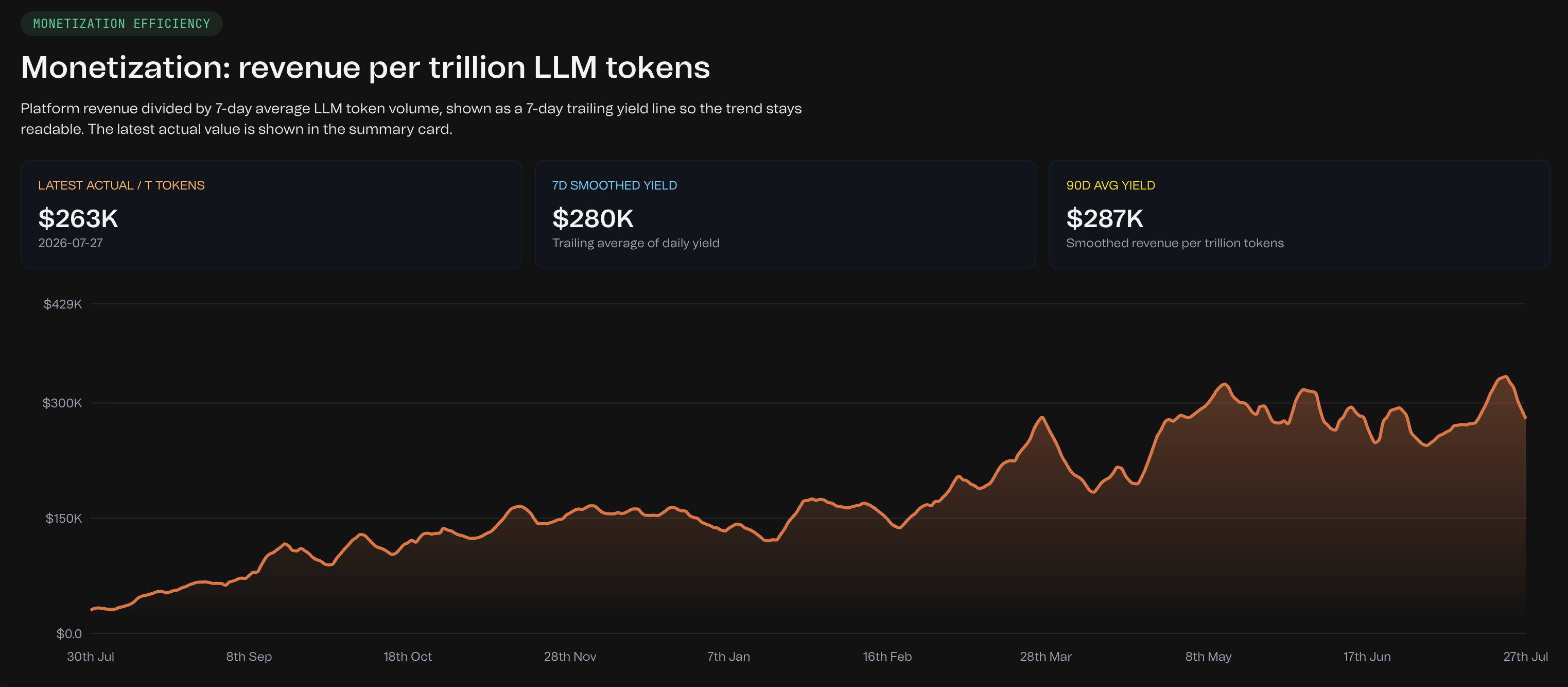
After removing loss-making traffic and tightening its subscription model, Chutes reported revenue per million tokens increasing 38% + revenue per active GPU increasing 45% from the start of February
Revenue has reached roughly $280k per trillion tokens served (picture above), with paying applications including Pax Historia running production workloads showing commercial viability
c) Confidential compute: Targon, Subnet 4
Portability creates a trust problem… Enterprises want cheaper distributed compute without exposing models, data or prompts to unknown operators.
Targon uses confidential VMs, host verification and NVIDIA nvTrust attestation to prove workloads ran inside approved protections without trusting the server owner.
Its new Tower lets anyone connect and rent compute through the Targon network.


d) Other emerging TAO subnets:
Algod recently launched a subnet (Engy AI) for verifiable inference, competing with the likes of Chutes:

ii) Algorithms become a licensable asset
The Innovation Game (TIG) is another expression of the open-intelligence thesis
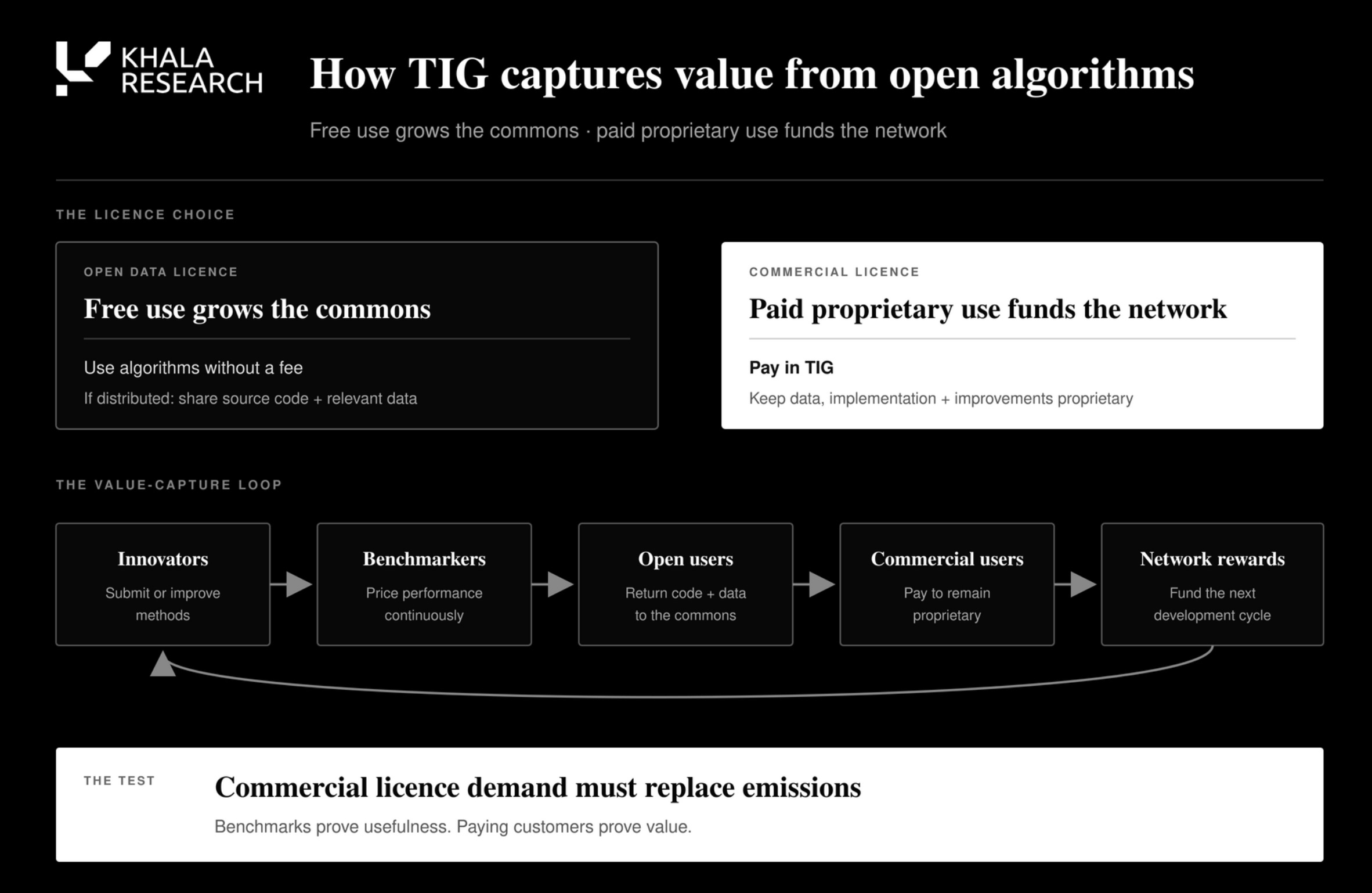
Innovators submit or optimise algorithms, benchmarkers compete to identify the most efficient methods, and contributor rewards increase as their algorithms are adopted
TIG’s licensing framework is the most interesting part of the mechanism, which I covered in this recent article:


TIG offers two licences:
free use if distributed code and relevant data stay open, or
paid use in TIG to keep data, implementation and improvements proprietary.
Innovators submit methods, benchmarkers price performance, open users grow the commons and commercial fees fund the next cycle.
The test is whether licence demand can replace emissions. Benchmarks prove usefulness; paying customers prove value.
This creates a cleaner value-capture loop than simply attaching a token to an open-source repository:
iii) Machines need a black box
As agents and robots gain autonomy, accountability becomes the missing layer.
The final output is not enough; companies and regulators will need the mandate, model, data, authorisation, decision path & payment record
This is Khala Research’s Machine Black Box thesis: networks such as Walrus can become a verifiable evidence layer for machine activity, not merely file storage.

iv) Open models become economic actors
McKinsey estimates that agentic commerce could orchestrate $3T - $5T globally by 2030… those agents will need to pay for inference, data, APIs, software and eventually physical services.
We covered the potential agentic payment rail projections in our x402 report:

Crypto becomes the network of permissionless wallets, stablecoins and machine-readable ownership forming part of the new age of financial infrastructure
That’s a wrap for this issue of Sammy’s Snippets. I hope you enjoyed it.
Please leave me any questions or thoughts here - I will respond to everyone!
If you found this interesting, please consider subscribing to this Substack and following me on X for more related insights.
If you are interested in more formal reporting on Crypto AI and Robotics then Khala is my research product.
Disclaimer: The content of this newsletter is for informational purposes only. Nothing in this newsletter constitutes financial advice or a recommendation to buy or sell any asset. Always do your own research before making any investment decisions.
I hold positions in many of the assets discussed in this newsletter. Valuations are approximate snapshots and move quickly. Verify all market data independently before acting.
Follow me on X | Khala Research