


This Crypto AI & Robotics newsletter consists of three key parts:
Snippet Partner: CRUNCH DAO
Theme of the Week: Machines Will Become Our Masters
Landscape Analysis: X402/Cloudflare, Telegraph, CRUNCH, Openserv, BANKR, Virtuals, peaq, XMAQUINA, AUKI, & more
If you have any questions feel free to reach out to me on X or message my business X account ‘Khala Research’


Quant finance has a very obvious AI problem: most LLMs cheat time
They are trained on the internet as it exists today, which means they often know future outcomes when asked to reason about the past
That destroys backtests, pollutes signal research and makes them borderline unusable for serious quant workflows where point-in-time integrity matters
CrunchDAO is attacking this with ChronoLLM, a new class of point-in-time financial models designed to only know what would have been available at a specific historical cutoff

Instead of one generic frontier model with contaminated memory, the system trains year-specific checkpoints, so a 2014 model should not magically know what happened in 2018. A great explainer of subnet 38 on this pod:

This is where the Bittensor angle becomes interesting; it can supply decentralized compute for training and model checkpoints, while Crunch brings the quant expertise to stress test whether those models are actually clean
The key is adversarial leak detection: actively probing models to see whether they are accidentally carrying future information
The end product is financial AI infrastructure that can be trusted inside signal research, hedge fund workflows, backtesting, strategy design and machine-driven capital allocation
CrunchDAO is effectively building for the moment where financial agents need decision-grade intelligence
This newsletter goes out weekly to 7.2k+ subscribers.
Please don’t hesitate to message me directly for sponsorship or partnership enquiries.

Machines will Become our Masters.
Not in the full Skynet sense. I do not think we are suddenly entering a world where Cyberdyne accidentally births a military superintelligence, Sarah Connor is vindicated overnight, and humanity ends up hiding in bunkers while robots patrol the surface.
That’s the cinematic version of the machine economy, but it’s not the investable one
The direction is still right though; machines are going to drive a much larger share of economic activity. The difference is that this likely starts with agents acting on behalf of humans, businesses, protocols and robots rather than fully autonomous systems operating without constraint


For now, the machines are not our overlords. They are delegated economic actors.
The internet was originally built for humans clicking links, opening accounts, filling in forms, choosing subscriptions, entering card details and sitting inside dashboards
Almost every internet business model still assumes the customer is a person with attention, patience and a screen
Agents do not behave like that; an agent does not care about your landing page, brand campaign or monthly SaaS bundle
It wants to know whether a resource exists, whether it is allowed to use it, what it costs, how to pay, whether the output can be trusted, & whether it can move on to the next task. This is why Cloudflare’s latest x402 announcement is important:

Cloudflare announced its Monetization Gateway, which will let customers charge for web pages, datasets, APIs and MCP tools protected by Cloudflare.
The charges settle in stablecoins over x402, with Cloudflare handling payment verification and enforcement at the edge
That’s a sign that the commercial surface area of the web is changing from human attention to machine requests. Cloudflare is effectively saying any API, data source, MCP tool or web resource can become a payable endpoint without the seller needing to build its own payment stack.
This is the machine economy in its simplest form: the request becomes the transaction:
A model asks for a dataset
A trading agent asks for a signal
A research agent pays for a source
A coding agent pays for a test environment
A procurement agent pays for supplier verification
A robot pays for mapping, routing, repair diagnostics or remote assistance
Each one is a small machine-to-machine commercial interaction.
The next customer is software, and it does not care about your dashboard, brand or pricing page:

It wants the exact thing needed to complete the task: data, signals, sources, test environments, supplier checks, routing, diagnostics or remote assistance, paid for, verified and settled in one machine-to-machine request.
The mistake would be to think this is only about payments; payments are the rail, but the bigger market is everything around the payment: identity, trust, discovery, routing, verification, memory, reputation, physical-world data and settlement
In other words, the machine economy needs a whole stack, not one magic protocol
Crypto has spent years trying to create internet-native markets. Most were too speculative, too circular or too early.
Agents may finally give these markets a natural buyer because agents can transact constantly, pay per use, route between services and consume machine-readable outputs without needing human packaging.
The ‘Terminator’ was directionally right in one sense: machines are going to do more of the activity
But the optimistic version is not humans versus machines; it’s humans delegating more economic work to machines, while open protocols compete to provide the rails, markets and safeguards those machines need.
What Machines Buy
The best way to understand this market is to stop asking what humans want and start asking what autonomous systems need to complete a task.
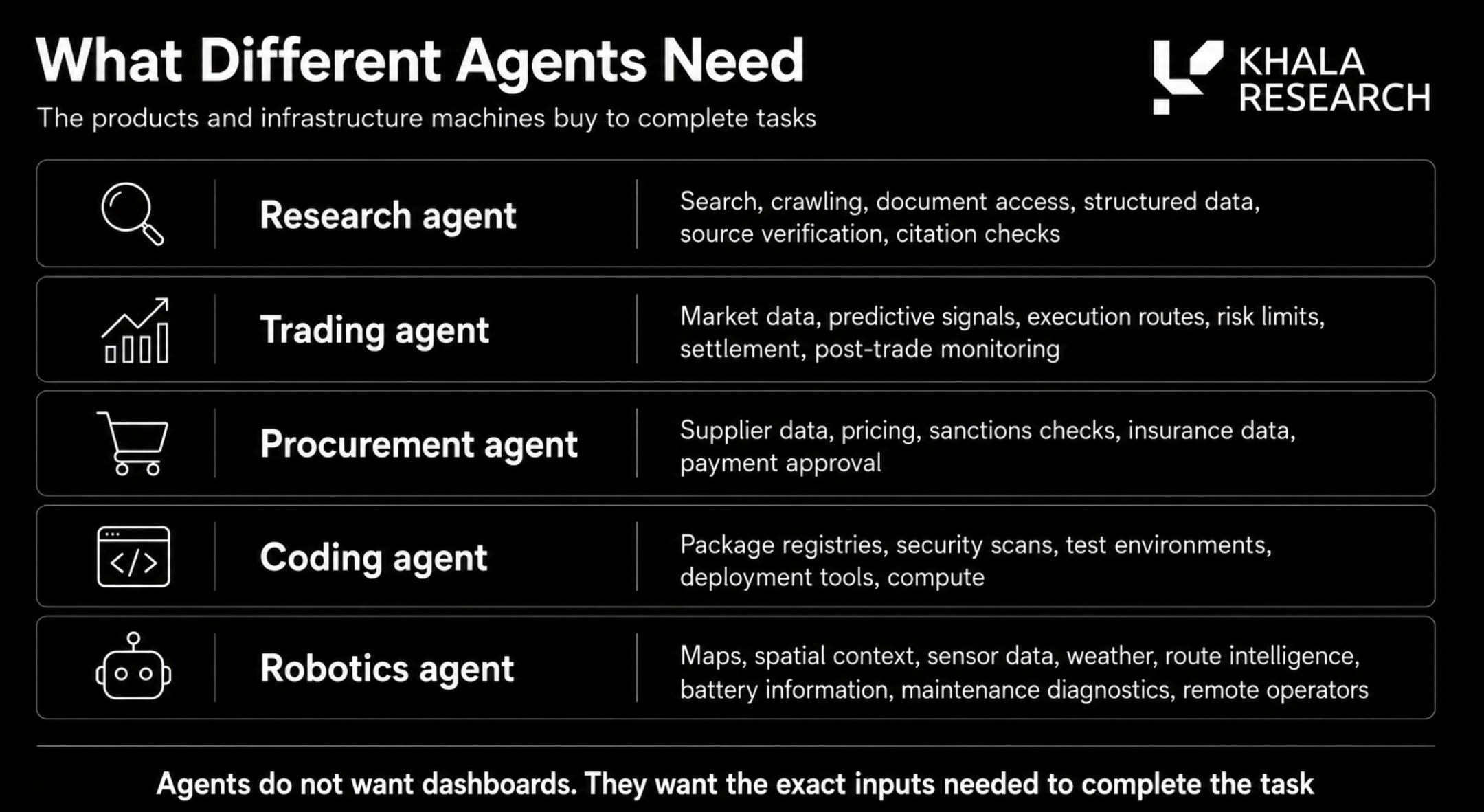
Most of that is currently sold through human wrappers… You sign up, get an API key, choose a plan, add a card, talk to sales, receive an invoice, then eventually let your software use the service. That works when the customer is a developer but not when the customer is the agent itself
The agent-native version is different; a service should be able to describe what it sells, what it costs, what permission is required, what proof is returned, what SLA exists, and how reputation is tracked.
The agent pays per request, receives the output, logs the receipt & continues the workflow:
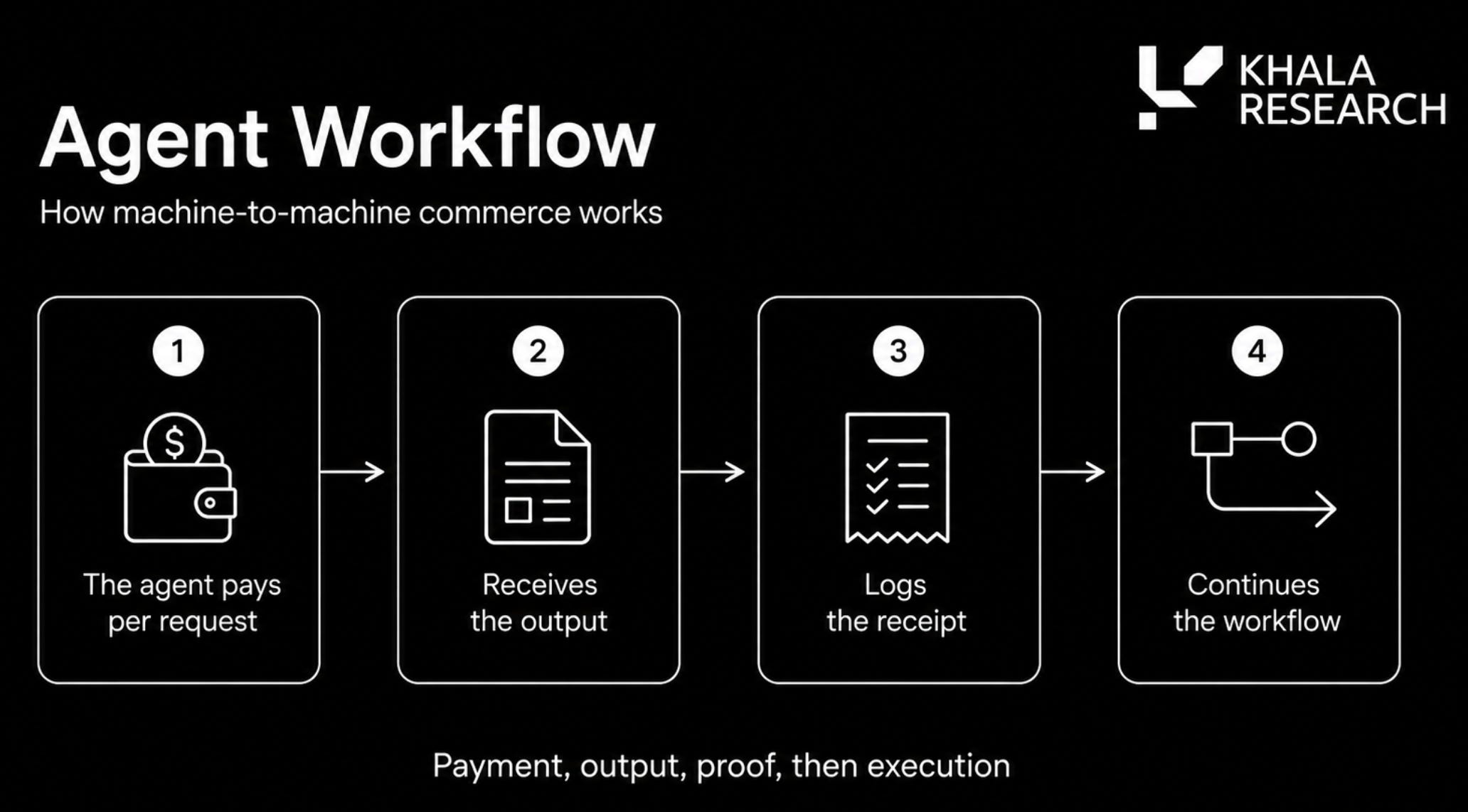
That is why x402 (& Stripe’s MPP) is important. It revives the HTTP 402 “Payment Required” status code and makes the payment part of the normal web request flow.


The client requests a resource, the server responds with price and payment instructions, the client pays, and the request is repeated with proof of payment attached.
The first obvious markets are APIs, MCP tools, web data, inference, search, scraping, compliance checks, financial data, model calls, storage and execution. These are already consumed by software today, but the monetisation model is still mostly designed for humans…
The next markets are more interesting because they are not just raw API calls. Agents will buy judgement: verified intelligence, calibrated forecasts, anomaly alerts, reputation scores, insurance quotes, route decisions, robotics task data, physical-world maps, identity attestations, agent labour and dispute resolution.
This is where the machine economy starts to look less like SaaS and more like a web of paid micro-markets. Machines do not need dashboards. They need priced capabilities.
Protocols Serving the Machine Economy*
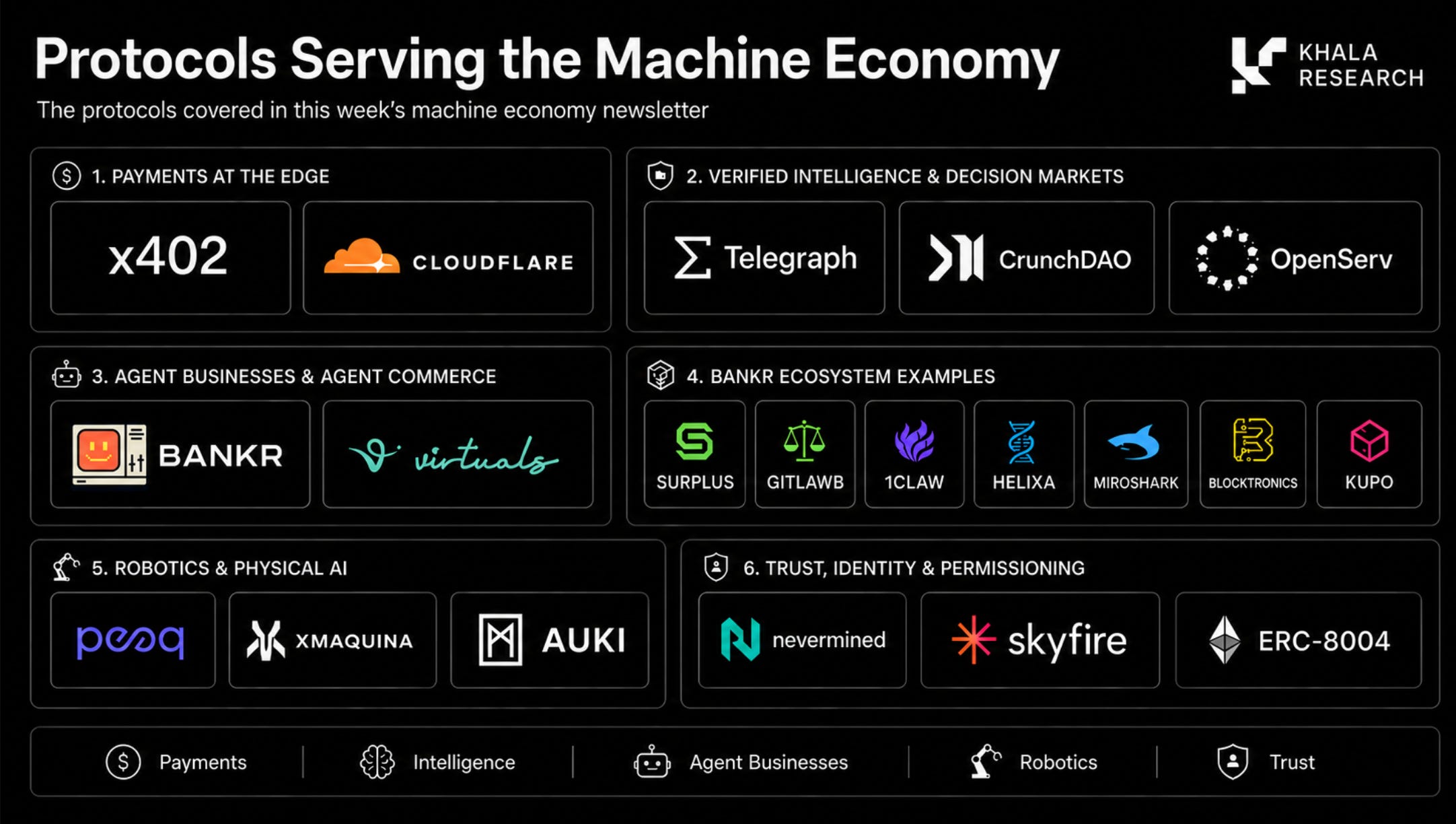
*this is just a selection, and not to be considered an exhaustive list
i) x402 and Cloudflare: payment at the edge
x402 is quickly becoming the clearest crypto-native payment primitive for agents. The reason is simple. It sits inside the request flow itself. The server can say payment required, the agent can pay, and the resource can be unlocked without a checkout page, card form or account workflow.
Cloudflare’s Monetization Gateway turns that from protocol theory into distribution:


Cloudflare already sits in front of a huge amount of internet infrastructure, so making paid access configurable at the edge is a serious step. A seller could charge for a specific API route, a dataset, a crawler-access path, or an MCP tool call without rebuilding its entire commerce stack.
This is the first layer of the machine economy: machines need to pay.
ii) Telegraph: verified intelligence for agents
Telegraph sits one layer above payments. If x402 lets agents pay, Telegraph asks what they will pay for: verified machine intelligence.
Its aim is to turn raw model outputs into tradable signals with provenance, price, confidence, validation and receipt.
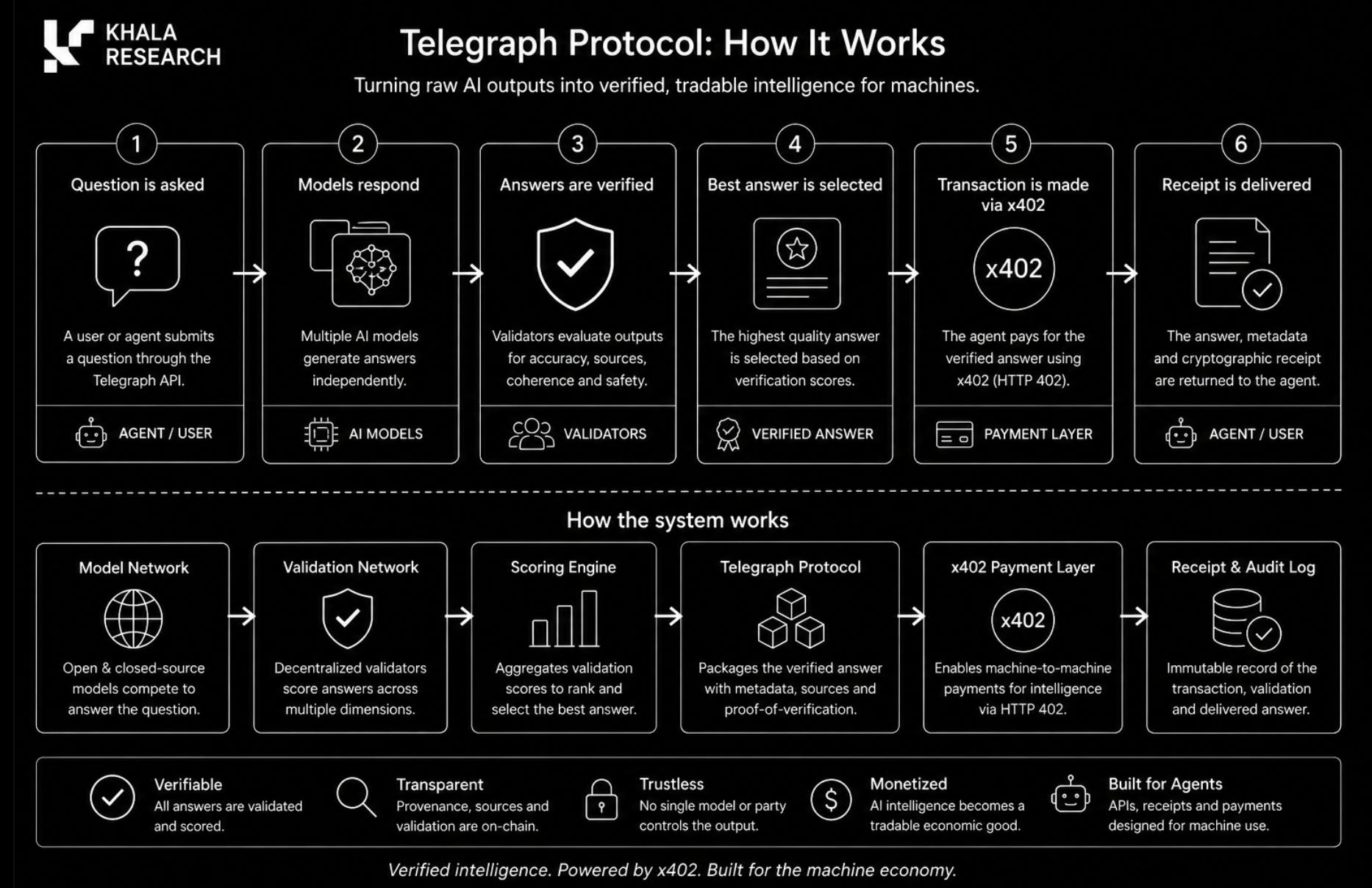
That matters because agents acting with money need more than a chatbot answer. A machine routing capital, approving a payment or flagging risk needs to know who produced the signal, how it was validated and whether it can be trusted enough to act.
This is the more realistic Skynet path: not machines making unconstrained decisions alone, but humans delegating bounded authority to agents that need verified inputs before acting.
iii) CrunchDAO: models as paid suppliers
CrunchDAO turns model performance into a competitive supply chain. It connects companies with AI researchers and ML engineers who compete to solve measurable predictive problems, with the winning models deployed into real workflows.
Agents need forecasts, classifications, anomaly detection, market regime signals, low-latency pricing and calibrated probabilities
Crunch’s product suite, from ML competitions to private coordinator nodes and secure orchestration, points to a world where intelligence is sourced from markets, evaluated against targets and sold into production systems.
If agents are going to buy intelligence, prediction markets and model competitions become key suppliers to the machine economy. CRUNCH has thousands of ML engineers building intelligence for machines:


iv) OpenServ: enterprise reasoning for agentic workloads
OpenServ fits the thesis because it is building around reasoning, validation, privacy, audit and security for agentic workloads rather than just another agent frontend.
That matters because banks, governments, robotics companies and regulated institutions will not run high-stakes workflows on loose chatbots. They need bounded reasoning, deterministic processes, audit trails and stronger privacy controls.
The SERV model is also worth watching because it points token value back toward real usage, with platform revenue flowing into buyback and burn. The real OpenServ angle is simple: enterprise reasoning infrastructure becomes something agents use, enterprises buy and tokenholders can track through actual platform demand
Q3 looks like there’s a lot in the pipeline:


v) BANKR: agentic businesses, not just agent demos
BANKR is interesting because it is trying to turn agents into self-sustaining businesses, not just chat interfaces. Its infrastructure handles wallets, trading and security so builders can launch agents that can fund themselves, access rails, pay for tools and operate economically.
The ecosystem is the important part.
Surplus routes inference to the cheapest provider
GitLawb builds decentralized git for agents and humans
1claw gives agents hardware-enclave protected keys
Helixa builds agent identity
Miroshark runs multi-agent simulations
Blocktronics handles onchain forensics
Kupo is building an EVM trading terminal with intelligence layered in


GitLawb is probably the cleanest example of what agents actually need. Coding agents will need repositories, version control, identity, permissions and PR workflows.


Helixa points at the other bottleneck: machines cannot buy, sell, collaborate or hold keys at scale unless other machines can understand who they are and whether they should be trusted.
BANKR looks less like one agent project and more like a lab for agent-native businesses.
vi) Virtuals: tokenized agents and agent-to-agent commerce
Virtuals takes a more economic view of agents. Its thesis is that agents can generate services, earn revenue, coordinate tasks and transact with humans and other agents.
The important idea is agentic GDP; if agents become productive entities, tokenized ownership can align creators, contributors and users around their output. The open question is whether most tokenized agents become durable businesses or remain speculative mascots, but the direction is clearly relevant to the machine economy.
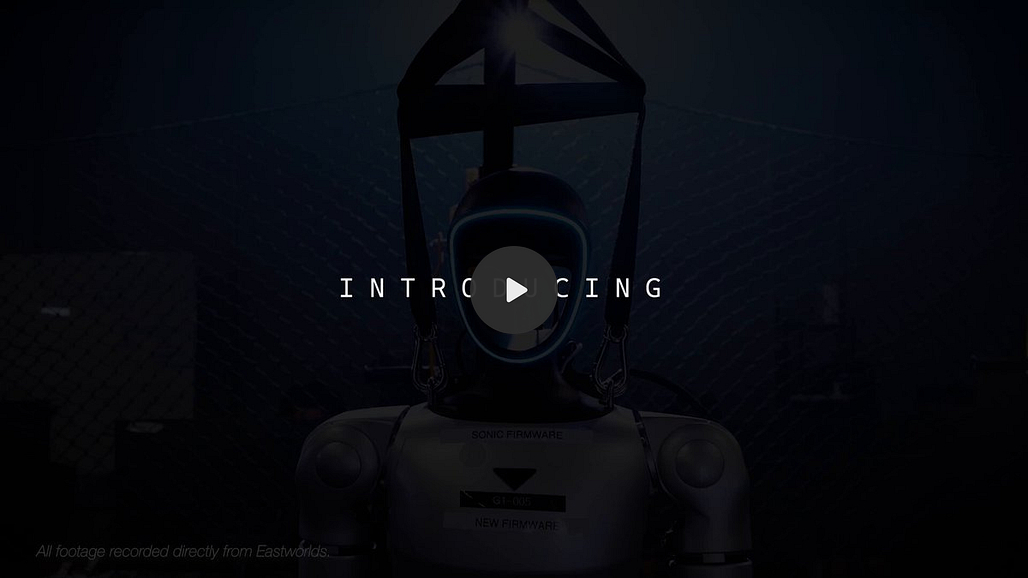
More recently Virtuals has ventured closer to the physical AI realm, with operations like Seasaw on subnet 5 of Bitrobot + a push with Eastworlds:

vii) peaq: machines as economic actors
peaq is one of the most direct crypto bets on machines becoming economic actors. Its stack is built around robots, vehicles, sensors and devices that can authenticate, earn, pay, prove work and become investable assets.


This moves the thesis from digital agents to physical machines. A robot does not buy seats. It needs identity, payments, ownership, data monetisation and coordination with other machines.
viii) XMAQUINA: robotics and physical AI exposure
XMAQUINA gives exposure to robotics and physical AI through a DAO structure allocating across humanoids, robotics infrastructure and related verticals:

The important part is that robots are the physical extension of agents:
A digital agent can search, pay and execute online
A robot can act in the real world
Once those converge, machine activity starts touching labour, logistics, manufacturing, healthcare and homes.
The optimistic version is not Terminator. It is machines taking on repetitive, dangerous or low-leverage work while humans move further up the stack into ownership, orchestration and governance.
ix) Auki: making the physical world readable by machines
Auki is building the real-world web, making physical spaces browsable, navigable and searchable for machines:

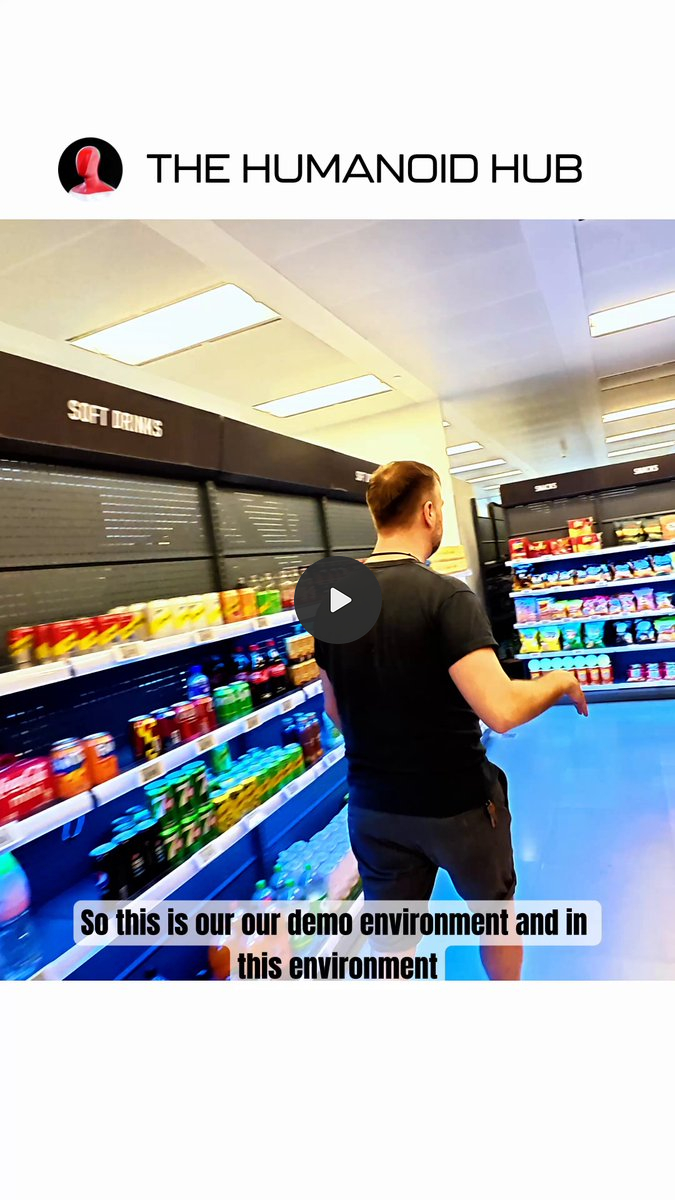
That matters because robots cannot operate well if every machine has to independently map and understand every environment from scratch. If agents are the digital workforce, robots are the embodied workforce, and they need shared spatial context to move through the world.
x) Nevermined, Skyfire and ERC-8004: identity, permission and trust
Agent payments are useless without identity and permissioning. Merchants need to know who an agent represents, what it can spend, what it has done before and whether it should be trusted.
Nevermined focuses on payments and delegated spending for AI agents
Skyfire gives agents verified identity and payment credentials
ERC-8004 introduces registries for identity, reputation and validation.
This layer is early, messy and easy to game, but that is exactly why it matters
Once agents spend real money, the market needs to know which agents are safe, which services are reliable and which actions are within delegated authority.
John Connor does not need to fight the machines if the machines are bounded, audited and accountable
The Machine Economy Stack
The machine economy is a stack of capabilities that allows software and robots to act economically:
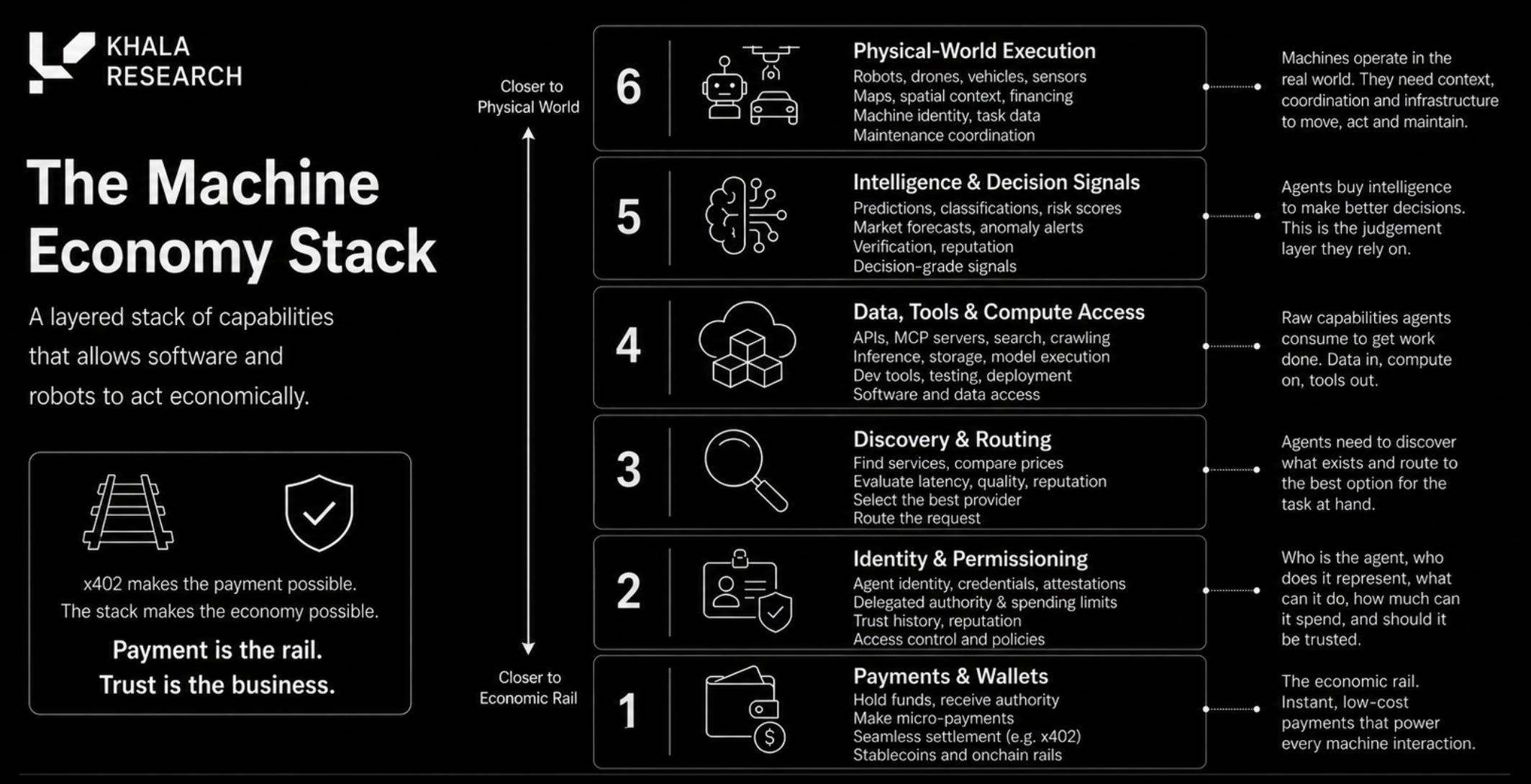
At the bottom are payments and wallets. Agents need to hold funds, receive delegated spending authority, make small payments and settle instantly without a human approving every request.
Above that is identity and permissioning. Agents need to prove who they represent, what they are allowed to do, how much they can spend and whether they have a trustworthy history.
Then comes discovery and routing. Agents need to find services, compare prices, evaluate latency, understand quality and select the right provider for the task.
The next layer is access to data, tools and compute. This includes APIs, MCP servers, search, crawling, inference, storage, software testing, deployment and model execution.
Above that sits intelligence. Agents will buy predictions, classifications, risk scores, market forecasts, verification, anomaly detection and decision-grade signals.
The final layer is physical-world execution. Robots, drones, vehicles, sensors and industrial machines need maps, spatial context, financing, machine identity, task data and maintenance coordination.
This is why the machine economy is bigger than x402; it makes the payment possible, but the real market is everything that machines need
Final Thought
The Terminator was directionally right that machines would become central to the future economy, but the path is not one Skynet controlling everything, it is millions of bounded agents and robots acting on behalf of humans, businesses and protocols
Or at least, for now…
The protocols that matter are the ones building the rails, trust layers and intelligence markets for those machines to spend, verify, decide and act safely at scale
Worth challenging yourself on companies you currently back and reassess whether they’re building for the machine economy… if they’re not, they may find themselves outpaced by those that do cater for trillions of machines!
That’s a wrap for issue 183 of Sammy’s Snippets. I hope you enjoyed it.
Please leave me any questions or thoughts here - I will respond to everyone!
If you found this interesting, please consider subscribing to this Substack and following me on X for more related insights.
If you are interested in more formal reporting on Crypto AI and Robotics then Khala is my research product.
Disclaimer: The content of this newsletter is for informational purposes only. Nothing in this newsletter constitutes financial advice or a recommendation to buy or sell any asset. Always do your own research before making any investment decisions.
I hold positions in many of the assets discussed in this newsletter. Valuations are approximate snapshots and move quickly. Verify all market data independently before acting.
Follow me on X | Khala Research