


This Crypto AI & Robotics newsletter consists of the following:
Snippet Partner: Umia Finance
Onchain is heating up: Robinhood Chain + Cyberleek
Agents consume 5x more intelligence + UR launches TAO Subnet 25
Robotics capital hits public + private markets
What I’m Watching
If you have any questions feel free to reach out to me on X or message my business X account ‘Khala Research’



Umia is building an operating stack for token-native ventures across issuance, treasury management, fundraising, decision markets + legal enforcement. Its own launch is the first live demonstration of that stack.
The public $UMIA auction opens Saturday 29 August at 8am ET (Pre-bid begins tomorrow) and closes Wednesday 2 September:


Bids are made in USDC on Base. Buyers set a budget and optional maximum price; bids fill while the clearing price stays below that ceiling. Unused USDC is refunded and the final clearing price becomes the onchain spot price.
The auction starts at $0.12 with no vesting on purchased tokens. The public receives 17.3M $UMIA, equal to 43% of the 40M launch supply and the largest single allocation. A separate 10M performance reserve only unlocks at price milestones
This newsletter goes out weekly to 7.2k+ subscribers.
Please don’t hesitate to message me directly for sponsorship or partnership enquiries.

Onchain Is Heating Up
From Stock Tokens to Attention Markets; Robinhood Chain is one catalyst in a wider acceleration.
Tokenized equities are becoming programmable, internet attention is turning into permissionless markets and privacy networks are finding live demand. Open settlement + composable assets let each market form quickly.
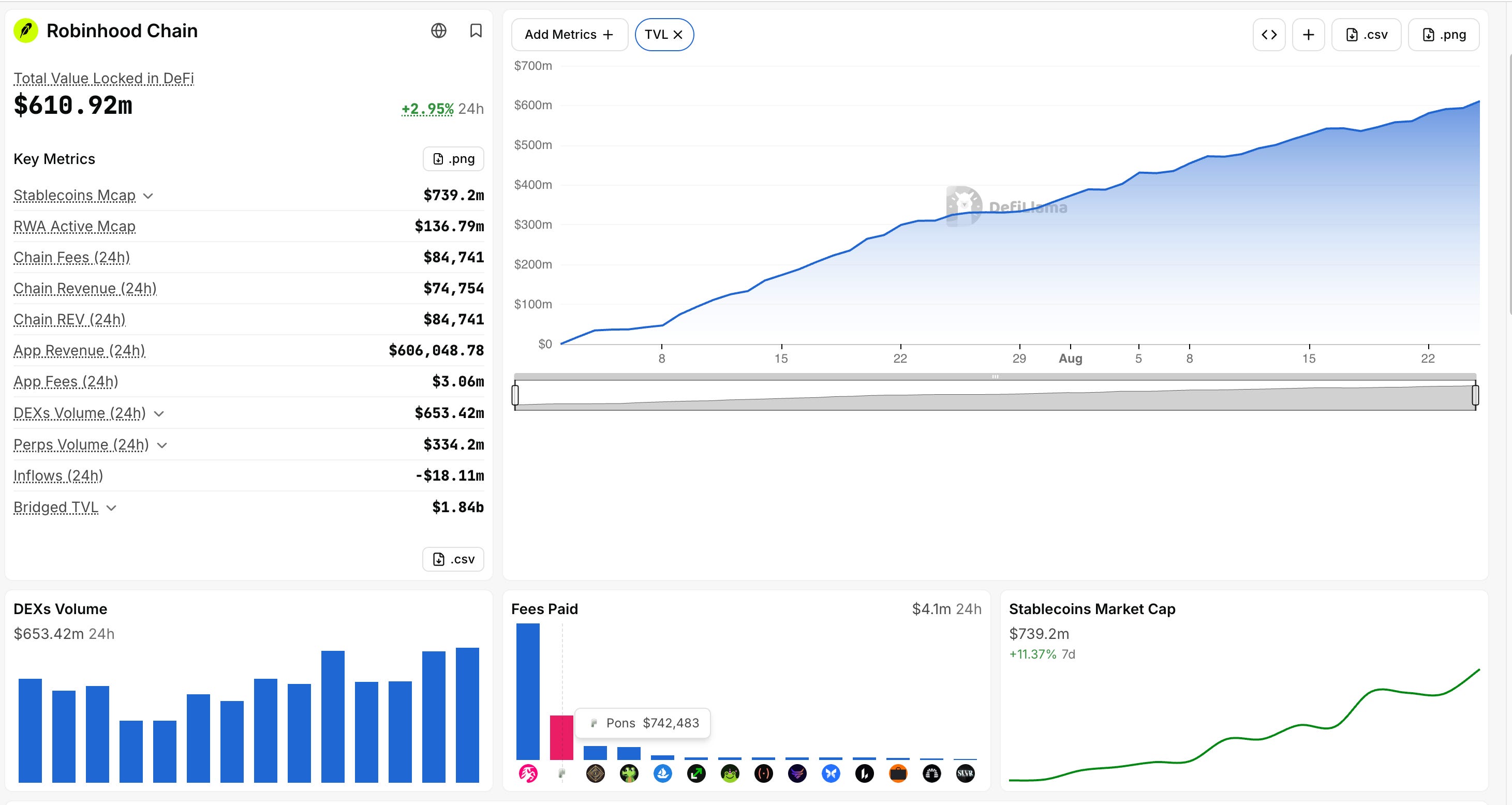
DeFiLlama currently shows $739M in stablecoins, $137M in active RWAs, $1.84B of bridged TVL + $3.64B of DEX volume over the last seven days:
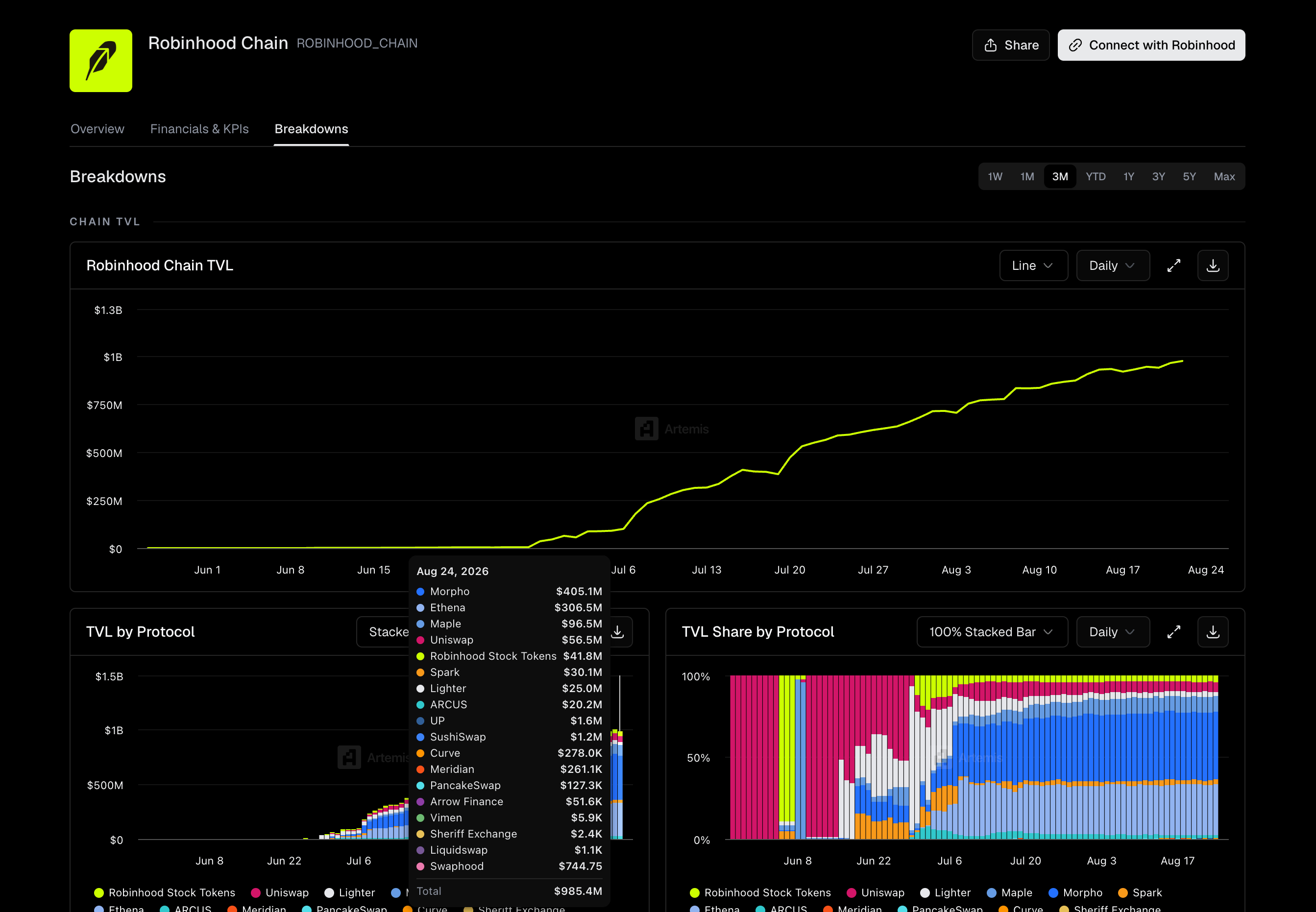
Artemis recently placed total TVL close to $1B (Morpho & Ethena dominating), although the exact number changes depending on which deposits and bridged assets are counted:
The app economics remain the most interesting part.
Apps generated $3M of fees and retained $510K of revenue over the latest 24 hours. The chain itself generated $85K of fees and $75K of revenue. That leaves the application layer earning nearly 7x more revenue than the underlying chain.
Early activity came from memes, launchpads + farming… but the next stage is already emerging as developers find more uses for Robinhood’s Stock Tokens.
Stock Tokens are standard ERC-20s with live Chainlink price feeds. This means any developer can plug them into a launchpad, rewards system, lending market, trading venue or agentic fund using familiar EVM infrastructure.
RobinHood Chain Apps Leading this Charge
1) Pons: token issuance meets tokenized stocks
Pons became Robinhood Chain’s breakout launchpad during its first month.
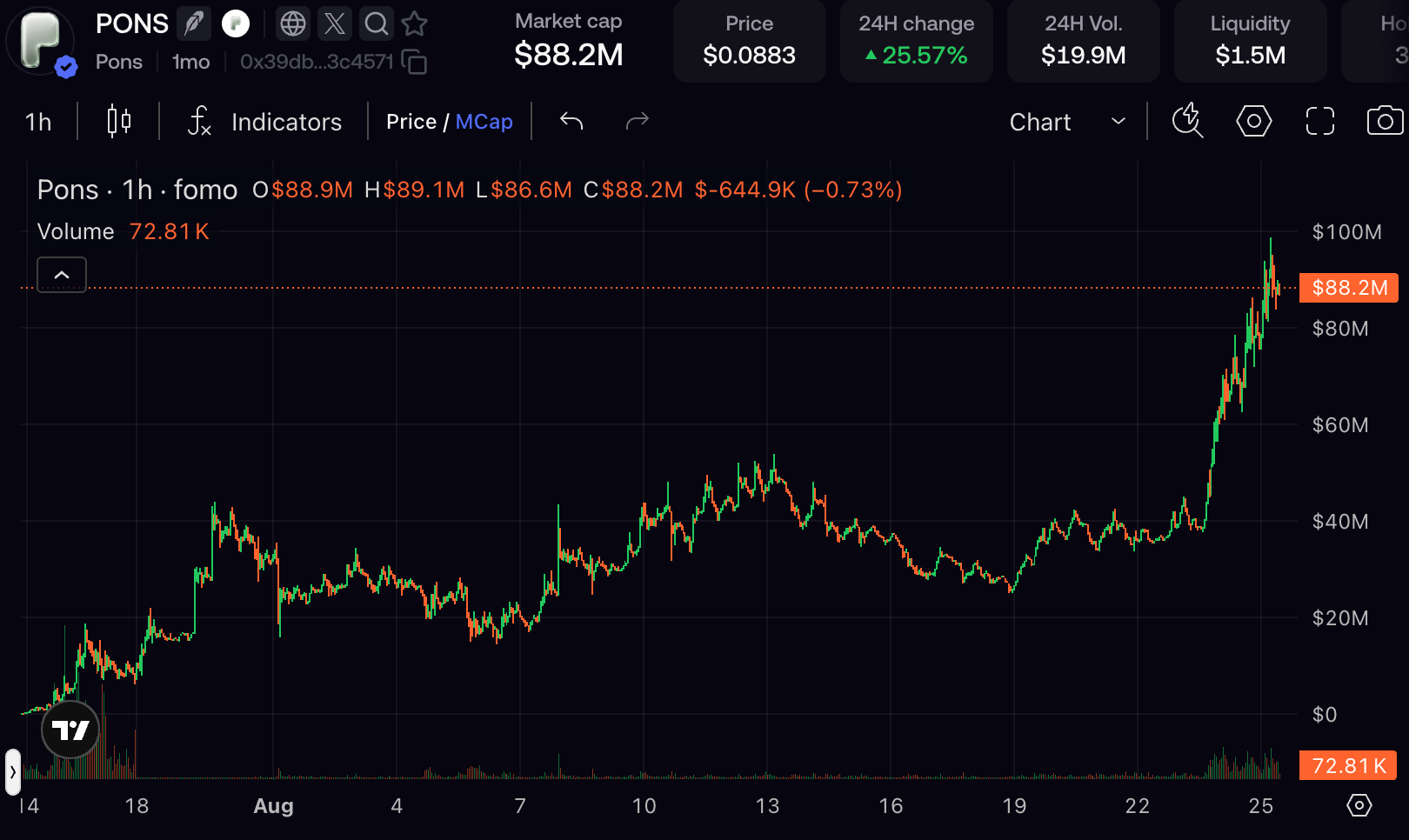
At its peak in late July, it processed $99.7M of daily volume, 1.3M transactions and 11,200 token deployments. Across seven days it produced $7.86M in gross fees on $826M of volume, several times more than the chain collected in gas fees.
Pons V2 now uses an ETH-denominated bonding curve + Uniswap v4 liquidity after graduation. Creators can launch against custom quote assets including USDG and tokenized NVDA, AAPL or HOOD, with creator fees paid in the selected asset.
A community can launch a token directly against a stock, accumulate creator revenue in that stock and carry the same pair into permanently locked Uniswap liquidity. Tokenized equities become productive building blocks inside crypto-native markets.
Launchpad revenue is reflexive: volume, fees + burns can fall together when attention moves. Pons needs V2’s stock-paired markets to sustain activity outside the initial launch cycle, but its recent uptick suggests we are about to see a second wind:


2) Index: turning speculation into stock ownership
Every $INDEX trade carries a 3% fee. The protocol uses that fee to buy a basket of tokenized stocks and distributes them directly to holders every 15 minutes. There is no staking or claim process.
The protocol says it has already distributed nearly $1.1M of Stock Tokens, which marrys up to the growth we are seeing in wallets holding equity tokens on RH chain:


Its next phase extends the mechanism beyond $INDEX. A project can launch through its preferred launchpad or connect an existing token, then route activity into real equities for holders. Index becomes a value-accrual layer that other tokens can plug into.
This creates a simple bridge between speculative demand + durable assets:
token activity → protocol fees → Stock Token purchases → holder distributions
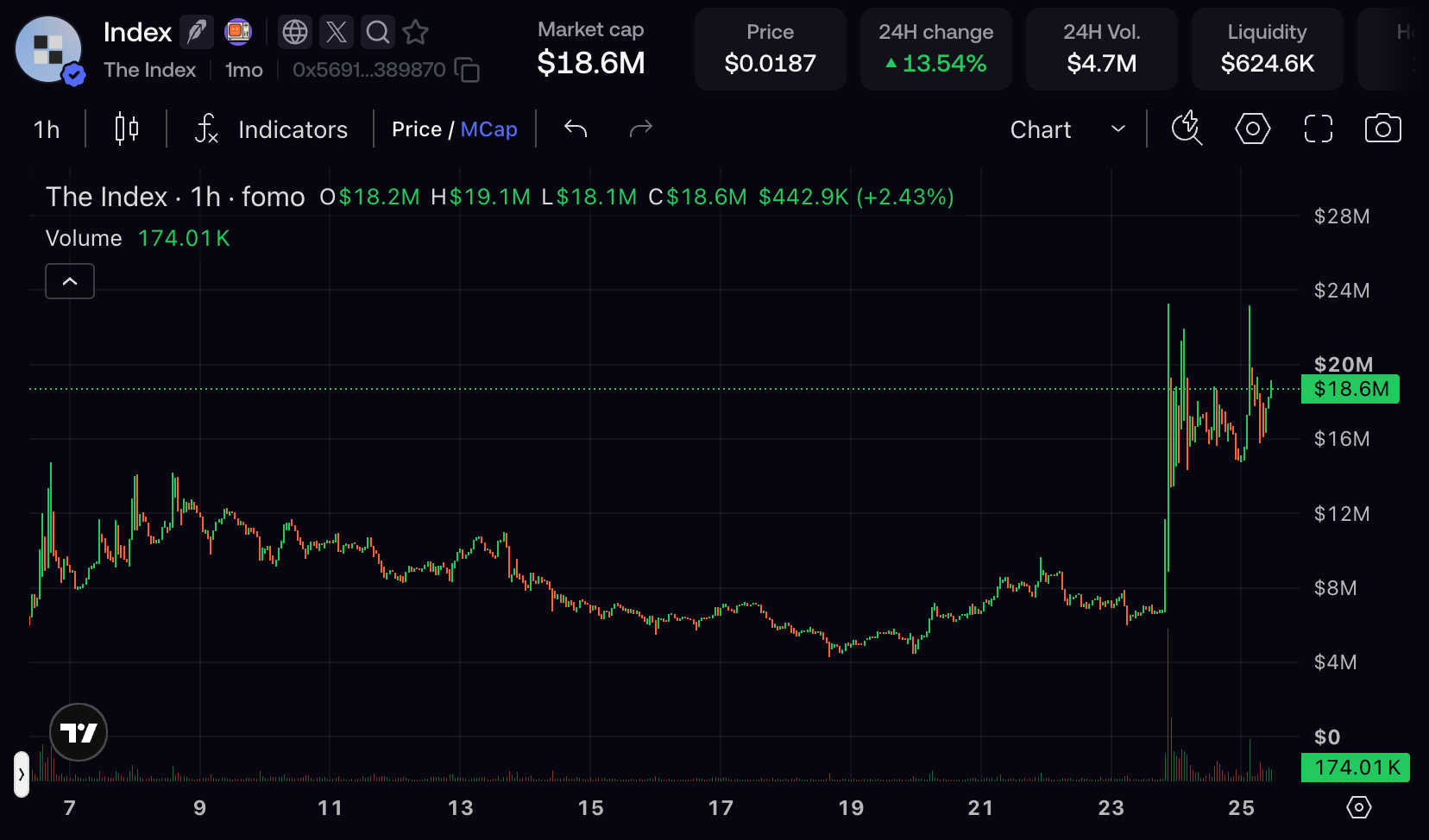
The mechanism depends on trading volume, treasury execution + contract security. Rewards fall quickly when activity slows, but in the meantime it’s clearly garnering a lot of attention:
3) Prism Assets: making the market legible
Prism sits at the discovery + verification layer, tracking 1,196 verified assets from 36 issuers across 17 networks and $13B in value; the current market cap seems low assuming the discovery strategy layer plays out:
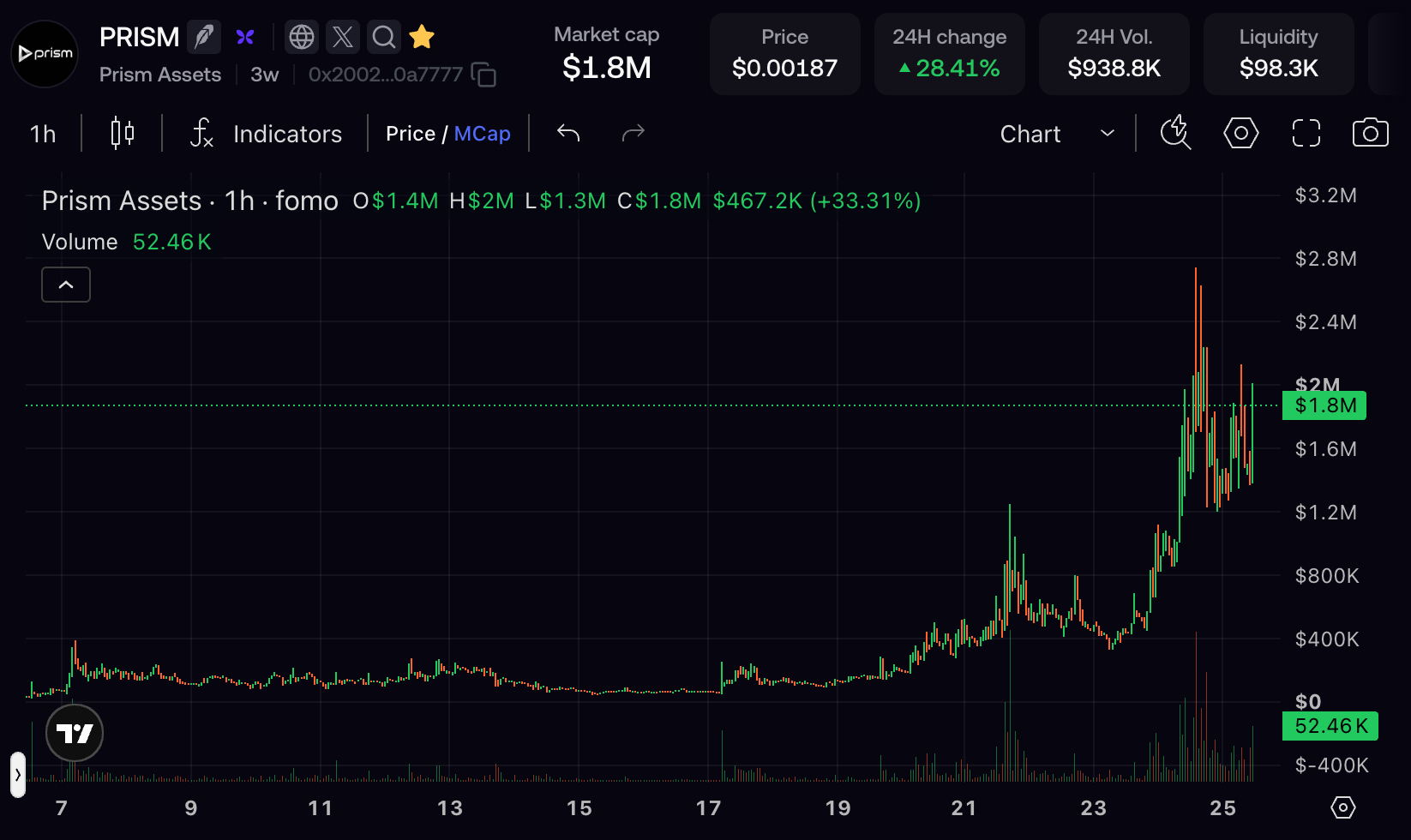
It verifies contracts against explorers + issuer documents, checks prices independently and simulates transfers for restrictions. Its latest run covered 128 deployments: 99 freely transferable, 16 permissioned and 13 inconclusive.
That catalogue is useful for agents that need verified contracts, machine-readable restrictions + execution routes. I’m watching repeat usage, issuer diversity and whether the 5M $PRISM creator pool translates into durable product demand.
4) The Broader stack
Three other projects show where Robinhood Chain can go next:
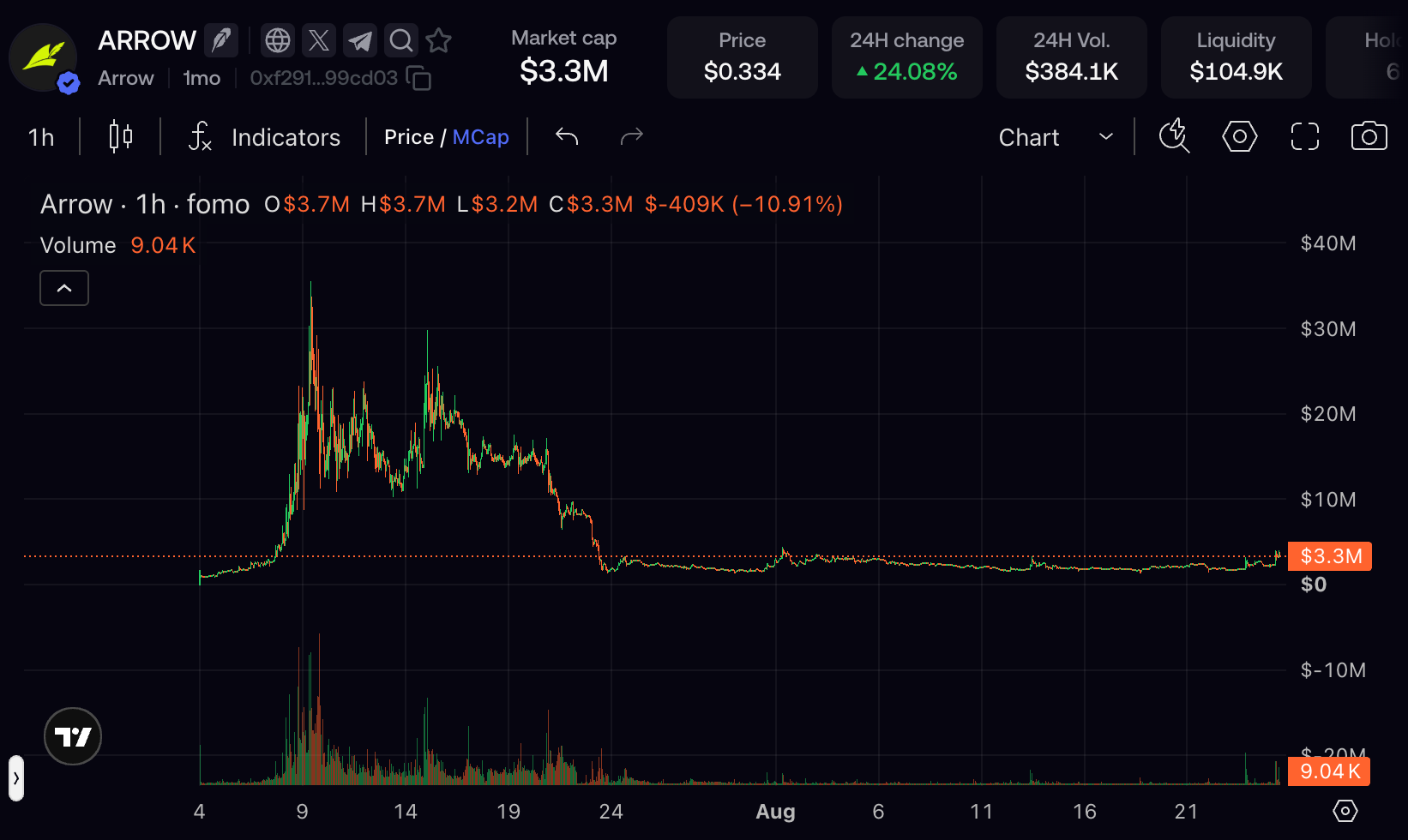
Arrow is building the credit layer. Users can deposit crypto, Stock Tokens or ETFs as collateral and mint aUSD instead of selling. Its dedicated Stock Token oracle accounts for closed-market conditions, which is essential when 24/7 collateral references assets with traditional trading hours. The blow off top earlier suggests the hype is out of the token following the initial RH chain launch:
StonkBrokers is expanding from stock-owning NFT wallets into the Stonk Exchange, a community-directed vDEX scheduled for 29 August. Mancer, DERP + Tickeryard extend the ecosystem into signed-order execution, routing + cross-chain access with more anticipated through its freshly updated launchpad:


Sherwood is building agentic funds as non-custodial vaults. Agents publish exact execution calldata before acting; depositors can vote proposals down and staked guardians simulate the calls before settlement. Fund performance is then ranked onchain.
Together these products cover issuance, ownership, verification, trading, credit + automated capital management. Robinhood supplied the chain, Stock Tokens + distribution; app usage now decides whether the activity becomes durable.
Broader Onchain Insights:
1) Cyberleek: GTA VI attention moved onchain
Cyberleek’s apparent GTA VI leaks show how quickly internet attention can become an onchain market with speculators making 6 figures ($500k at peak):
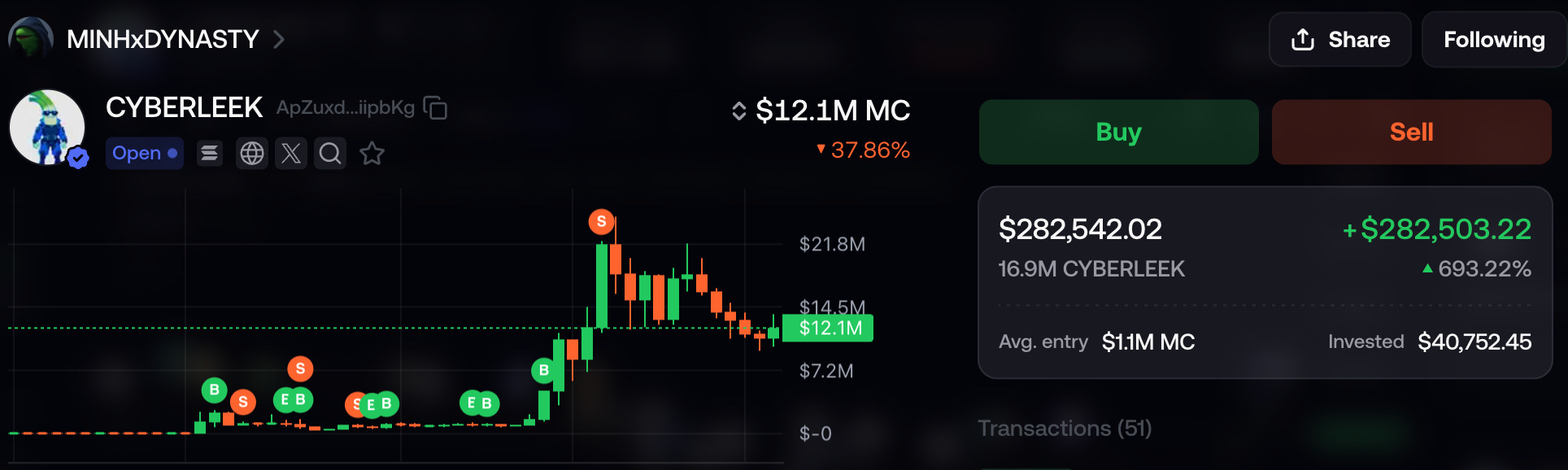
Bitquery reconstructed the sequence:
an Arweave name was purchased on 14 August
$CYBERLEEK began trading on Solana on 15 August
footage appeared on 18 August carrying QR codes for the site + token
The first leak-driven hour produced a 13x move on $1.47M of volume
The operator and provenance remain unverified
Take-Two’s requests to subpoena Microsoft + Discord were approved, although Discord said it had not yet been served
Cyberleek has since offered advertiser contact through Session for a 400 XMR (Monero) fee worth roughly $165K
Monero provides transaction-level privacy by hiding the sender, recipient + amount
The activity is speculative and legally exposed, but the distribution pattern still matters: attention, storage, payments + liquidity moved across open crypto rails within hours.
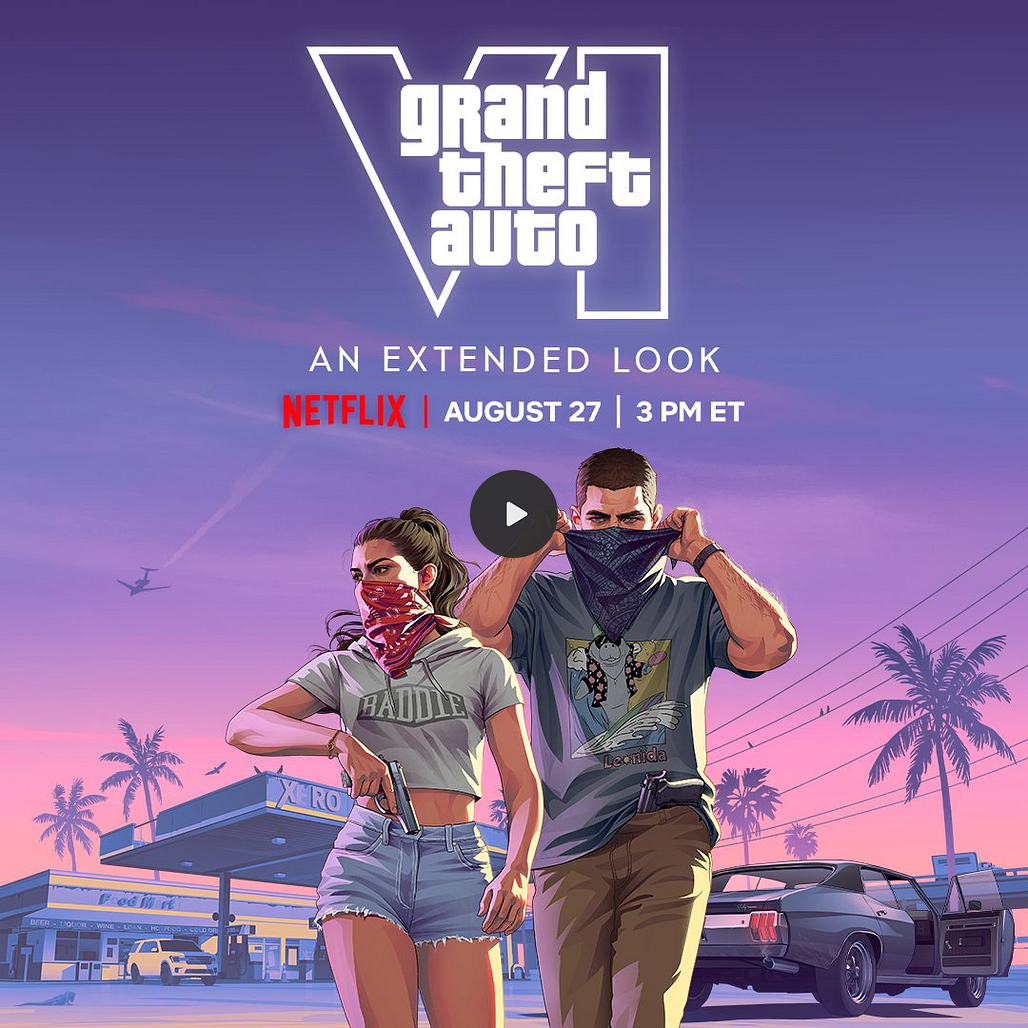
Many are saying this attention capital market will come to a head in a few days as the Netflix GTA 6 show is set to premiere:

2) Agents Consume 5x More Intelligence
AI agents now consume roughly 7.3T tokens a day on OpenRouter, around 5x human volume. Agentic usage has increased 14x in six months, versus 2.8x for humans:


Long-running, multi-step workflows concentrate demand around three rails: model routing, machine payments + verifiable assets. Stripe’s reported $8B OpenRouter acquisition targets the first; MPP + x402 compete around the second; Robinhood Chain sits inside the third.
Binance added Agent OS, letting agents access market data, monitor accounts + trade through controlled subaccounts. Robinhood is approaching from both ends: agentic brokerage accounts above the chain and permissionless assets below it.
3) UR brings live demand to Bittensor (TAO) SN25
UR launched as Bittensor Subnet 25 with 350K+ monthly users, 100K+ residential providers + coverage across 100+ countries.

ur.io is the first demand-side operator. Miners supply encrypted, routable IP coverage; validators walk routes and score demand, reliability + unique coverage before Yuma Consensus directs emissions.
The result is a measurable market for residential internet access—useful for privacy users today and agents as websites restrict automated traffic. UR enters with active product demand; SN25 now has to prove operator payments can support useful miner economics as coverage scales.
Robotics Capital Hits Public + Private Markets
Robotics funding accelerated across bodies + brains this week:
i) XPeng’s robotics unit raised more than $900M at a valuation above $6.3B, with a target of 1,000 IRON humanoids per month by year-end. Generalist raised another ~$200M only two months after a $400M round to scale its robotics foundation models.
ii) Unitree carried that excitement into public markets. Its $905M Shanghai IPO priced the company around $9B; the shares finished 460% higher on debut, briefly valuing it at $66B, before falling roughly 45% from the peak. Speculators were trading the Unitree market pre-IPO onchain via tradeXYZ/Hyperliquid:


The demand signal is enormous, but so is the gap between capital + commercial reality: Unitree’s adjusted profit fell 53% in Q1 and broad deployments remain limited.
Crypto robotics is attacking one constraint money alone cannot solve: diverse training data + open evaluation.
iii) Axis Robotics has built a network of 100K+ contributors and 3M+ multimodal trajectories. Its OpenRoboto partnership feeds that data into Bittensor SN80, where miners compete to improve a shared model and stronger submissions replace the benchmark.
iv) BitRobot coordinates a wider open lab through mission-specific subnets spanning rover teleoperation, egocentric video + simulated manipulation. TeleArms generated 3,000+ hours of behavioural data, while SN04 connects Axis to the same network.
The stack is becoming clear: capital funds bodies + models; distributed networks collect data; open competitions evaluate improvements; deployments prove economic value.
I’m watching shipped units, productive hours, intervention rates + model improvement per dollar. These will separate robotics infrastructure from robotics content.
What I’m Watching
Pons: whether stock-paired V2 launches sustain volume after the initial launchpad cycle.
Index: the adoption of its plug-in stock-reward layer by tokens outside $INDEX.
Stonk Exchange: execution quality, liquidity + the effect on the wider StonkBrokers economy after 29 August.
Prism: repeat users, verified coverage + the link between trading activity and $PRISM.
Agent infrastructure: whether OpenRouter’s 5x ratio persists and UR converts existing demand into durable miner economics on SN25.
Robotics: Unitree + XPeng deployments, and whether Axis + BitRobot data produces measurable model gains with a few methods of getting involved now:


[Alpha] Standard Reserve: This one caught my attention from 0xBeans which will be going live on RH Chain soon, so worth paying attention to:


That’s a wrap for this issue of Sammy’s Snippets. I hope you enjoyed it.
Please leave me any questions or thoughts here - I will respond to everyone!
If you found this interesting, please consider subscribing to this Substack and following me on X for more related insights.
If you are interested in more formal reporting on Crypto AI and Robotics then Khala is my research product.
Disclaimer: The content of this newsletter is for informational purposes only. Nothing in this newsletter constitutes financial advice or a recommendation to buy or sell any asset. Always do your own research before making any investment decisions.
I hold positions in many of the assets discussed in this newsletter. Valuations are approximate snapshots and move quickly. Verify all market data independently before acting.
Follow me on X | Khala Research