


This Crypto AI & Robotics newsletter consists of the following:
Snippet Partner: Umia Finance
What Robinhood Chain actually is
Ten projects ranked by live usage
The PONS, LONG(), Stonkbroker, GIGA, Lighter opportunities
The mainnet launch calendar
A practical participation guide
If you have any questions feel free to reach out to me on X or message my business X account ‘Khala Research’



This week’s issue is brought to you by Umia Finance, the operating stack for token-native ventures.
Umia is taking its venture-creation stack live on testnet, beginning with project discovery and onboarding its founding cohort. Founders can submit a GitHub repository through Umia Score, verify ownership and establish an initial valuation signal before launching:
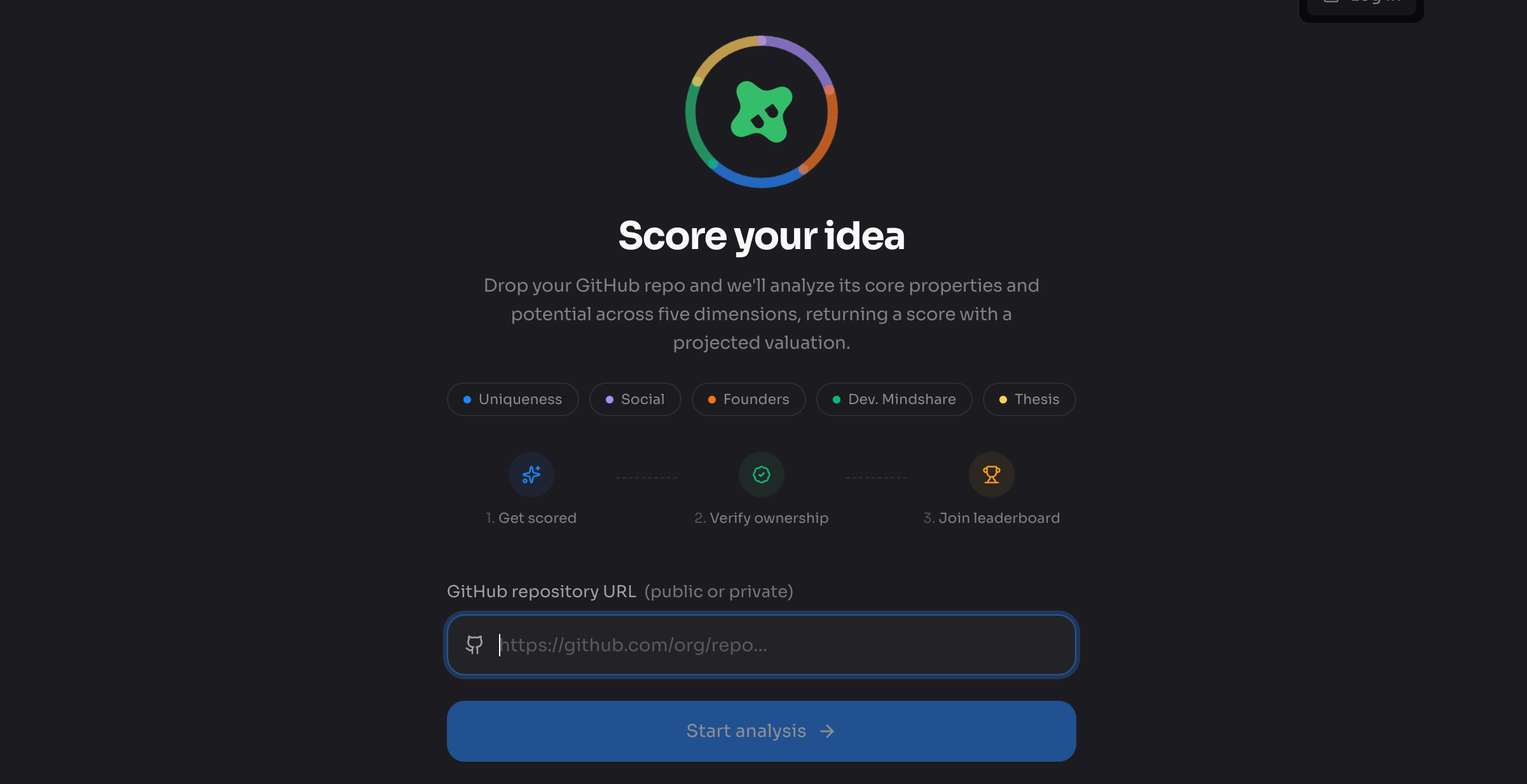
The full stack combines a legal wrapper, token, non-custodial treasury and community fundraising through Uniswap v4 Continuous Clearing Auctions. Once live, major treasury decisions are resolved through decision markets, while Umia’s MetaLeX-powered legal structure gives those outcomes real authority.
The timing matters for agentic ventures. AI lets small teams build products quickly; Umia compresses the capital formation, ownership and governance required to turn them into investable businesses.
Explore the testnet or read how the Umia stack works.
This newsletter goes out weekly to 7.2k+ subscribers.
Please don’t hesitate to message me directly for sponsorship or partnership enquiries.

Robinhood’s Onchain App Store Is Open (Meme - RWA Barbell + agents)
Over the latest 24 hours, users paid Robinhood Chain applications $1.6M in gross fees, retaining $226K as protocol revenue, while Robinhood Chain kept $50K:
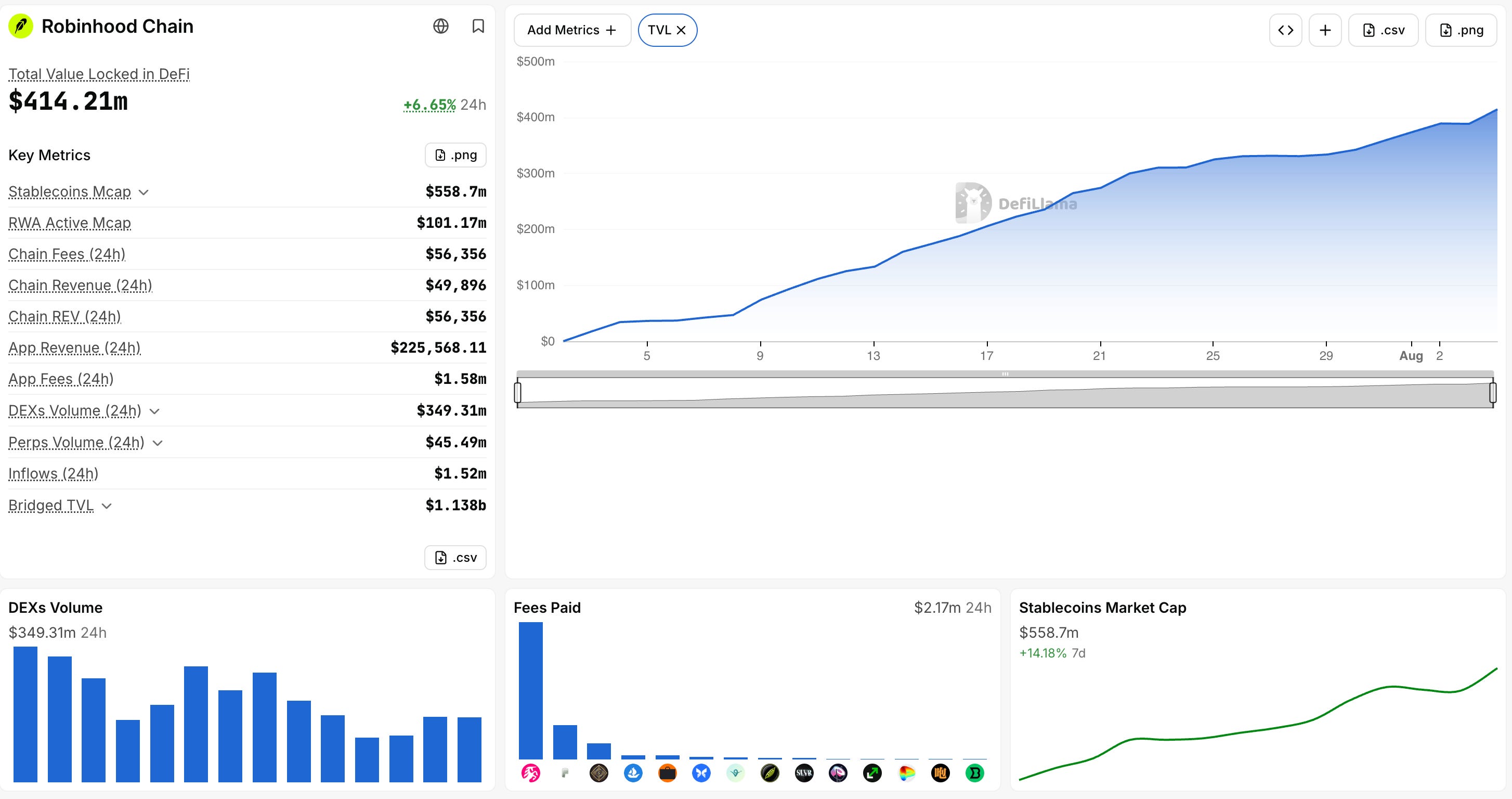
Put simply: the app layer collected 32x the chain’s revenue in gross fees and retained 5x the chain’s revenue for itself.
The 32x figure measures what users paid to apps
The 5x figure compares what applications and the chain actually retained
This supports a “fat apps, thin chain” thesis, meaning that Robinhood provides inexpensive settlement while applications capture most of the economics through trading, lending, launches & agentic services
That makes Robinhood Chain attractive for deployment and why over the next few months you can expect a flurry of activity, with opportunities for those paying attention
To note: Robinhood Chain has no native token, so the investable surface sits across exchanges, launchpads, lending markets & agentic applications
Fees are what users pay, protocol revenue is what an application keeps and holder revenue (arguably the most focused on metric given the lack of trust in the market currently) is what reaches a token through distributions, buybacks or burns
What Robinhood Chain actually is
Robinhood is a permissionless, EVM-compatible Ethereum Layer 2 built with Arbitrum’s Nitro tech stack. It settles directly to Ethereum, uses ETH for gas and runs on chain ID 4663… technical jargon for an ETH aligned layer 2
The chain now holds $411M of DeFi TVL, $558M of stablecoins, $101M of active RWAs and more than $1B of bridged assets. Seven-day DEX volume reached almost $3B; perps reached $228M, up 130%.
The Meme - RWA barbell
Memes acquire users, stocks anchor value and agents automate the portfolio between them. Vlad (Co-Founder and CEO, RH) has doubled down on this meme-RWA barbell thesis:


Pure memes like CashCat have captured decent attention with artists like Beeple posting about it:


But as is the case with any pure attention based speculation instrument it’ll be volatile:


… and it’s actually the interesting mechanisms that lean into the robinhood thesis that have really piqued my attention; namely Stonkbrokers and LONG() with plenty more fresh bouts of innovation shining through with tokenholders at the heart of that value accrual (refreshing I know!)
So how does the landscape look today, and what opportunities exist in the not too distant pipeline? I’ll explain below:
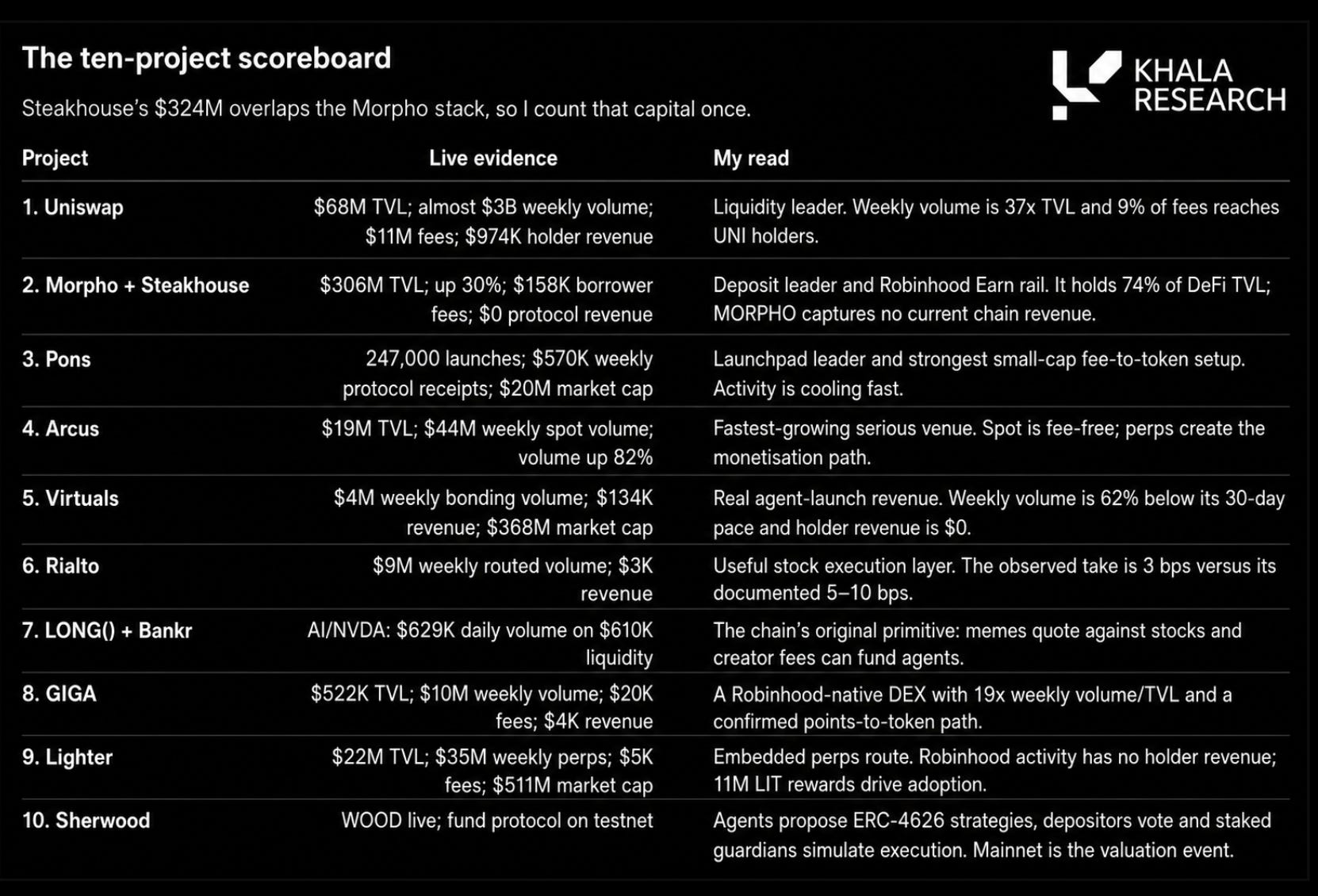
1) PONS: the strongest small-cap fee anomaly
Ponsinomics (nice name) measures protocol receipts from collector-wallet transfers and launch events. The latest week produced $570K… annualised, that’s $30M against a $20M market cap: which equals 68% of annualised receipts.
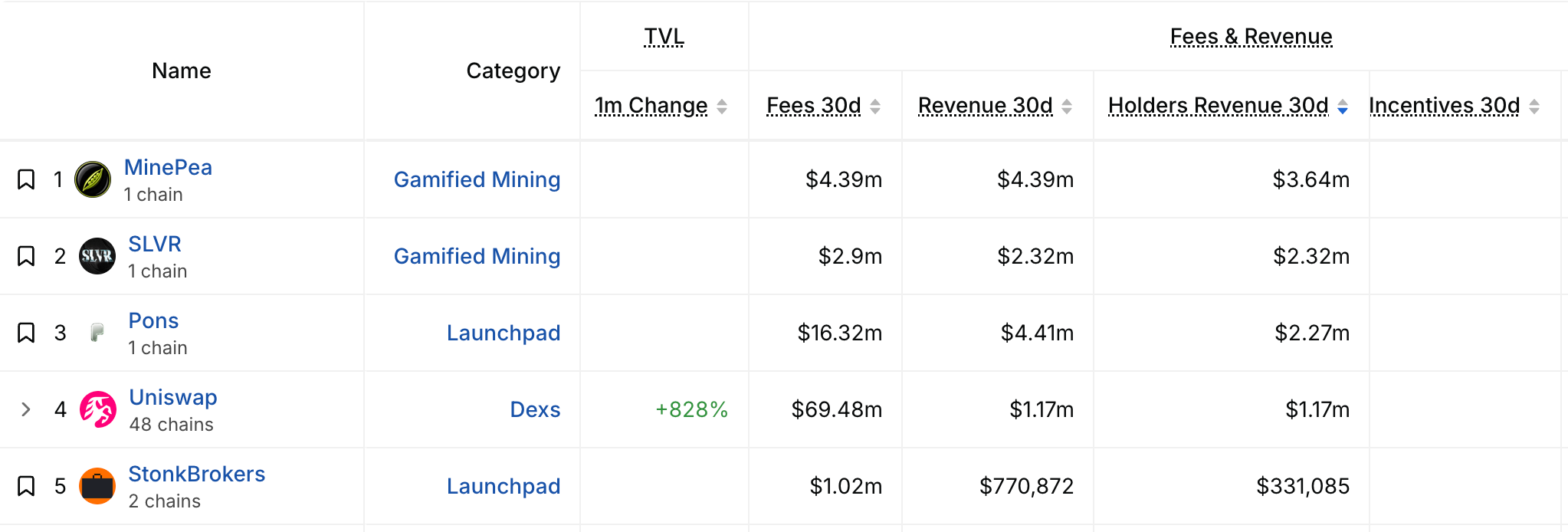
When you strip out the two gamified mining tokens (Minepea + SLVR), Pons is the leader in returning revenue to holders:
On 25 July, Pons handled 64% of launchpad volume and 64% of token deployments across the chain:
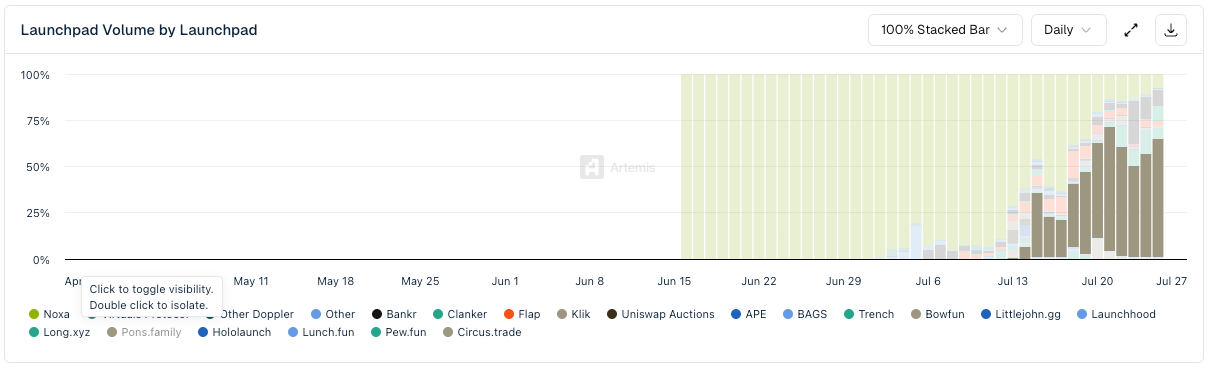
Current policy directs roughly 80% of receipts into TWAP buybacks and burns. The weekly pace implies $24M of annual buying, equal to 118% of market cap. Burns have removed 24% of supply.
Pons V2 is now live with Uniswap V4 and stock-token quote pairs:


If they continue with the 80% fee value accrual to Pons token holders then this is a lucrative asset to watch provided launch volume sustains
2) LONG(): the meme-stock barbell
On 25 July, Artemis measured meme pairs at $297M, or 75% of daily DEX volume. Stock-token pairs were $36M, or 9%. It’s clear these are making a difference to stock trading onchain also:


LONG() links those markets: token such as AI uses NVDA as its quote asset. Every swap creates NVDA turnover and the pool holds NVDA liquidity. The token’s dollar price becomes AI/NVDA multiplied by NVDA/USD, creating two sources of volatility.
AI/NVDA currently has a roughly $2M market cap, $610K liquidity, $629K daily volume and 6,100 holders. Daily volume equals 36% of market cap. LONG() reported $32M of cumulative stock-token volume on 22 July and has since announced Index Expansion into sector baskets:


Bankr adds natural-language launches and trading. Its creator-fee model explicitly lets agents fund their own compute. This creates a loop: memes distribute, stocks build treasury assets and agents deploy the proceeds.
The AI/NVDA pool carries a 48/100 security score and uses a proxy contract, so contract risk sits beside the two-factor market risk.
3) StonkBrokers: the NFT is the stock wallet
LONG() puts the meme and the stock in the same liquidity pool, while StonkBrokers puts the stock inside the meme… this one is novel and worth paying attention to!!
The collection contains 4,444 broker NFTs; each ERC-721 controls an ERC-6551 token-bound account seeded with tokenised stock at mint. The wallet and its stock balances travel with the NFT when it changes hands; the new owner can reactivate it for future distributions. Each broker therefore functions as a transferable onchain portfolio… pretty non-fungible and could move in line with the underlying portfolio?
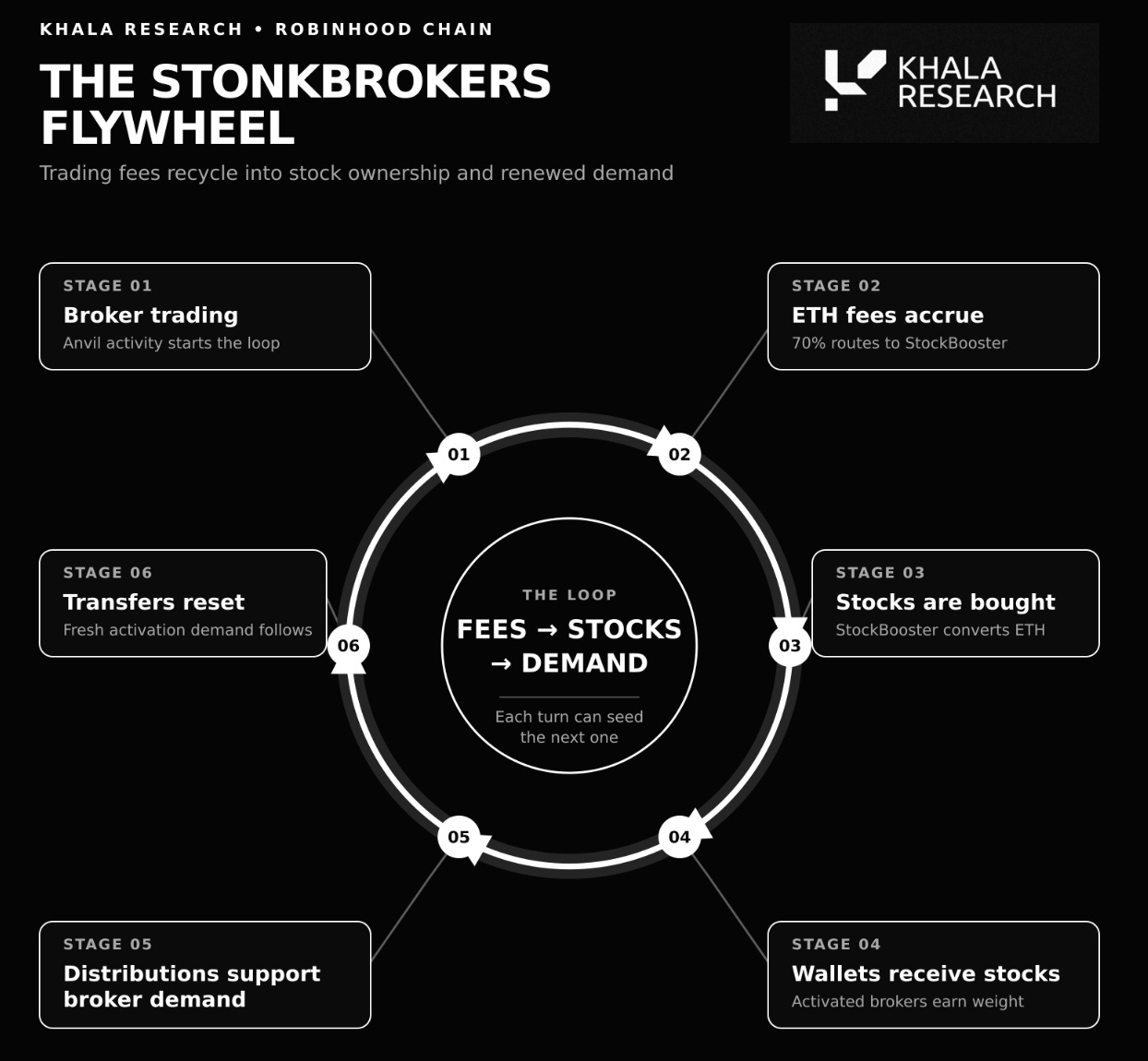
The Anvil AMM creates the cash-flow loop:
A broker costs 666,666 STONKBROKER plus a native ETH fee.
The fee is 10% for a standard swap and 15% for a specific NFT.
70% of that ETH funds StockBooster; 30% goes to the protocol.
Any wallet can then “Clock In”, converting the accumulated ETH into the stock tokens selected by activated broker holders.
Activation creates the token sink. Holders pay between 66,666 and 1,666,666 STONKBROKER for higher distribution weight. At the captured token price, that is roughly $1K to $27K, driving positive price acction to the fungible token also (+8%):


Half of each activation payment burns and half goes to the protocol. A genuine NFT transfer clears the activation, so an active secondary market creates repeat demand for STONKBROKER.
On 4 August, the OpenSea collection showed a 6 ETH floor, 176 ETH of daily NFT volume and 1,116 ETH cumulatively.

Floor multiplied by supply gives a $47M headline valuation. Liquidity behind that mark is thin: only 57 NFTs, or 1% of supply, were listed, while 557 wallets held the collection. Holders equal 13% of supply and the average wallet owns eight brokers.
This is the Stonkbroker flywheel:
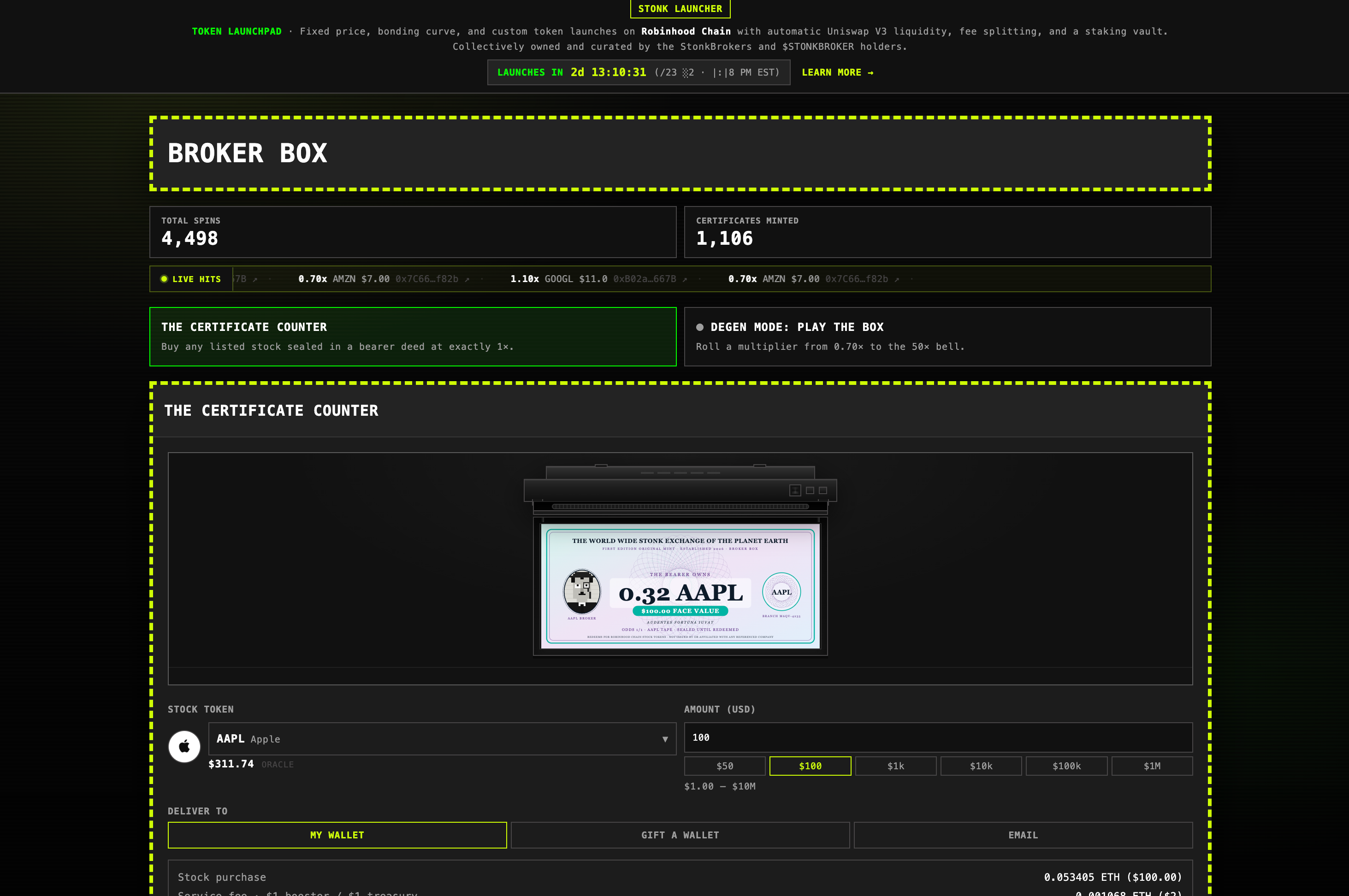
Broker Box extends the idea into stock-token distribution. Nine mainnet machines cover GME, AAPL, AMZN, NVDA, GOOGL, MSFT, SLV, SPCX and USO:
The Certificate Counter swaps ETH into stock and seals it inside another ERC-6551 bearer NFT.
Each purchase charges $2, split evenly between StockBooster and the treasury.
Degen Mode adds a 90% design RTP and stock payouts ranging from 70% of stake to 50x; instant cash-out retains a 5% spread.
This is a gamified acquisition funnel for tokenised stocks with every prize backed by inventory onchain.
The metric worth tracking is stock-token distributions per activated broker.
A dashboard showing Clock In volume, stocks purchased, average payout, active brokers and activation burns would make the productive value visible beside the NFT floor.
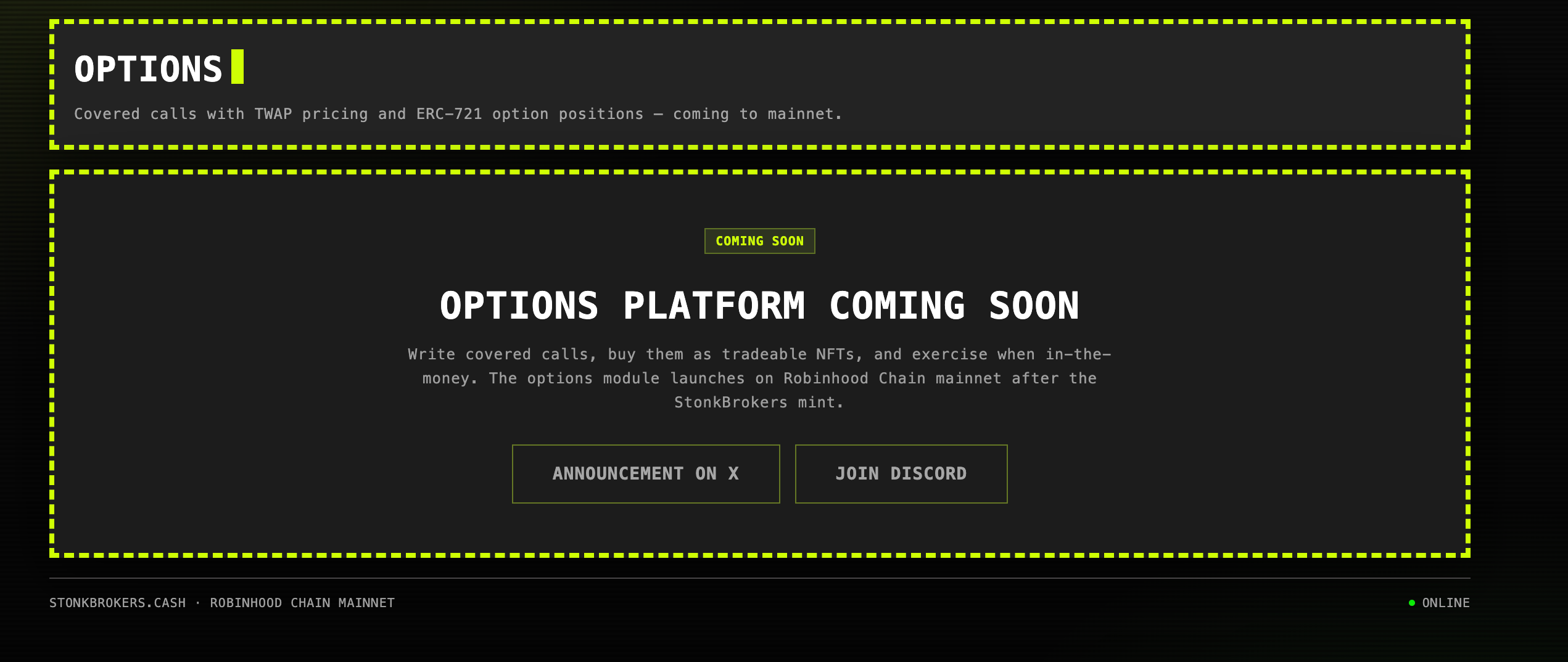
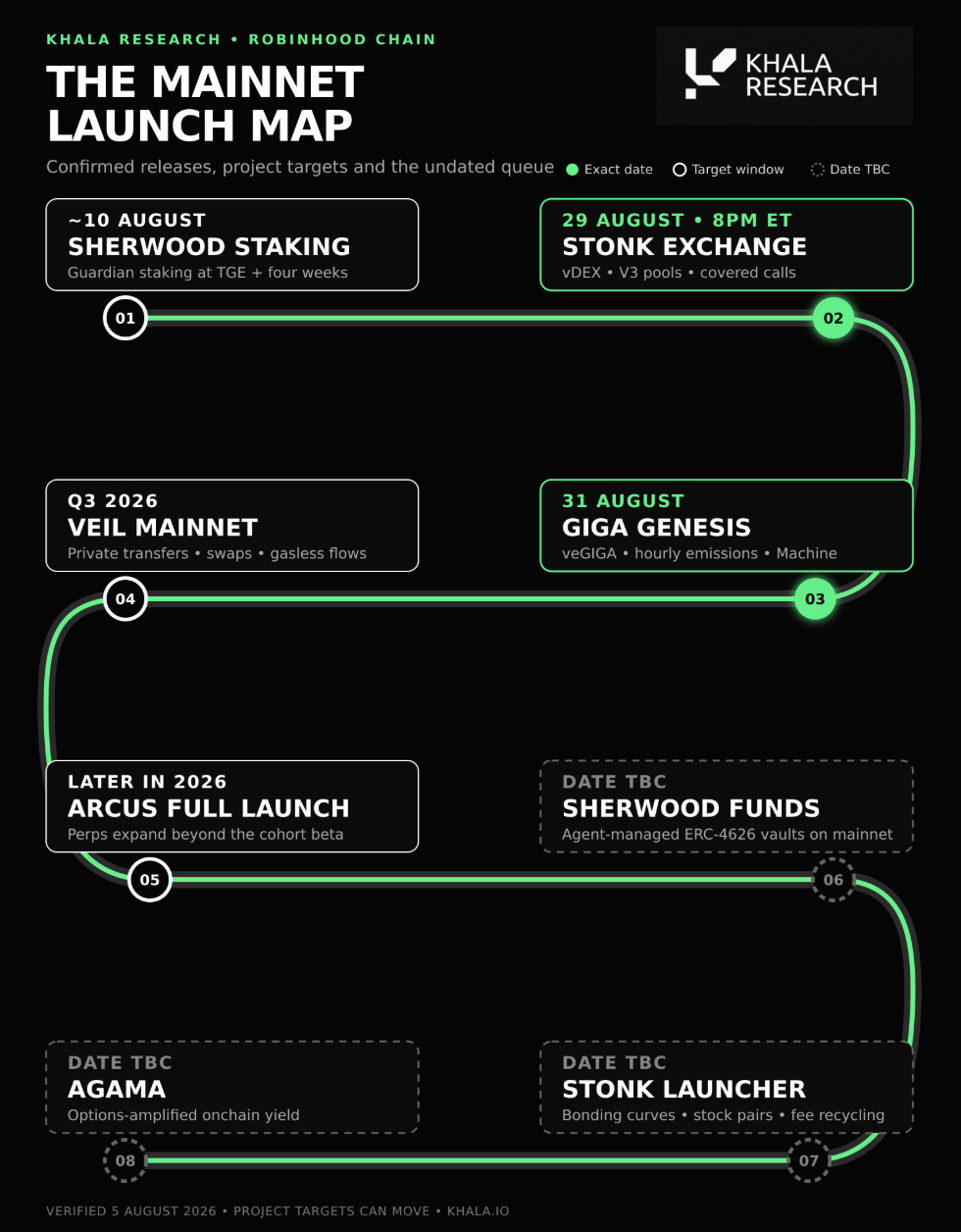
The project’s Stonk Exchange, pools and covered calls are scheduled for 29 August, creating the next test: whether the same fee-recycling model can extend beyond NFT trading with options involved also:
4) GIGA: what it is and why it matters
GIGA is a Robinhood-native DEX and liquidity coordination system; it supports stable, volatile and concentrated pools. At Genesis, its controller will redirect emissions every hour toward pools producing the most revenue. This replaces weekly gauge voting and bribes with an automated signal.
The current phase already produced $10M of weekly volume from $522K of TVL. LPs keep 80% of swap fees; the protocol kept $4K from $20K total. Points reward the busiest pools, so part of that volume is farming.
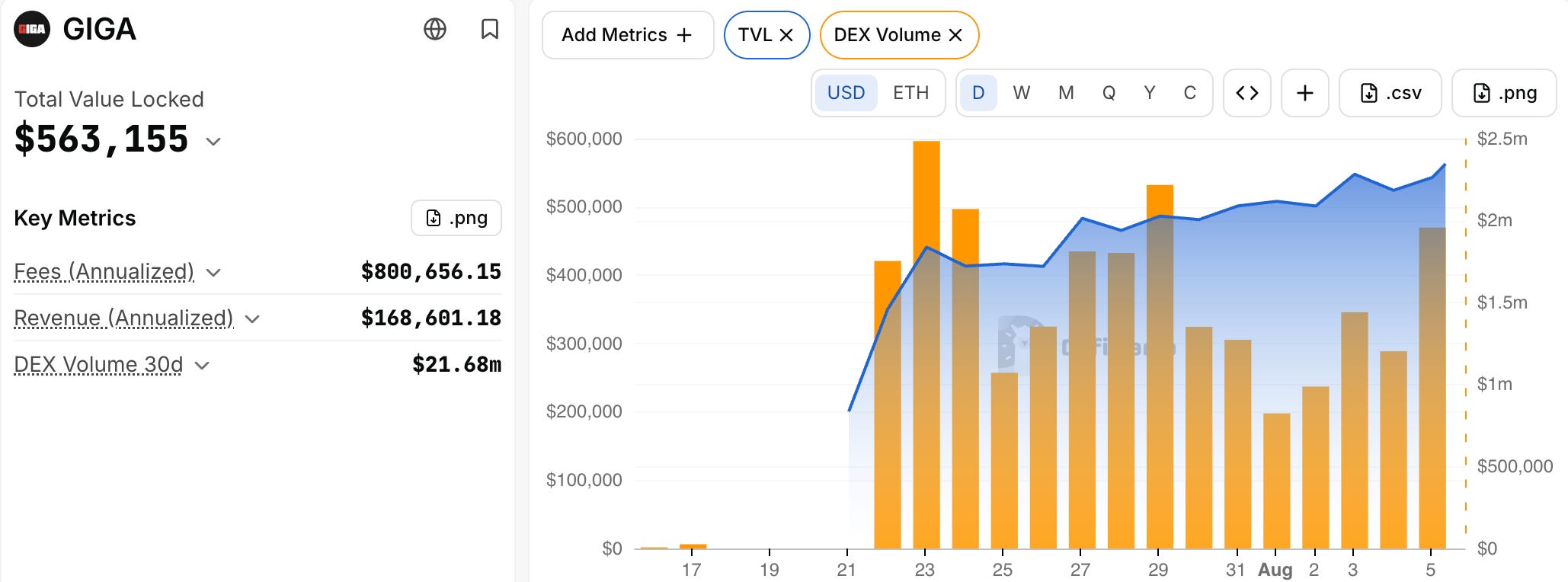
The six-week points program is redeemable for 15M GIGA from a fixed 1B supply. GIGA Genesis is scheduled for 31 August, when the custom emissions system activates.
Two diligence flags matter. The custom controller remains team-controlled and under audit. The official tokenomics page assigns 190M GIGA, or 19%, to the GIGA Machine; the Machine page states 200M, or 20%. That allocation needs a single answer.
5) Lighter: Perps
Lighter is multi-chain but it’s hard to ignore when Perp volume is hitting new all time highs daily:


If the protocol solidifies itself as the number one venue on robinhood chain then we could see some serious competition against the king of perps; Hyperliquid.
It’s pretty clear now that users want to trade tokenized equities and commodities onchain, so offering venues to speculate on derivatives of tangible assets with decent user experiences is becoming increasingly appealing
Where headline activity misleads
UP trades at a $30M FDV. It generated $14M of weekly volume and $27K of holder revenue, then distributed $519K of incentives. Weekly earnings were -$492K.
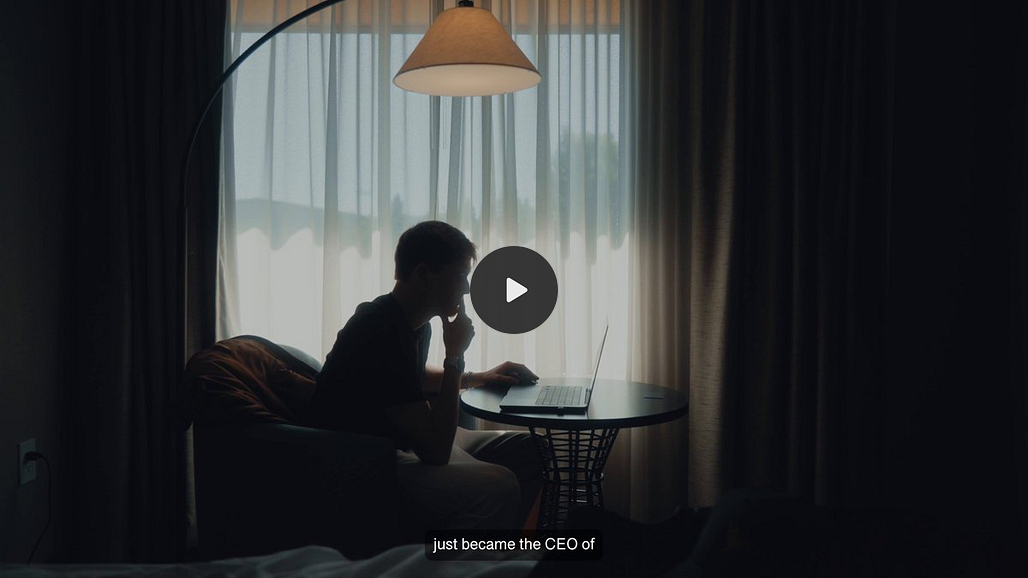
Sushi routed $9M through $216K of TVL and generated $357K of fees. Holders received $5K, or 1%; likely because its more established with greater overheads + a hike in marketing expense from a pretty decent video:

NOXA generated $872K of fees with $0 protocol and holder revenue.
RamsesX has a $649K market cap and $452K TVL, with $0 tracked volume or fees.
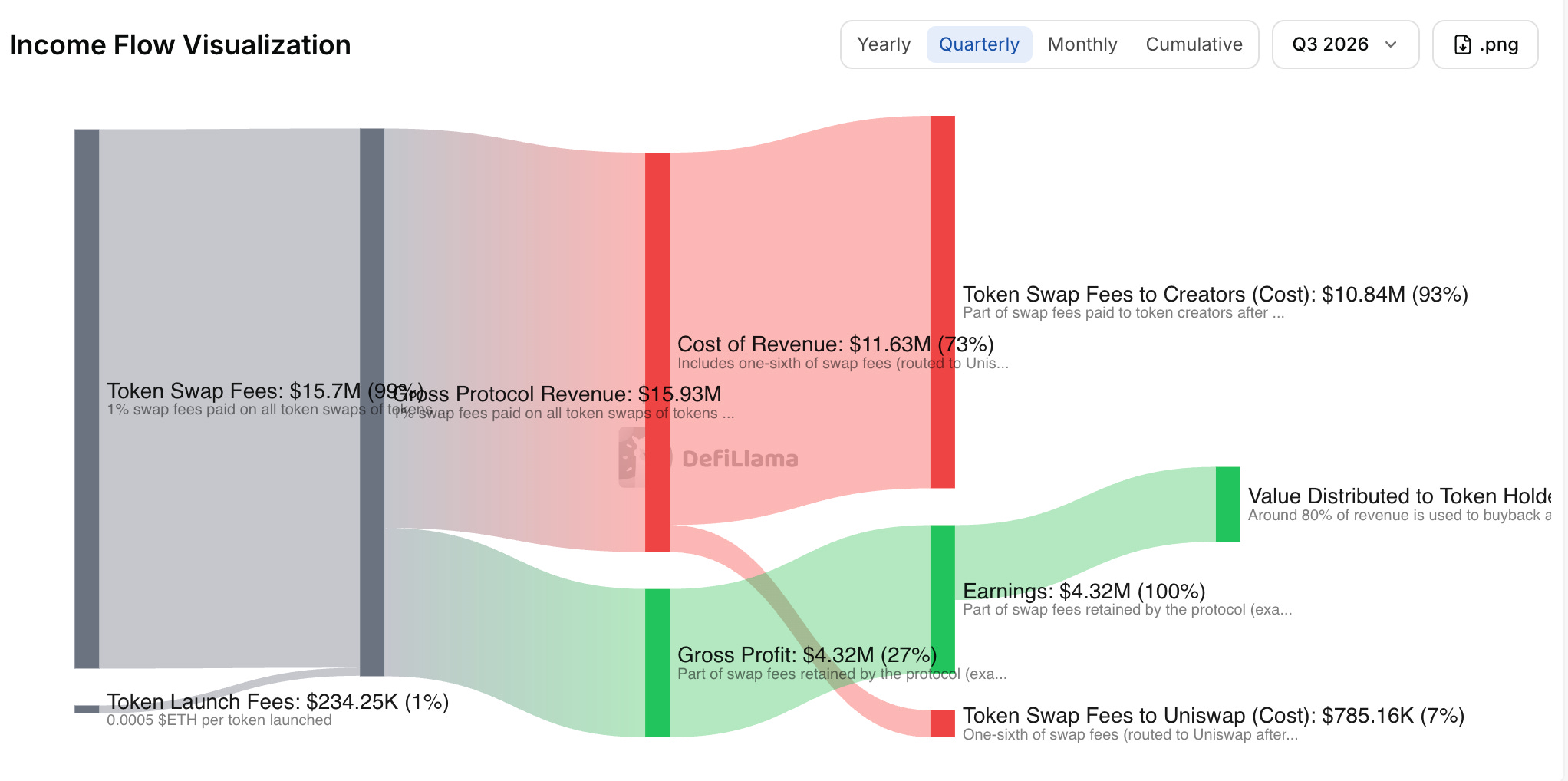
Fee screenshots show activity but it’s the token value depends on the cash-flow path. So when you’re looking at the DeFi llama fee flow diagrams in search of investible tokens, check the flows back to token holders like for Pons ($2.18m of the $4m):
The mainnet launch calendar
How I would participate
1. Add the network from official docs. Chain ID 4663, ETH gas, official RPC and Blockscout.
2. Bridge a test amount. The canonical bridge takes about ten minutes in and seven days out. Relay and Across provide faster routes.
3. Establish the base layer. Make a small Uniswap swap, inspect Morpho markets and try Arcus (dydx team) spot if eligible.
4. Separate experiments. Use small amounts for Pons V2, LONG()/Bankr and GIGA points. Run Sherwood and Veil on testnet. Keep experimental contracts in a dedicated wallet.
5. Track the same columns weekly. Volume, TVL, protocol revenue, holder revenue, incentives and market cap.
DeFiLlama ranks apps;
Entropy Advisors shows network economics, RWAs and Morpho in one dashboard; Ponsinomics covers collector flows;
Blockscout verifies contracts and transactions.
Robinhood has announced no chain token or chain airdrop. Stock Tokens are tokenised debt securities providing economic exposure to shares
Also set up an agentic trading account and play around with it:

Robinhood Chain’s first month belongs to:
Uniswap for trading,
Morpho for deposits, and;
Pons for token-level value capture.
The deeper opportunity is the meme-stock-agent loop:
LONG() & StonkBroker have created the pairing model.
Pons and Bankr are distributing it.
GIGA is competing to coordinate the liquidity alongside Uniswap.
Sherwood is building the agent-managed capital layer.
Continually track these (and other emerging) projects for activity and position accordingly as attention and activity grows.
It may even pay to establish what Robinhood typically sets as its core exchange listing requirements in the hopes they start running some of their own native tokens through to their user base:


That’s a wrap for this issue of Sammy’s Snippets. I hope you enjoyed it.
Please leave me any questions or thoughts here - I will respond to everyone!
If you found this interesting, please consider subscribing to this Substack and following me on X for more related insights.
If you are interested in more formal reporting on Crypto AI and Robotics then Khala is my research product.
Disclaimer: The content of this newsletter is for informational purposes only. Nothing in this newsletter constitutes financial advice or a recommendation to buy or sell any asset. Always do your own research before making any investment decisions.
I hold positions in many of the assets discussed in this newsletter. Valuations are approximate snapshots and move quickly. Verify all market data independently before acting.
Follow me on X | Khala Research