


This Crypto AI & Robotics newsletter consists of the following:
Snippet Partner: Axis Robotics
Standard Reserve’s monetary model
Bank Charters and Branches
Benchmark Analysis: Standard Reserve vs NetNet Capital
The launch and current economics
How to participate + the main risks
If you have any questions feel free to reach out to me on X or message my business X account ‘Khala Research’



Large Language Models (LLMs) learned from the internet with “digital” being sufficient, but Robots need physical interaction data to evolve
Axis Robotics is building the data infrastructure required to train Physical AI.
Its network of more than 200,000 contributors have added > 5 million trajectories now; completing robotics tasks through browser-based simulations, generating the demonstrations and corrections required to improve real-world robot models:


You don’t need a robot, GPU or technical background. The simulations run locally in your browser, while completed trajectories are signed and verified onchain
As robotics companies move from impressive demos towards general-purpose machines, proprietary interaction data is becoming one of the industry’s most valuable resources
Axis is building the engine that collects it.
Explore Axis Robotics and track their monthly progress through their X articles
This newsletter goes out weekly to 7.4k+ subscribers.
Please don’t hesitate to message me directly for sponsorship or partnership enquiries.

The Standard Reserve: An “Onchain Central Bank”
Onchain banking normally means lending, borrowing and trading; “The Standard Reserve” has interpreted it more literally…
It’s created 1,000 banks, issued each one a Charter & connected them to an autonomous monetary system that adjusts issuance according to capital flows
Why has this gotten so much attention?
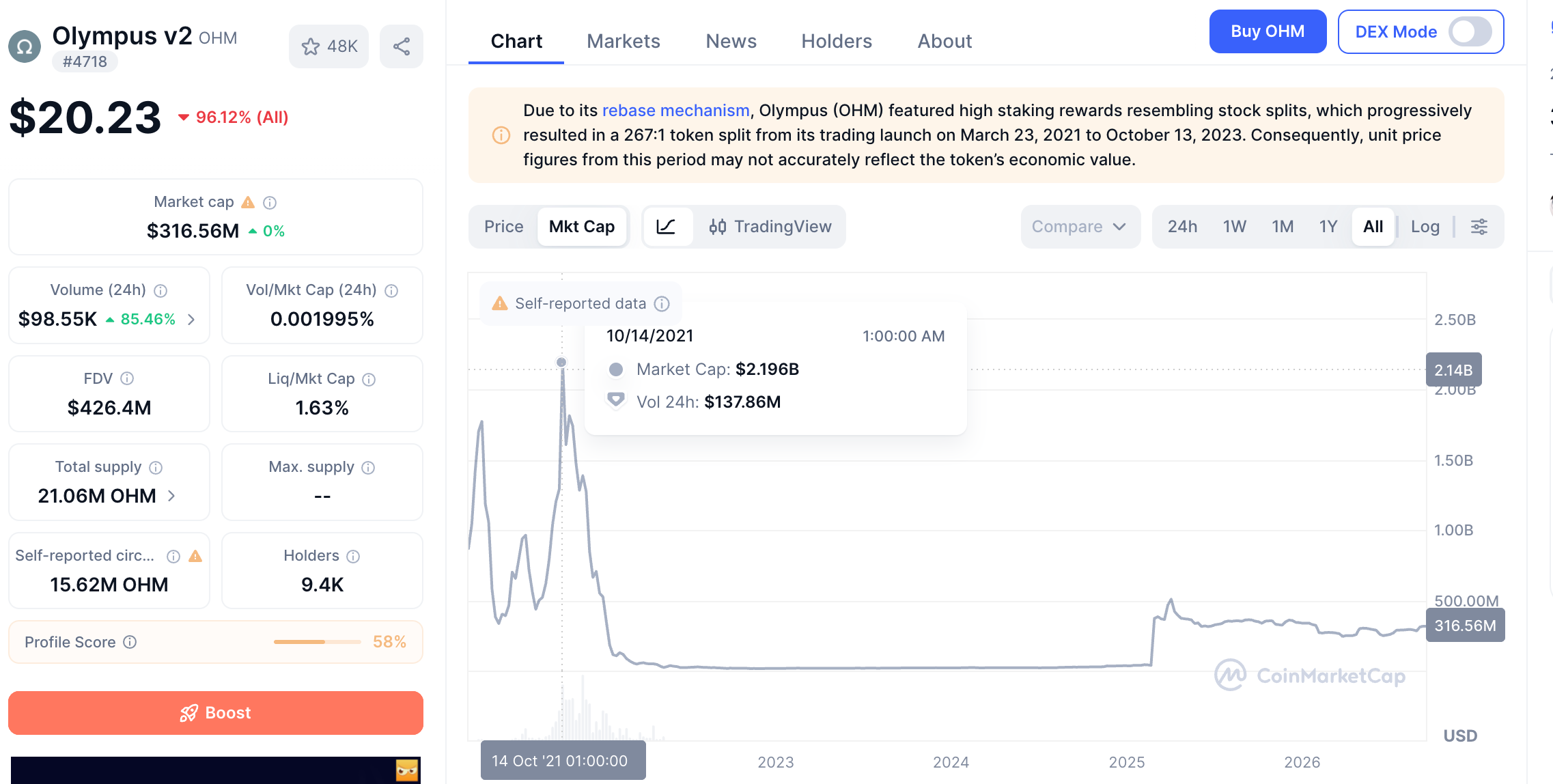
Well, it’s been likened to “Ohm” which was a crypto protocol in 2021 that ran into the billions; some of the largest participants netting $80m in unrealised gains, until it all came crashing down:

Prior protocol shortcomings have been analysed, so perhaps this new Reserve Banking mechanism will follow a different outcome this time?
Buckle up… this is a bit of a read but those who do this NOW could be thanking themselves a month from now
1. Standard Reserve’s Monetary Model
Standard Reserve describes itself as a sovereign onchain central bank; It’s not a regulated bank, it doesn’t offer insured deposits, & STANDARD is not a stablecoin
It is also an independent protocol deployed on Robinhood Chain, not a product operated by Robinhood… to emphasize this!
The system consists of:
One currency: $STANDARD (ERC-20 token)
One canonical STANDARD/ETH market (Liquidity pool)
Banking Charters (NFT)
Branches that earn token issuance
Expansion and contraction vaults
A monetary policy based on net ETH flow
The protocol monitors how much ETH enters its canonical pool through STANDARD purchases and how much leaves through sales
This determines whether the system is expanding or contracting:
Positive net ETH flow places Standard Reserve into expansion (as per below with 3,109 ETH)
Negative or neutral net flow places it into contraction
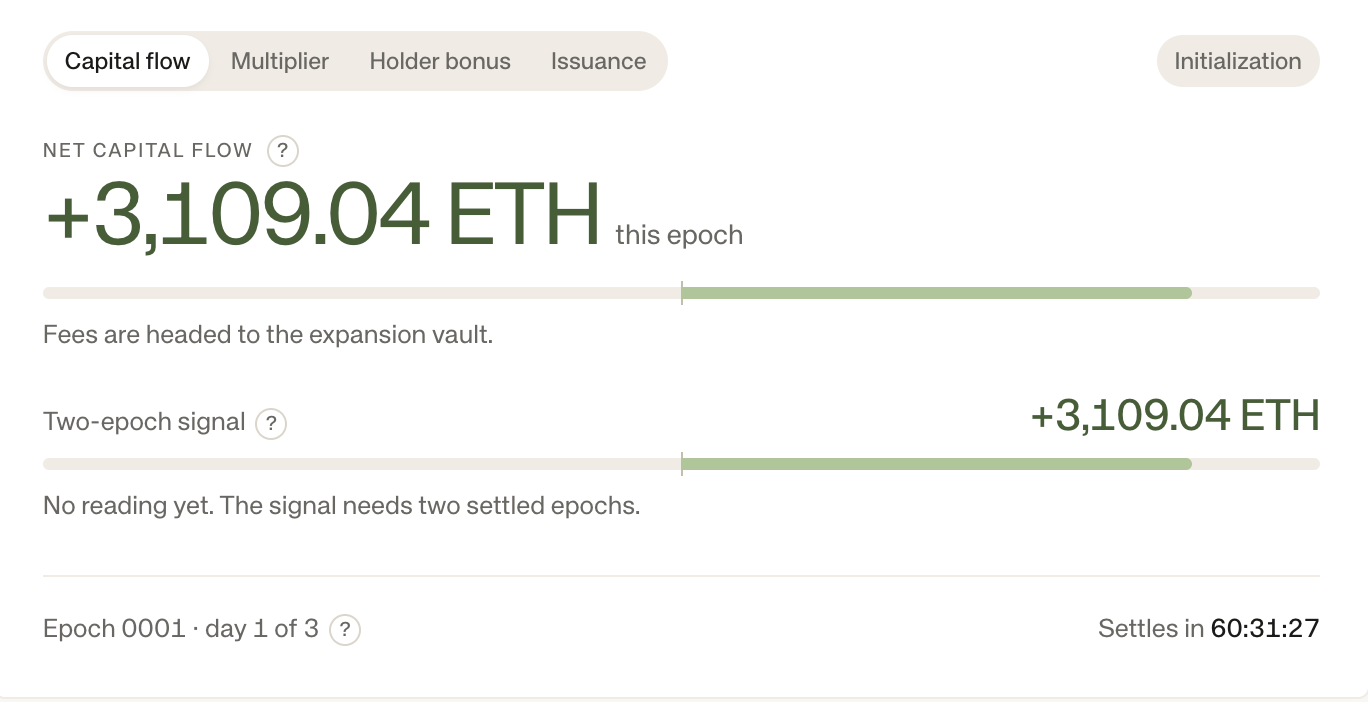
The current epoch determines where trading fees are routed. Monetary issuance responds more slowly, using the previous two completed epochs.
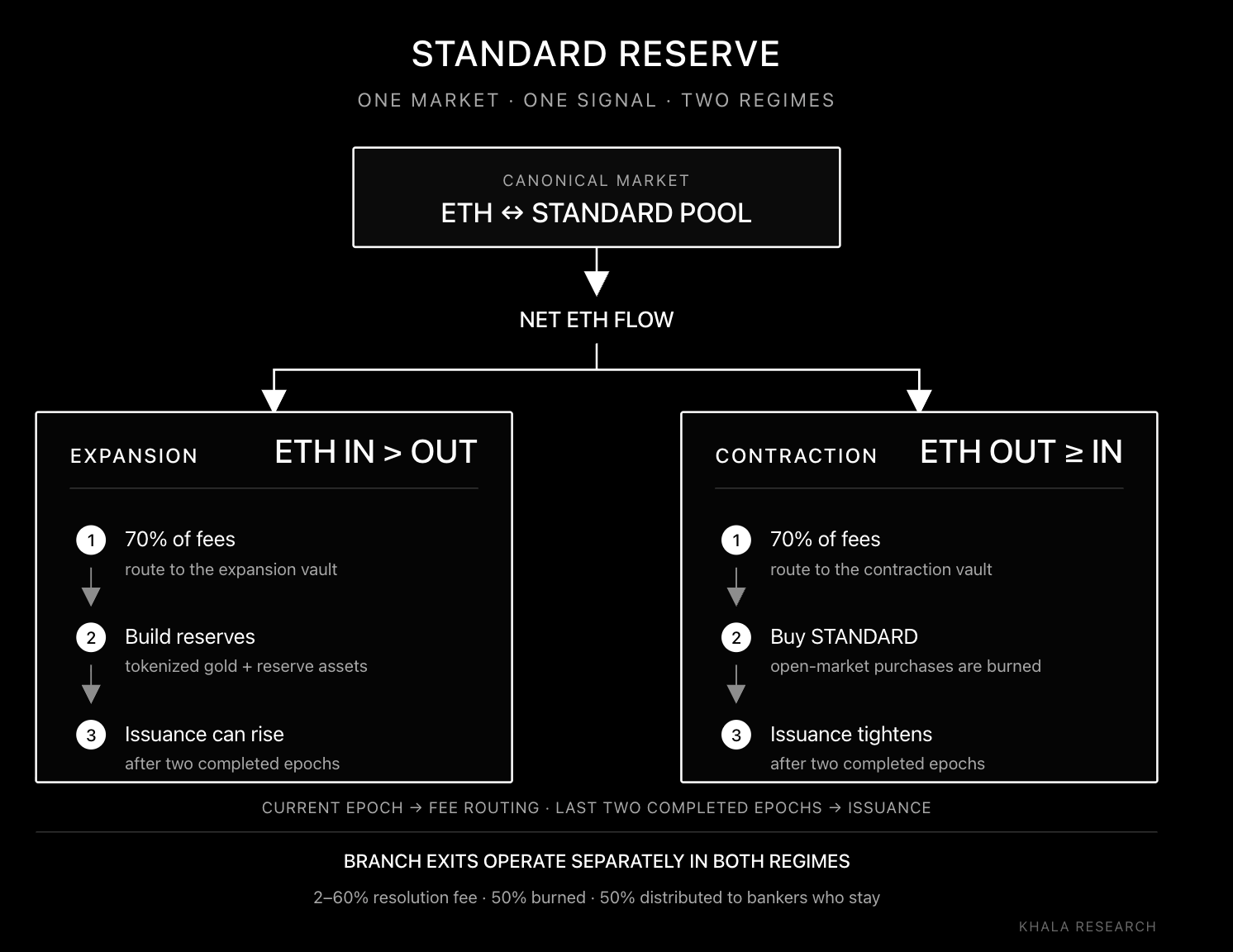
The protocol collects ETH-based taxes from both buyers and sellers; those fees are divided:
70% to the active “expansion” or “contraction” vault
15% to protocol-owned liquidity
15% to the team
During expansion, the largest allocation can be used to accumulate tokenized gold and other reserve assets… e.g. XAUT (Tether Gold… ACTUAL tokenized gold thanks to RWA issuers on RH chain)
During contraction, it finances open-market STANDARD purchases and burns.
STANDARD holders cannot redeem their tokens for a fixed amount of ETH, gold or any other reserve asset.. the reserves are monetary-policy tools rather than direct token backing… I’ll touch on this distinction with the benchmark against Net Net cap later
Day 1 Performance Analysis:
$STANDARD has already reached a $47 million market cap ($470M valuation), with the first Branch auctions selling out within minutes:


The price action illustrates there’s demand, but here’s why it’s interesting
Most previous DeFi reserve currencies relied on fixed or aggressively expanding emissions…
They produced attractive yields while new capital entered (Ponzi 101)
Once demand slowed
issuance continued
supply overwhelmed buyers and the yields became irrelevant…
Ohm is a prime example (hit multi billion dollar val at its peak FYI):
Standard Reserve is attempting to make issuance responsive
Its base issuance begins at 700k STANDARD per day, distributed across every active Branch (currently 1,099 live branches):
Sustained positive ETH flow can increase the issuance multiplier
Negative flow tightens it while redirecting fees towards buybacks
This creates several competing forces; the protocol is continually balancing token issuance against token burns, Branch demand + banker exits; essentially BETTER protocol design:

2. Bank Charters and Branches
A “Founding Charter” is an NFT banking licence…
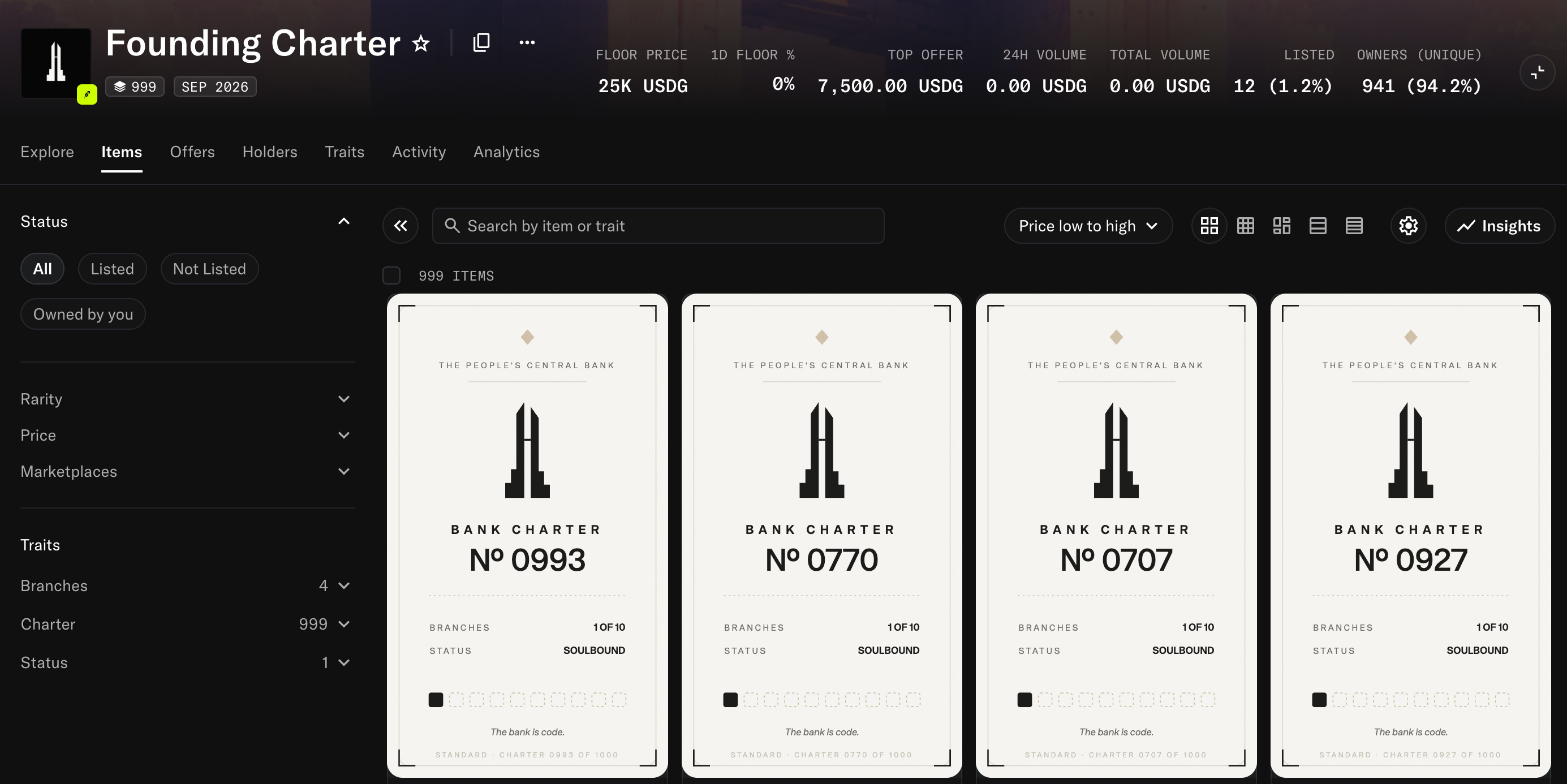
There were 1,000 Genesis Charters at launch; each began with one Branch & can operate a max of ten
Charters are initially soulbound (meaning they cannot currently be transferred or sold…yet) despite there currently being a $7.5k offer on them on OpenSea (pictured above)
Branches are the productive assets inside each Charter
Every active Branch receives an equal share of daily STANDARD issuance
A Charter with ten Branches earns ten times the issuance of a Charter with one, although every new Branch added to the network slightly dilutes every existing Branch
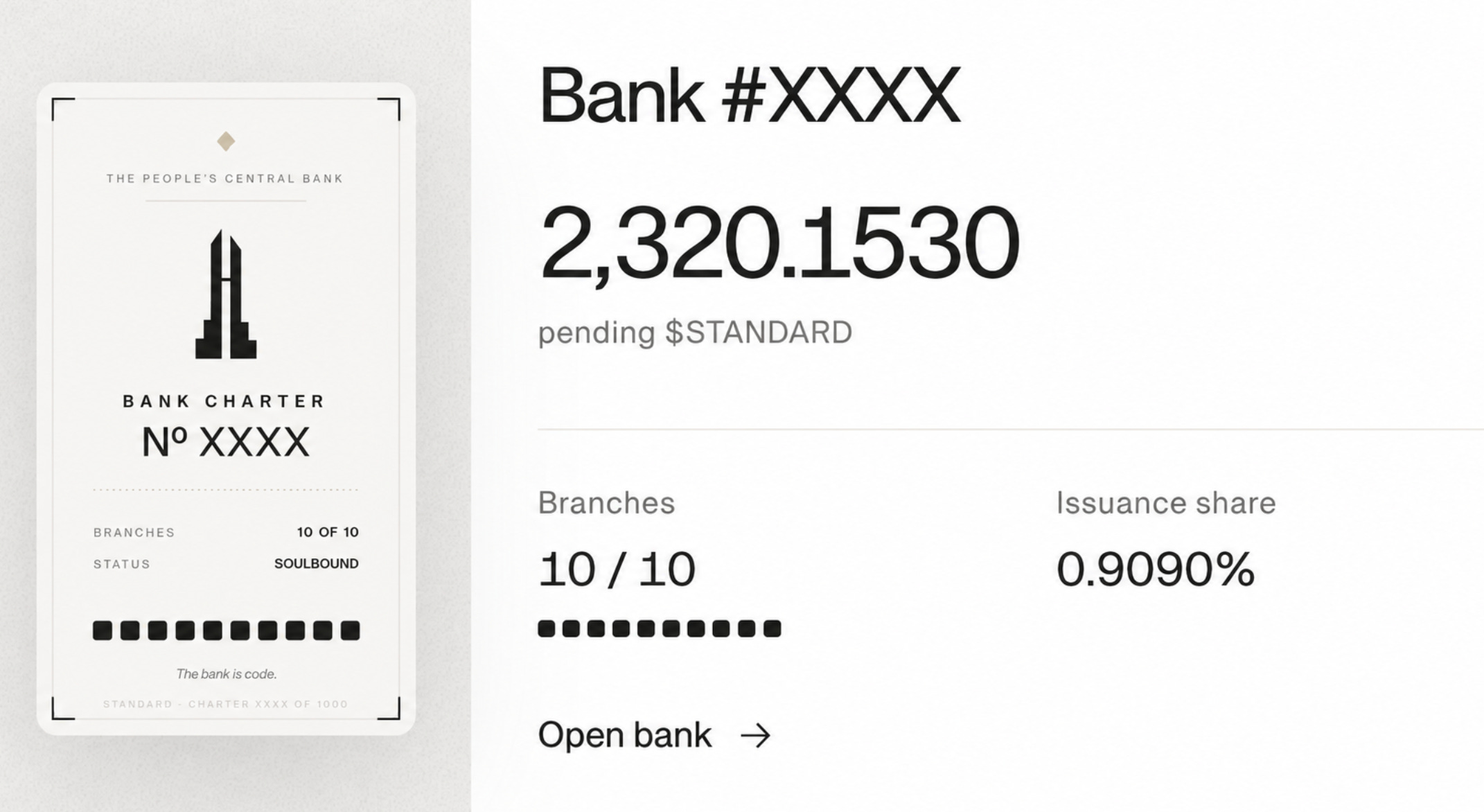
Ten Branches produce ten shares of issuance, while STANDARD accumulates as a pending internal balance… that balance does not immediately enter the banker’s wallet
Withdrawing destroys the Branch
To withdraw STANDARD (the liquid token), a banker must permanently retire a Branch.
If a Charter has ten Branches and retires one, one-tenth of its internal balance is released, that Branch then stops earning forever.
Retiring the final Branch releases the remaining balance and burns the Charter itself. Withdrawals are also subject to a resolution fee ranging from 2% to 60%; the fee responds to total withdrawal pressure across the previous seven days:
Half is burned.
Half is distributed to the bankers who remain.
The holder bonus therefore ranges from 1% to 30% of exiting balances. Bankers cannot repeatedly claim emissions while retaining all their productive capacity and every withdrawal exchanges future earning power for current liquidity
Charter owners must also remain active. Failing to check in for 30 days allows another participant to report the dormant bank, triggering a 70% penalty and burning its Charter… the game theory gets more interesting!
SO CHECK YOUR CHARTERS PERIODICALLY
3. Standard Reserve vs NetNet Capital vs the Federal Reserve
Standard Reserve is not Robinhood Chain’s first “reserve” experiment. NetNet Capital has already built a reserve-backed onchain fund. The two use similar financial language, but the underlying economics are different:

A key takeaway to note:
NetNet can be valued against its reserve backing. STANDARD cannot.
NetNet enforces at least one USDG of onchain risk-free value for every NET. This creates a calculable NAV and limits how much NET can be issued.
STANDARD offers no equivalent per-token backing or redemption claim.
Its valuation depends on whether demand from Branch auctions, Charter access, trading and future buybacks can absorb its long-term emissions
4. The launch and current economics
The launch established clear demand for both the currency and the banking layer after snipers were taxed heavily + the early launch distribution was equitable:

I covered the first auction burn, remaining Branch capacity, initial Charter exit and current licence economics in the post below:
There are three parts of the system that matter from here:
STANDARD’s future supply
The changing economics of each Branch
The optionality attached to owning a Charter
so I’ll expand on each:
i) STANDARD’s future supply
Around 100 million STANDARD was created at Genesis, primarily to establish protocol-owned liquidity. The remaining 900 million forms the future “issuance budget”.
This makes the distinction between current market cap and maximum-supply valuation important… essentially a 10% float currently. But at current burns from licence mints far exceeding the issuance this is becoming a deflationary token (for now)
ii) What is a Branch worth?
The basic calculation is:
Licence cost in STANDARD ÷ expected STANDARD earned per day
The token price cancels out when calculating the simple payback period in STANDARD, although expected earnings constantly change.
They depend on:
Total daily issuance
The monetary-policy multiplier
The number of active Branches
Future licence auctions
New Charter issuance
The eventual resolution fee
The displayed payback period assumes these variables remain unchanged. They won’t…!
More Branches dilute existing bankers.
Lower issuance extends the payback period.
Higher issuance accelerates earnings but also increases total token supply.
A Branch should therefore be valued under multiple scenarios rather than using one headline yield. Poor one out for the solo banker that exited immediately at a loss:


iii) What is a Charter worth?
A Charter provides access to a part of the protocol that STANDARD holders cannot reach independently
It begins with ONE productive Branch and provides capacity for nine more… so you’ll accrue STANDARD by holding a charter (as long as you don’t burn your only branch!!)
At the time of writing there are only 10 Banks that have 4 branches on them:
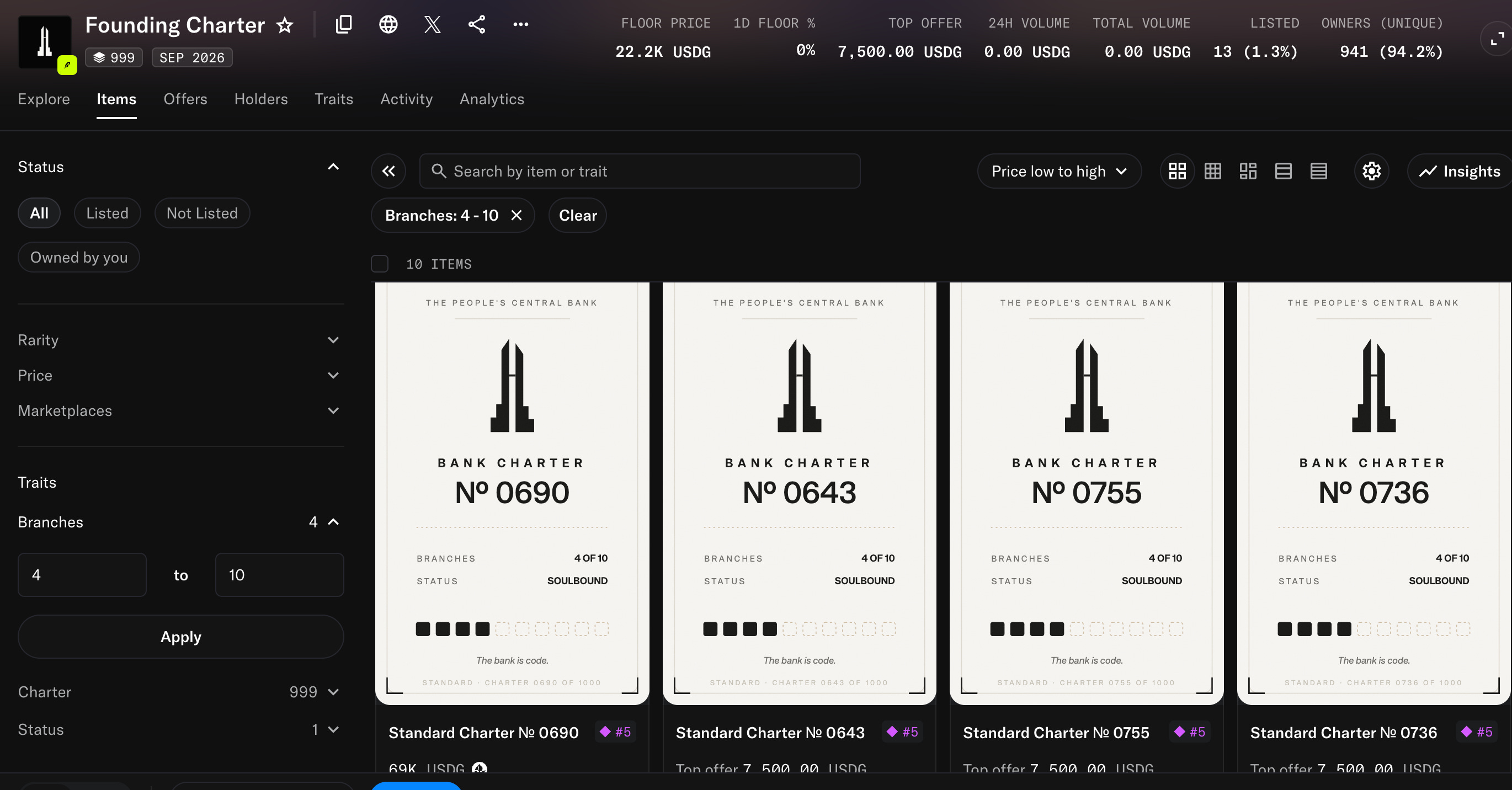
It also creates several forms of optionality:
Participation in future Branch auctions
Exposure to holder bonuses
Accumulation of an internal STANDARD balance
Potential sale of the entire banking portfolio
The protocol contains a one-way switch that could permanently enable Charter transfers. If activated, a Charter could be sold together with its Branches and accrued balance. This would create a second exit route… essentially a sale of your entire operations to a third party
5. How to participate
Standard Reserve has different entry points depending on available capital and whether someone already owns a Charter.
a) Observe without deploying capital
The protocol can be followed through its live dashboard. The most important metrics are captured here onchain for anyone to observe:
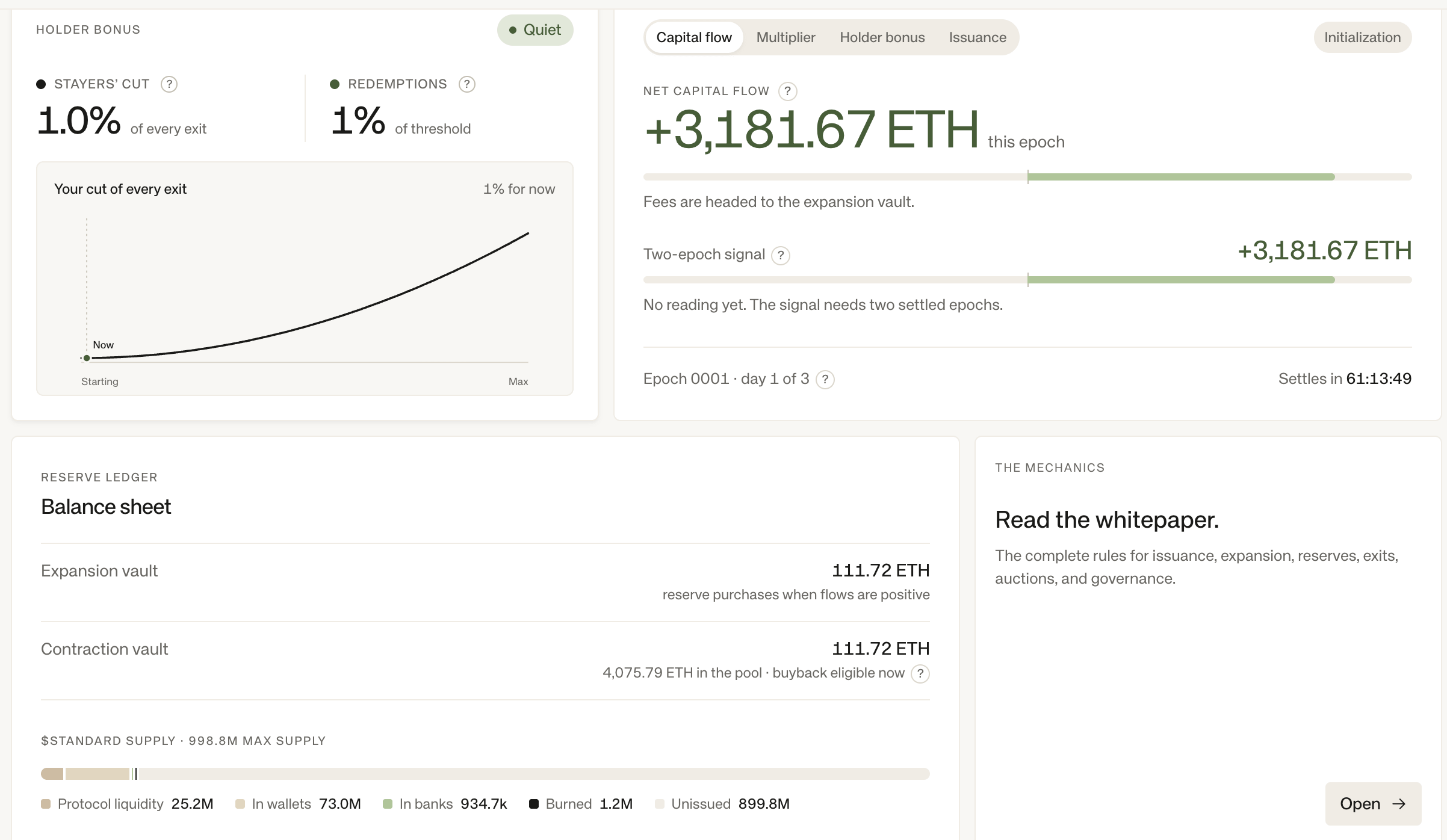
The first completed policy epochs will provide more information than the opening price action, and for anyone savvy enough to grasp the economics can then play the market very well in this larger game theory
b) Buy STANDARD
The simplest liquid position is STANDARD itself; this provides exposure to the currency without operating a bank.
Holding STANDARD alone does not earn Branch emissions and does not provide a direct claim over protocol reserves
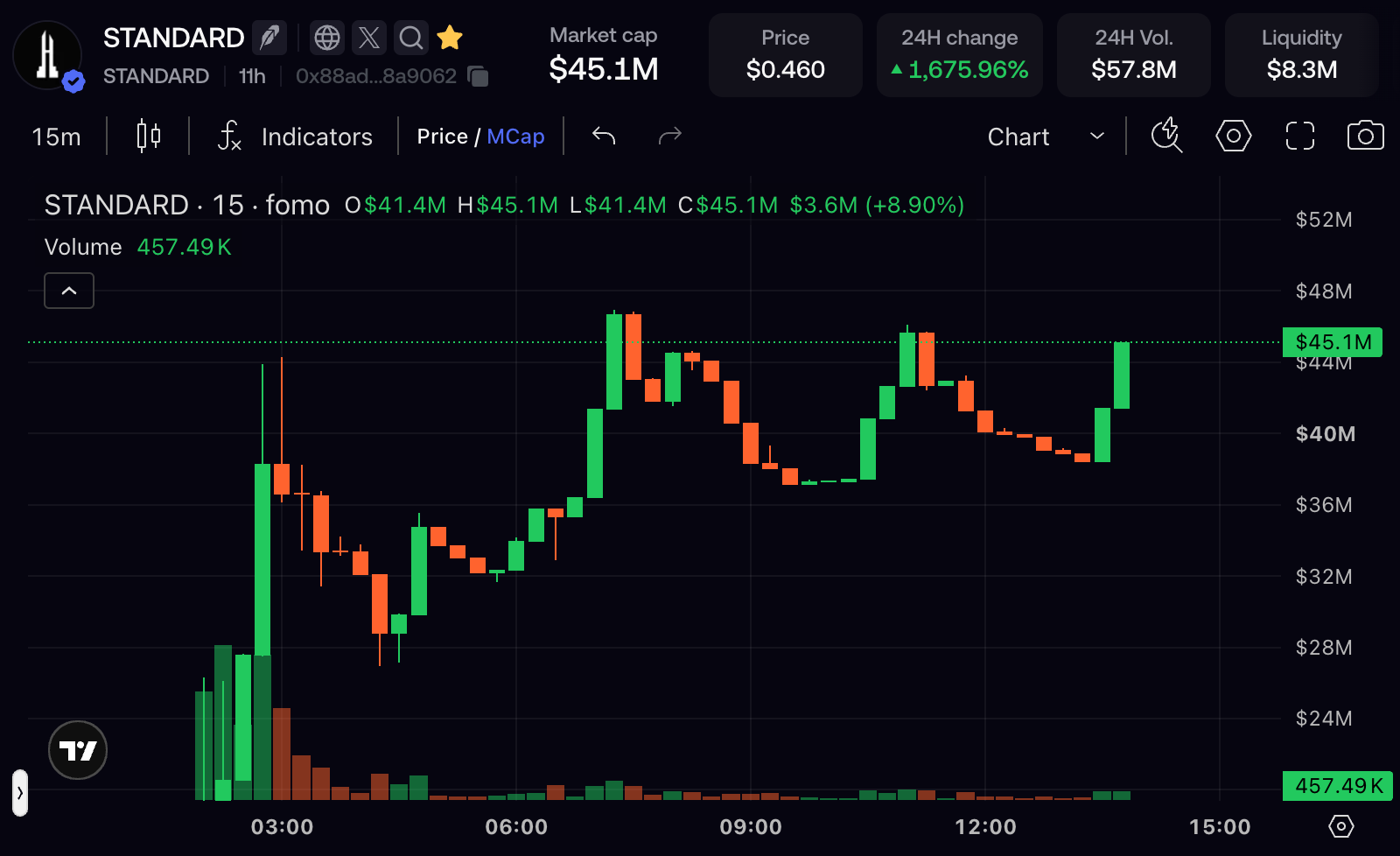
It is primarily exposure to the balance between future demand, burns, buybacks and dilution… so as long as the demand outpaces the daily issuance then this should be deflationary
c) Expand an existing Charter
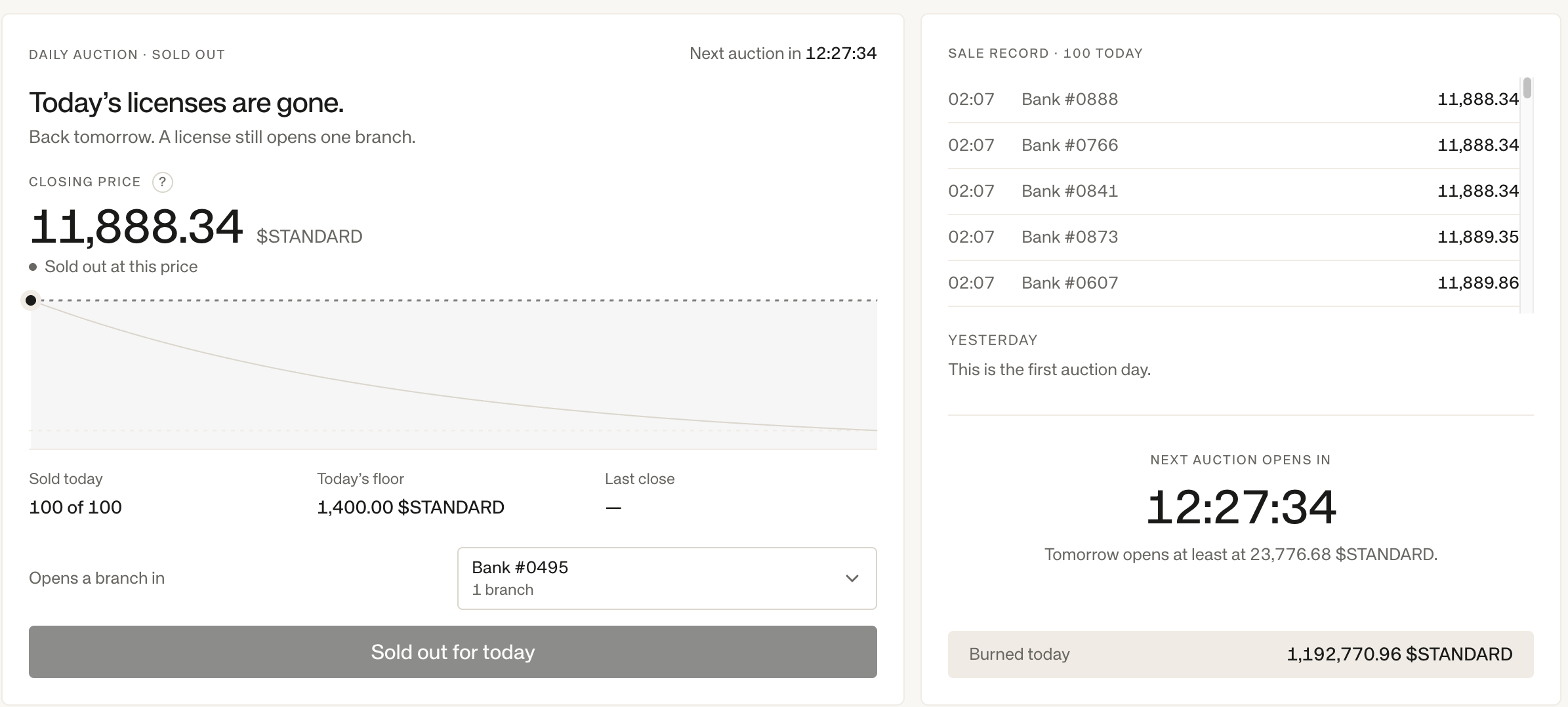
(Existing) Charter owners can bid for additional Branch licences using STANDARD.
Each Charter can operate ten Branches and purchase no more than three licences in one auction. This increases the banker’s (your) share of daily issuance but exchanges a liquid token for an illiquid productive asset
Because the auction price decays throughout the day, waiting can improve the economics. The risk is that every licence sells before reaching your target price:
d) Wait for future Charter access
Don’t own a charter but want to play the game theory? You’ll need to wait for Soulbound NFT charters to go live for trading or the new season of minting
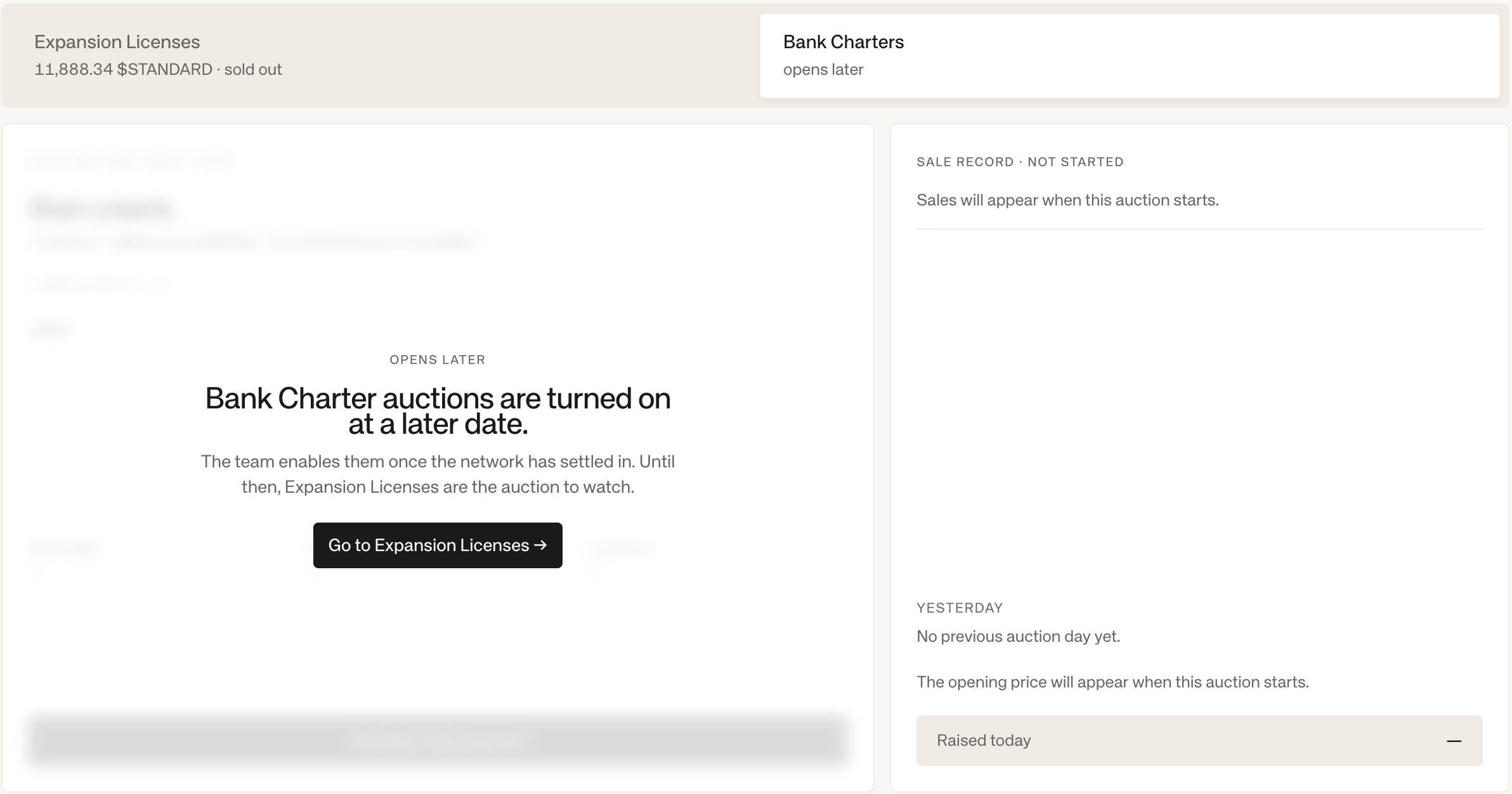
The protocol can eventually conduct daily Charter auctions denominated in ETH; the current daily Charter allocation is set to zero, so this route is not yet open.
The other potential entry is purchasing a complete Charter if transferability is activated on OpenSea
Until one of those routes becomes available, a non-Charter holder can own STANDARD but cannot operate a Branch
e) Trade around banker activity
STANDARD’s liquid supply will change as bankers retire Branches; the main events to monitor are:
Epoch completions (3 days)
Multiplier changes
Rising internal balances
Weakening Branch-auction demand
Clusters of Branch retirements
Increasing resolution fees
A transition into contraction
Large withdrawals add liquid STANDARD to the market; they also increase exit fees, burn part of the withdrawn supply and reward the bankers who remain
Getting a thorough understanding of all of this could be very lucrative when trading price swings in the STANDARD token
6. What can go wrong?
Standard Reserve reorganises reflexivity, but risk is still prevelant
The main risks include:
High token issuance (inflation)
Increasing Branches compared to your holdings (dilution)
Manipulation of the canonical-pool signal (contract/expansion impact)
Smart-contract failure (bad actors everywhere)
Illiquid and non-transferable Charters (stuck holding the bag)
Resolution fees reaching 60% (too expensive to sell)
Reserves that cannot be redeemed by holders
Weakening licence demand (issuance exceeds token demand)
Dependence on Robinhood Chain retaining capital
Accumulated internal balances becoming future sell pressure… when people decide to exit
The protocol is non-upgradeable, but not every operating parameter is fixed.
The owner can adjust certain settings within predefined limits, including tax rates, daily licence quantities, daily Charter quantities, fee splits and auction parameters.
The autonomous central-bank framing should not be interpreted as every variable being permanently outside human control
TLDR:
To me, this is an extremely interesting onchain experiment so participating should be taken with the best risk management controls in place; don’t risk more than you’re willing to lose… but the game theory on this protocol is too good to avoid
Most crypto projects launch a token and attempt to add utility later.
Standard Reserve launched the currency, banks, Branch auctions, reserve vaults, burn engine and monetary policy simultaneously.
It also provides several reasons for participants to keep returning:
Daily auctions
Three-day policy epochs
Changing Branch economics
Internal balances
Holder bonuses
Potential Charter transfers
Future Charter auctions
Expansion and contraction cycles
The first test was whether people wanted to become bankers.
They did.
The next test is whether Branch demand, reserve accumulation and buybacks can absorb long-term issuance without the economics becoming dependent on a continually rising STANDARD price.
That answer will come from watching the auctions, withdrawals and monetary-policy changes play out over the coming months.
That’s a wrap for this issue of Sammy’s Snippets. I hope you enjoyed it.
Please leave me any questions or thoughts here - I will respond to everyone!
If you found this interesting, please consider subscribing to this Substack and following me on X for more related insights.
If you are interested in more formal reporting on Crypto, AI and Robotics then Khala is my research product.
Disclaimer: The content of this newsletter is for informational purposes only. I am commenting on the underlying activity of what I am observing in the market to keep my audience updated and informed.
Nothing in this newsletter constitutes financial advice or a recommendation to buy or sell any asset. Always do your own research before making any investment decisions.
I hold positions in many of the assets discussed in this newsletter. Valuations are approximate snapshots and move quickly. Verify all market data independently before acting.
Follow me on X