


This Crypto AI & Robotics newsletter consists of the following:
Snippet Partner: Axis Robotics
The Robinhood Chain sell-off
Standard’s liquidity position
The launchpad + its 1M+ USDG rewards campaign
What the economics mean for STANDARD holders
My predictions + how to approach the opportunity
If you have any questions feel free to reach out to me on X or message my business X account ‘Khala Research’



Axis Robotics is building infrastructure for collecting the demonstrations robots need to learn physical tasks.
Contributors operate simulated robots through their browsers, producing data that Axis cleans, augments + uses to train models.
Its data pipeline connects those demonstrations to simulation and real-world evaluation, while model failures help identify where further training data is needed.
Axis has already secured numerous top tier partnerships with established companies:


Our upcoming Khala Research report examines how this process works, the published benchmarks + the commercial opportunity for robotics data providers
A full robotics data report featuring Axis is coming later this week. Keep an eye out!
This newsletter goes out weekly to 7.4k+ subscribers.
Please don’t hesitate to message me directly for sponsorship or partnership enquiries.

Standard Reserve’s Next Phase
In my September newsletter, I covered Standard’s launch: an onchain currency, NFT banking Charters + Branches that earn token issuance

Its monetary policy responds to capital flows, adjusting issuance while directing fees towards reserves, buybacks + other protocol functions
A month later, trading activity across Robinhood Chain has slowed considerably. Standard is preparing a launchpad that could bring new projects and traders into markets supported by its reserve":
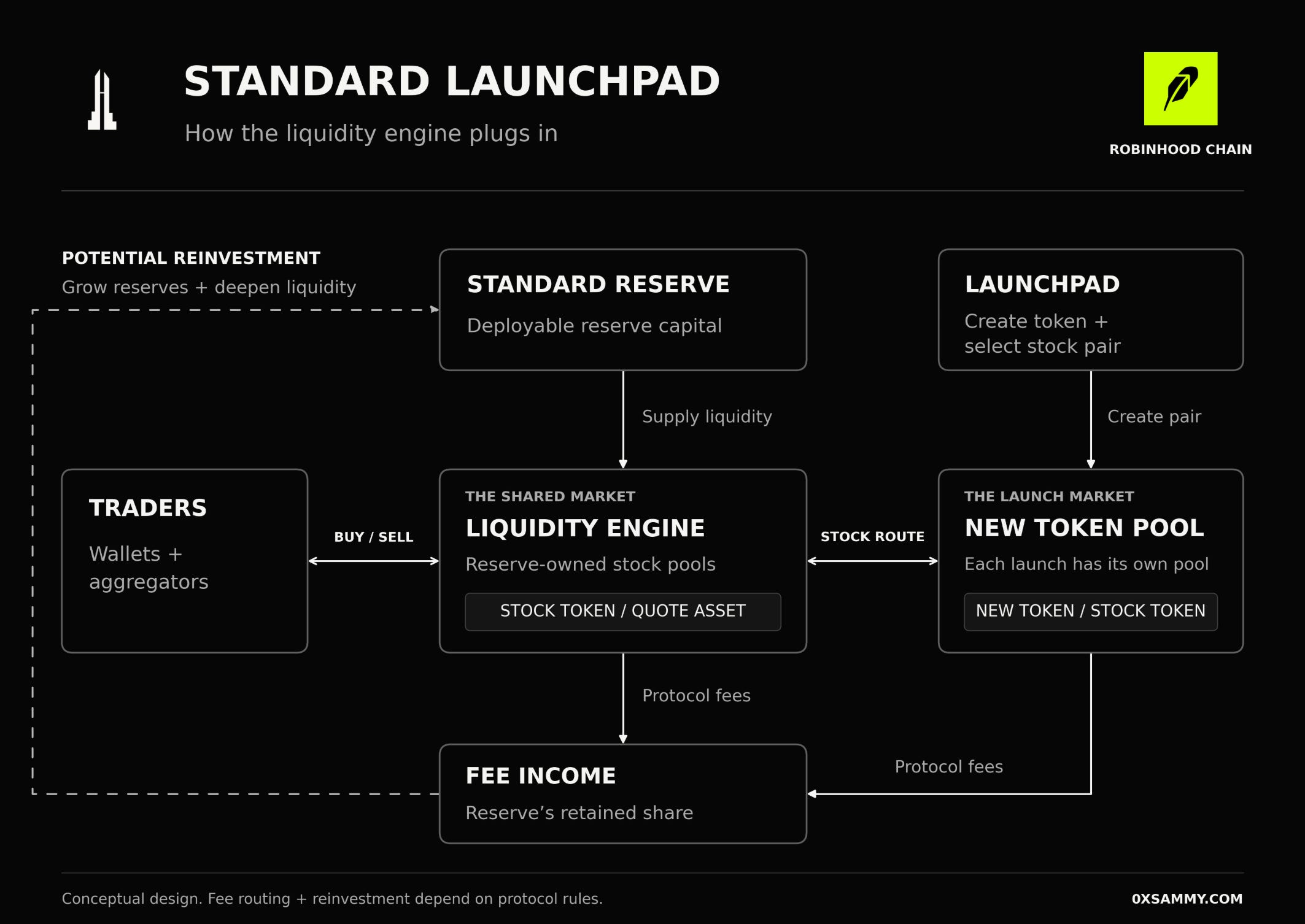
That gives us another way to assess the business: how much income can it earn from people trading other assets?
1. The Robinhood Chain Sell-Off
Average daily DEX volume on Robinhood Chain fell from $2.29B during 1–15 September to $897M during 6–12 October, a decline of approximately 61%:
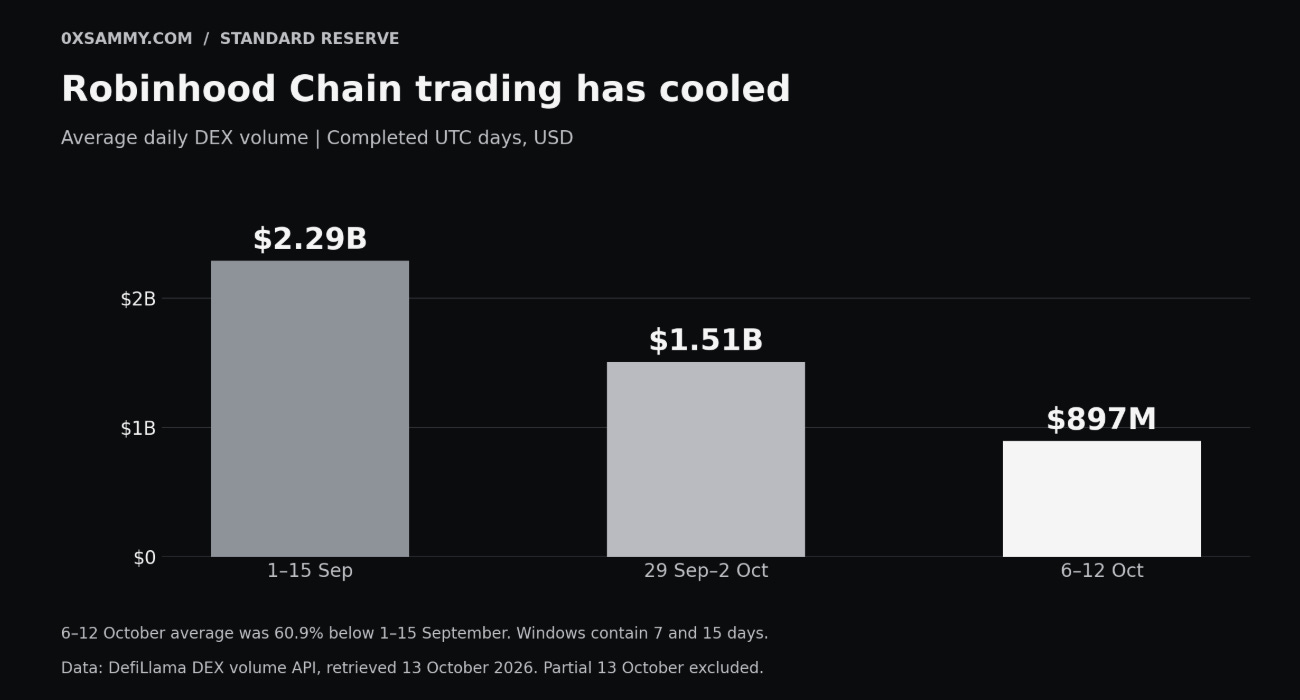
There is still substantial activity on the chain, although launchpads and trading venues are competing for less volume
STANDARD has been moving against some of the larger ecosystem tokens:
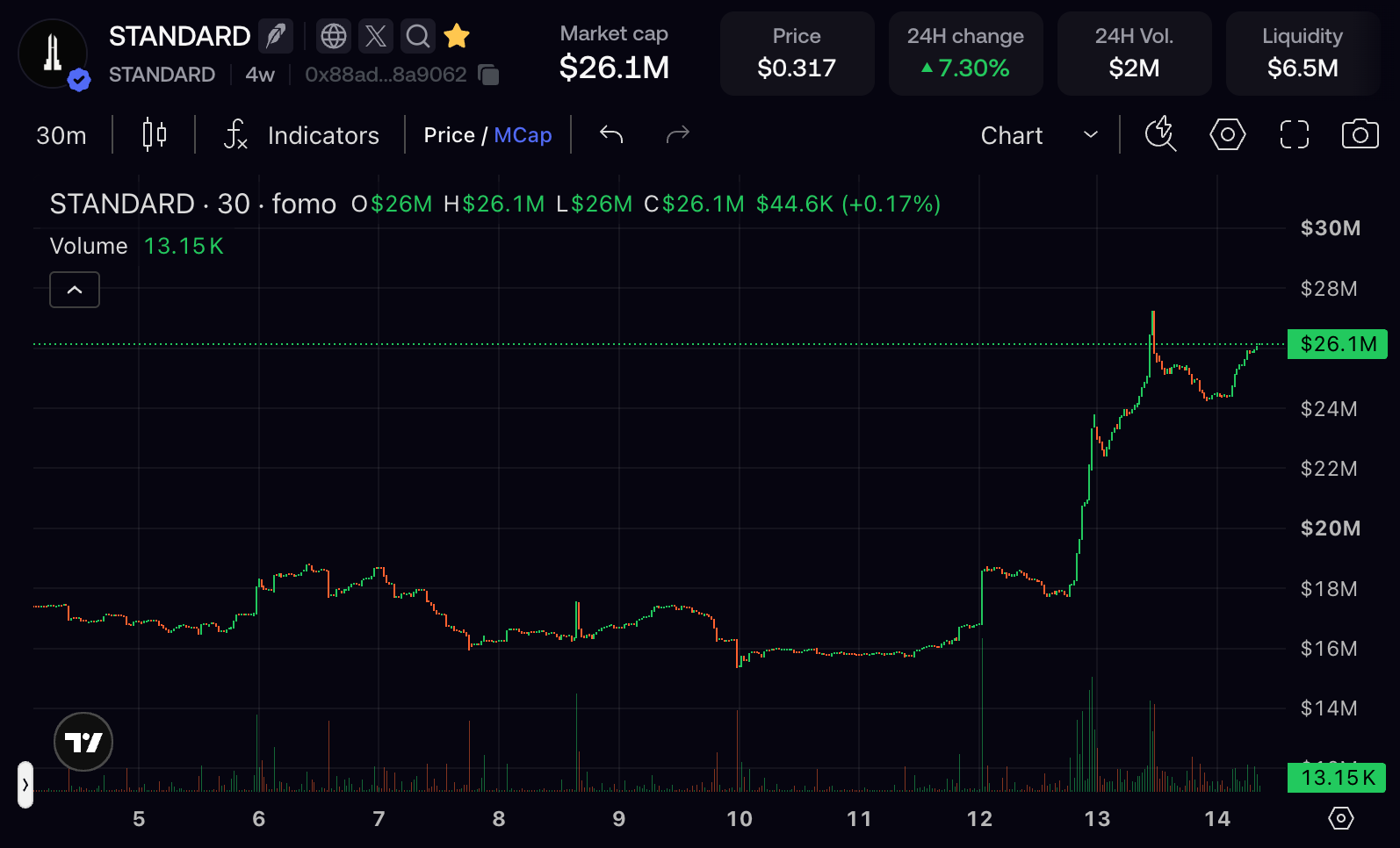

*DEXScreener snapshots checked on 13 October 2026. Values are rounded and move quickly.
The launchpad announcement could be attracting buyers, although one day of outperformance gives us limited information about how STANDARD will behave through a longer downturn

The underlying liquidity + proposed fee income deserve a closer look:
2. Standard’s Liquidity Position
STANDARD’s main trading pool currently shows approximately $15.8M of combined pool inventory:
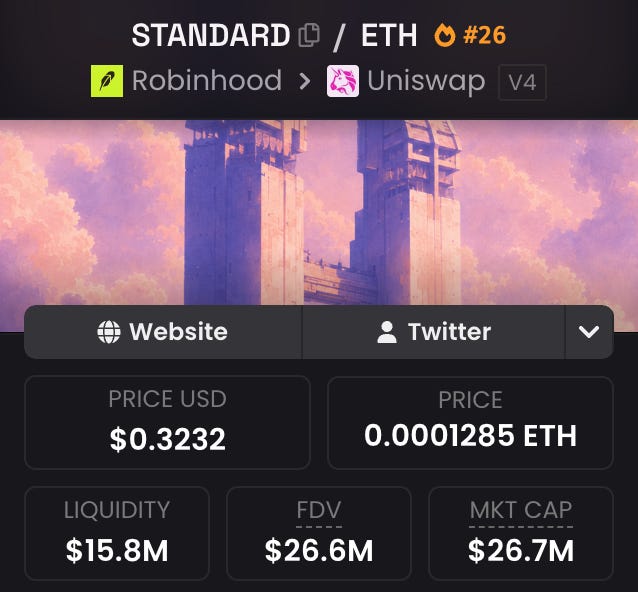
Comprising around 2,600 ETH + 28.8M STANDARD
That is a substantial pool alongside a token market cap of roughly $26M.
The whitepaper describes the genesis liquidity as protocol-owned and permanently locked in the canonical Uniswap v4 pool.
In its 29 September update, the team reported owning 99% of its liquidity; that percentage is a dated team-reported figure.
Owning liquidity reduces dependence on external liquidity providers choosing to stay. It also gives the protocol an established market around which to build further products.
There are some practical limits to what the headline number tells us.
The $15.4M includes STANDARD itself. Its dollar value changes with the token price, and locked pool assets have restrictions on how they can be used. Capital available for stock-token markets needs to be accounted for separately.
For traders, the useful comparison is the cost of executing an order.
I would check buy + sell quotes at $1k, $10k and $100k, including pool fees, hook charges and price impact. Concentrated liquidity can produce very different execution depending on where positions sit relative to the current price.
Standard’s potential moat comes from keeping useful liquidity available and attracting recurring trading through it.
3. The Launchpad + $1M USD Campaign
I touched on Standard’s launchpad in last week’s v4 hooks newsletter:
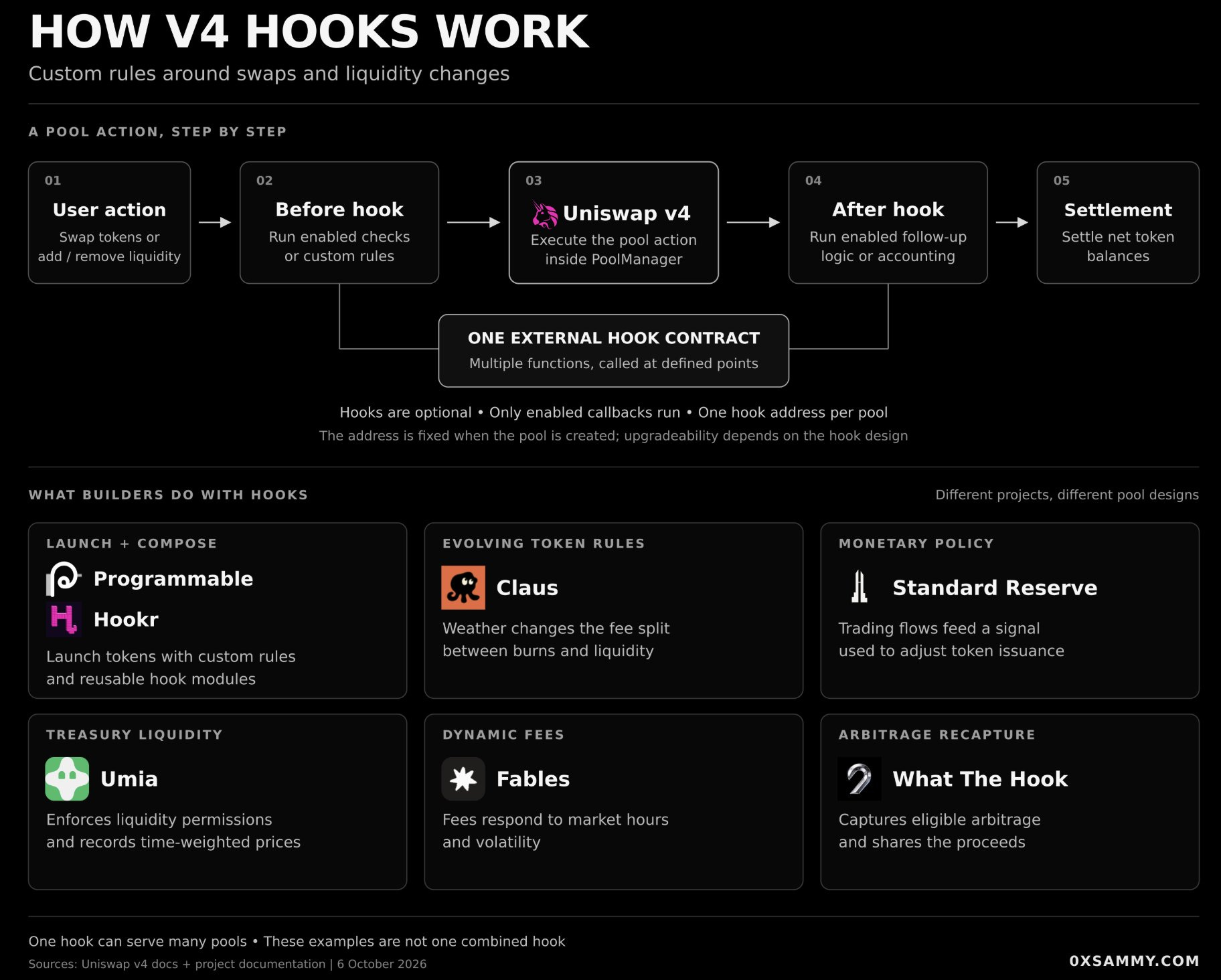
The proposed model connects new token markets to reserve-owned stock liquidity.
A new token can trade against a stock token, while an underlying market allows traders to enter or exit that stock exposure. Deeper liquidity in the underlying market could improve that part of the trading route and make it easier for projects to launch around it.
Each new token still needs sufficient liquidity in its own pair. The stock pairing determines what it trades against; any rights over the underlying company would require separate arrangements
This point has had reasonable coverage when AMC CEO had a public bout on the timeline with Vlad as one of the arguments against tokenized stocks not having the same rights to holders (for now).
On 12 October, Standard announced King of the Markets (going live today), described as its launchpad and initial stock-token liquidity pilot:
Traders + token deployers will compete for a growing rewards pool starting at 1M+ USDG.
That should give people a reason to try the markets. It will also make early activity difficult to interpret, because some trading will be motivated by the rewards.
There are two ways I could see this developing:
Launchpad activity: projects launch tokens, bring their communities + generate trading fees
Wider stock trading: competitive stock pools attract orders routed through other wallets and aggregators
The second route would give Standard customers who arrive through other apps. For that to happen, its pools need to offer competitive prices, sufficient depth + reliable execution
4. What the Fees Need to Cover
The reward campaign gives us a useful scale for modelling the rollout.
To generate $1M of retained fees, the required trading volume would be:
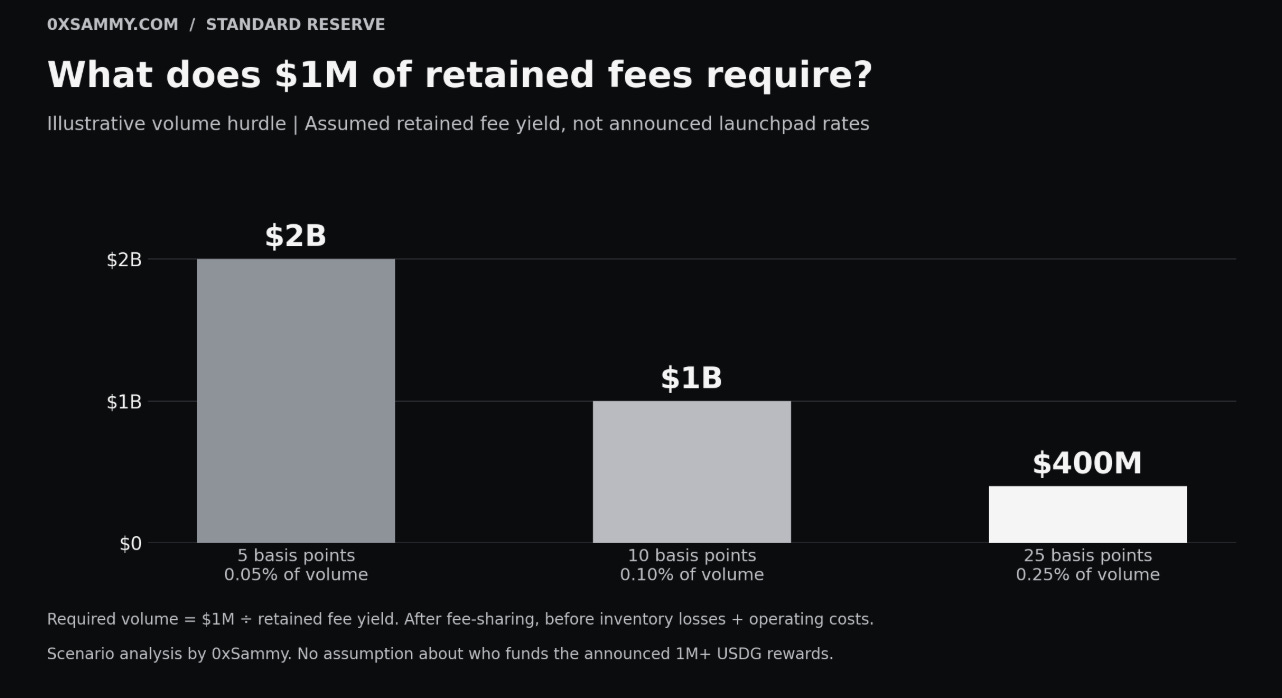
Illustrative scenarios. These are assumed retained fee rates, rather than announced launchpad charges. The calculation makes no assumption about who funds the rewards.
At a retained rate of 0.10%, the markets need $1B of trading volume to generate $1M of fees. At 0.05%, that requirement rises to $2B.
The amount retained after fee-sharing has a large effect on the business.
I would track:
Fees retained by the protocol
Rewards paid from the protocol’s own assets
Operating costs
Changes in the value of its liquidity positions
Market making can leave a pool holding more of an asset as its price falls. That inventory exposure needs to be assessed alongside fee income, including when the underlying stock market is closed.
After the campaign, recurring volume will tell us how much demand the rewards helped establish. Continued subsidies would increase the cost of maintaining those markets.
5. How This Connects to STANDARD
STANDARD’s investment case depends on where the launchpad’s earnings go
Fees could support reserve growth, token purchases or distributions, depending on the final rules. Those allocations need to be explicit before investors can sensibly include launchpad income in their valuations
There has also been an update to the existing fee model since my September article.
The current whitepaper describes the split as:

The 15% allocation was previously associated with adding liquidity. The purchased tokens now remain available for future distribution, so supply forecasts need to account for them returning to circulation.
Charter economics also continue to change.
A 14 October protocol snapshot showed 970 active Charters, 3,468 open Branches + a 0.35× issuance multiplier:
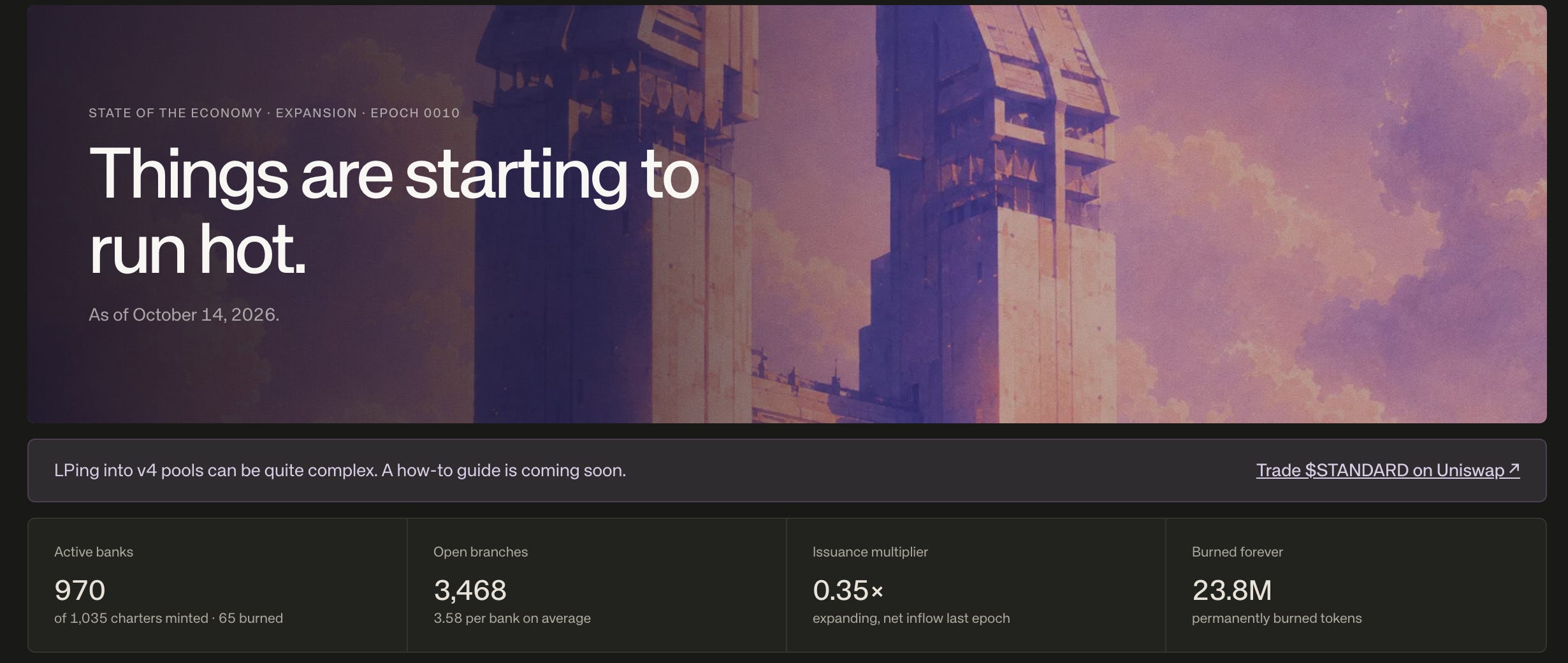
Using the 700,000-token base rate, that equates to 245,000 STANDARD per day, or approximately 71 STANDARD per Branch, before recycled rewards and any subsequent changes
The team’s 11 October update anticipated a further reduction towards 0.20× and announced support using accumulated tokens. The snapshot above still showed 0.35×
For Charter owners, future issuance, competing Branches + withdrawal costs all affect the return
For liquid-token holders, I would focus on how external earnings change supply and the reserve’s productive assets
6. My Predictions
a) Activity will rise during the rewards campaign
First month after launch | Medium confidence
I expect rewards to attract an initial burst of trading, followed by a decline when the campaign ends
Four weeks afterwards, I would want average daily volume to remain at least half of the final campaign week’s level, alongside returning fee-paying wallets. That is the threshold I’ll use to assess retention, after checking for self-trading + reward recycling.
b) Sustained volume will concentrate in a few stock markets
First three months | Medium confidence
I expect a small number of useful stock markets to attract most recurring activity.
Projects will have a reason to return if their users receive competitive execution and can enter or exit positions reliably. Further launches could fragment liquidity if they create isolated markets with little ongoing demand.
Repeat issuers + orders arriving through outside aggregators would strengthen the case
c) Valuation will become more sensitive to external earnings (the equities + crypto markets converge)
First six months | Medium confidence
I expect the initial launchpad premium to fade unless Standard establishes repeat fee income from the new markets.
Two consecutive 30-day periods of positive net contribution, with incentives deducted and inventory changes disclosed, would give me more confidence in assigning value to that business
Persistent subsidies or worsening execution would reduce my expectations
7. How I’d Approach the Opportunity
For builders: assess which stock markets are supported, what launch liquidity is available + what users will pay to trade. Distribution through the launchpad becomes valuable when those users stay active
For traders: compare actual quotes across venues. Reward eligibility, fees and the cost of exiting a position all belong in the calculation
For STANDARD holders: follow reserve deployment and the destination of external fees. Growth in launchpad activity needs a clear route into the token’s economics
For Charter owners: model returns using several issuance rates and Branch counts, including the cost of withdrawing
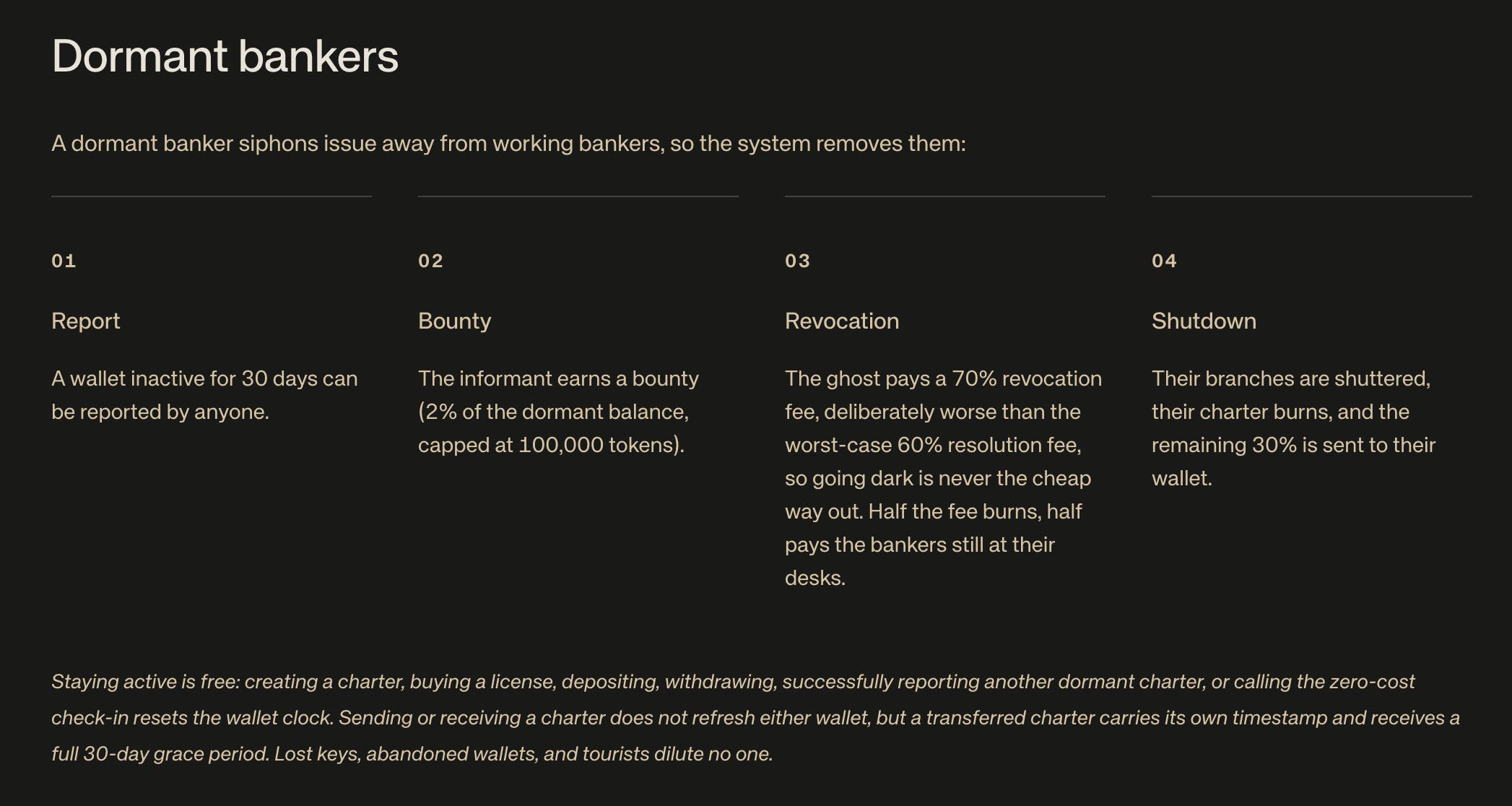
BONUS: Snitches get Stitches! turns out you can grass up your fellow inactive bankers for a bounty:
Caveat:
The risks remain substantial; smart-contract failure, changes to permitted parameters, inventory losses, token issuance + weaker demand across Robinhood Chain.
Standard holders also have no fixed-value redemption claim over the reserves.
Standard has an established liquidity base + a concrete plan to expand the markets it serves.
The launchpad could give that capital more ways to earn fees, while introducing new projects and traders to the protocol. Its progress should become measurable through returning users, execution costs + the income left after incentives.
I’ll be following those numbers as the rollout develops.
That’s a wrap for this issue of Sammy’s Snippets. I hope you enjoyed it
Please leave me any questions or thoughts here - I will respond to everyone!
If you found this interesting, please consider subscribing to this Substack and following me on X for more related insights
Disclaimer: The content of this newsletter is for informational purposes only. I am commenting on the underlying activity of what I am observing in the market to keep my audience updated and informed.
Nothing in this newsletter constitutes financial advice or a recommendation to buy or sell any asset. Always do your own research before making any investment decisions.
I hold positions in many of the assets discussed in this newsletter. Valuations are approximate snapshots and move quickly. Verify all market data independently before acting